


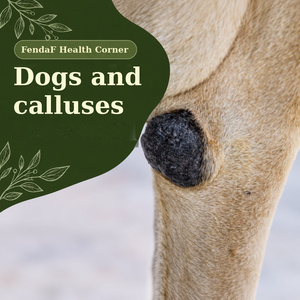
Dogs and skin calluses
Reading time: about 6 min
When a large dog develops a hairless patch of thickened skin on an elbow or around a hock, the first explanation is often simple: the hair must have worn away. This subject became interesting to me when I noticed that some of those patches on Faddu and Ossu were actually growing hair again.
Ossu's calluses are mainly on his elbows, while Faddu had more of them on pressure points on his hind legs. From what I observed at the time, Faddu's small bald patches had almost completely filled in. The change on Ossu's elbows was slower. For years I had heard that once hair disappears from a pressure point, it never comes back. Now I wanted to understand why calluses develop and when skin can recover.
Why do dogs develop calluses?
A callus is the skin's protective response to repeated pressure and friction. It is especially noticeable on the elbows and hocks of large dogs and sometimes on the sternum. When a dog rests on a hard floor, only a thin layer of soft tissue separates the bony prominence from the floor. The skin starts to thicken. This is a protective mechanism, not automatically a disease.
Large, heavy dogs, short-coated animals and dogs that frequently lie on hard surfaces are at greater risk. Joint pain, limited movement, excess weight or, conversely, loss of muscle and fat can also change how pressure is distributed. Buying a cream is therefore not always enough: first look at where and how your dog rests.
An ordinary callus is often dry, hairless and thickened, but may not bother the dog. If the skin cracks, becomes red, bleeds or develops discharge, or the dog avoids contact because it hurts, this is more than a cosmetic issue. Embedded hairs and secondary bacterial infection can make it quite uncomfortable.
A callus and a hygroma are different things
A hygroma can also develop around an elbow. This is a fluid-filled swelling under the skin caused by pressure and repeated trauma, rather than simply thickened skin. It may be soft and initially painless, but chronic irritation can lead to ulceration and infection. A new soft or growing swelling over a pressure point should be checked by a vet. Do not puncture or drain it at home.
Can the hair grow back?
It can, but not always. The key questions are the condition of the hair follicles and whether pressure continues. If the skin is not heavily scarred and irritation decreases, hair may return in some areas. If prolonged friction, inflammation and scarring have destroyed the follicles, full regrowth may no longer be possible. A glance or a fixed number of months cannot predict this.
That is why the changes in Faddu and Ossu fascinated me, but I cannot use them to claim there is a cure for calluses. I was not measuring skin pressure or follicle condition, and I did not separate one change from another. I know what I saw, but cannot say with certainty which factor caused it.
What did I change for my own dogs?
At the time, I had been working on their diet and daily habits for about a year and a half. They ate Winner Plus food, and occasionally their diet included bog-plant extract, diatomaceous earth powder, chlorella and apple cider vinegar. I had tried various ways of supporting their bodies and discussed them in my first video about calluses.
Earlier video about calluses (in Estonian)
Today I separate two things in that story. First, I really did observe hair returning to some worn patches. Second, my interpretation at the time was that improvements in gut health, food and general health might be behind it. Skin and nutrition are connected: protein, essential fatty acids and micronutrients matter for normal skin. But in my dogs, it is impossible to prove that one of those supplements restored hair at pressure points. That would require a controlled comparison. This does not erase our experience.
I have also previously discussed post-vaccination “cleansing” and using garlic granules instead of a wormer. These are part of my choices, not proven callus treatments. Although I still favour post-vaccination “detox”, that does not prove it will restore hair follicles. Vaccination needs, possible adverse reactions and parasite-control frequency can be assessed individually with a vet.
What does an integrative approach add?
Integrative veterinarian Julie Buzby looks first at local pressure and skin condition, and recommends considering accompanying joint problems or other health issues when appropriate. Integrative skin care pays attention to the skin barrier, gentle moisturising and the dog's overall condition. This fits well with the conventional veterinary principle: reduce pressure and keep healthy skin healthy.
Some specialised emollient balms have been reported to improve the appearance of calluses. For example, a three-month observation of 35 dogs described in an integrative veterinary publication found changes in skin thickness and dryness with one product. That is an interesting practical signal, but without a strong independent comparison it does not establish that the product restores hair in every dog or removes the cause of calluses. A cream may improve skin flexibility, but cannot replace reducing pressure from hard surfaces.
What can you actually do at home?
If a callus is small, the skin is intact and the dog seems comfortable, treatment is not necessarily needed. A sensible starting point is a soft, sufficiently thick bed the dog genuinely likes. “Soft” means the elbow does not sink through the padding onto the hard floor. If your dog prefers cool tiles, offer several resting places and see which one they choose. Some dogs need a cooler padded mat instead.
For dry, intact skin, a fragrance-free moisturising balm with a simple formula intended for dogs may be suitable. Start on a small area and watch for redness, itching or excessive licking. Do not apply a thick greasy layer to an open, wet or inflamed wound on your own. If pressure is substantial, a vet may recommend a properly fitted elbow protector, but a tight or rubbing protector can make things worse.
When is it more than a callus?
A veterinary assessment is needed if the patch grows quickly, has an unusual shape, develops a deep wound, pus or an unpleasant smell, hurts to touch or is accompanied by limping. The same applies when the “callus” is actually a soft lump. Parasitic or fungal disease, deep skin infection or a tumour can sometimes resemble a callus. With an older dog, also consider whether joint or back pain makes them lie on one side more often.
What do I take away from this experience?
Above all, this experience taught me not to treat calluses as a final verdict. I saw a change in Faddu and Ossu that I had thought impossible. That does not turn every supplement into a hair-growth treatment or mean every callus must be removed. With a dog's skin, consider three things together: local pressure, the actual skin condition and the health of the whole animal. Sometimes it is worth simply taking photographs and watching what really changes. Without measuring, a small improvement can easily go unnoticed.
Sources
- Merck Veterinary Manual. Hygroma in Dogs (Moriello, Winkler; 2025).
- Grant D. Managing callus in dogs. Veterinary Practice (2019).
- Buzby J. Dog Elbow Callus: What’s Normal and What’s Not (2023).
- IVC Journal. Managing hyperkeratosis in canine patients (2021). Product-study limitations discussed in the article.
- Buckley L. Is There Any Evidence to Support the Use of Garlic as a Wormer for Dogs and Cats in the UK? Veterinary Evidence (2019).
- VCA Animal Hospitals. Onion, Garlic, Chive, and Leek Toxicity in Dogs.
- WSAVA Vaccination Guidelines Group. 2024 guidelines for the vaccination of dogs and cats. J Small Anim Pract. doi:10.1111/jsap.13718.
🐾 FendaF believes in informed choices
The purpose of the FendaF blog is not to tell you what you must do. Our aim is to share knowledge, introduce different evidence-based and integrative perspectives, and help you make more informed decisions for your pet.
Every animal is unique, and no article can replace a consultation, diagnosis or treatment provided by a veterinarian. If your pet has a health concern or you need individual advice, always contact a veterinarian.









Leave a Reply