



New year, better health!
Reading time: about 9 min
I have never been a great fan of New Year's resolutions. At least not the big ones that turn life upside down in January and quietly disappear by February. I believe much more in small changes that actually last. The same goes for our dogs. You do not need to replace the entire food cupboard tomorrow, buy five new supplements and start running marathons with your dog. Sometimes noticing one habit you could improve is enough.
Over the years, feedback in FendaF's showroom and experience with my own dogs have taught me a great deal. One recurring lesson is that nutrition, digestion, movement and general wellbeing cannot be completely separated in a real dog's life. Yet looking at the whole picture should not take us to the other extreme: not every complaint necessarily comes from “the wrong food”, and not every beneficial plant compound prevents cancer. Let us look calmly and thoughtfully at what we can actually change.
First look at what goes into your dog's bowl
Strange arguments about dog feeding sometimes break out on social media. Some insist dogs should eat only meat; others say they need no animal food at all. I have never supported unbalanced extremes, but one thing is clear to me: I do not recommend a fully plant-based diet for dogs. Dogs are not humans, and our own dietary preferences cannot simply be transferred to them. For me, animal ingredients are an important part of a dog's diet, alongside an entirely natural place for suitable fruit and vegetables.
Dogs need essential amino acids, sufficient energy, vitamins and minerals. Those needs cannot be reduced to the word “meat”, but that does not establish that fully plant-based feeding is equally well researched or suitable for every dog.
In a 2024 study, 15 healthy adult dogs ate one particular commercial plant-based complete food for 12 months. No clinically important deterioration occurred in the measures examined. That is interesting, but the study was small, lacked a parallel animal-food control group, and did not assess the heart by echocardiography. A one-year result does not reveal what happens over a dog's lifetime or establish that every plant-based dog food is safe. A 2023 systematic review also rated the certainty of evidence for most health outcomes as low or very low.
I do not consider this sufficient grounds for recommending that owners remove animal food from their dogs' diets. If someone is considering such feeding for a particular need, the diet should be formulated or reviewed with a veterinary nutrition specialist and the dog's actual health monitored. This is not a field where I want to experiment just because some dogs did well for a limited period in one study.
My own preference is a varied diet containing animal ingredients, with room for vegetables and suitable additions. Alongside complete dry food, my dogs receive raw meat and organs, occasionally suitable raw meaty bones, and fruit and vegetables. This is my choice, not proof that every dog must eat this way. Any “good stuff” added to food also needs consideration for quantity and safety, so it does not substantially change the main ration's nutrient balance.
Why do I take possible nutrient deficiencies seriously?
Here is a personal story. A few years ago I gradually ate less meat without noticing. It was not a deliberate diet; I simply had less appetite for it. When I eventually had blood tests, my haemoglobin had fallen below 90 g/l and my iron stores were almost nonexistent. Most surprising was that I did not think I was particularly unwell. Of course, my iron deficiency cannot be used as evidence that plant-based diets harm dogs. But it painfully reminded me that the body's condition and how we feel do not always tell the same story.
A dog's nutrient deficiency may also remain invisible for some time, especially with a homemade, highly restricted or therapeutic diet. An ordinary blood test does not measure every nutrient reserve. Diet formulation, body condition, muscle condition and, when needed, targeted tests all matter. This becomes even more important for puppies, pregnant or older dogs and those with chronic disease.
Fruit and vegetables: an easy small addition
When customers ask about probiotics or fibre, I often start by asking what their dog already eats. I like real foods: pumpkin, broccoli, appropriately prepared green vegetables, a little plain kefir or yoghurt if tolerated. This does not mean a precisely formulated complementary feed is always worse than a “natural” product. Sometimes a supplement with a controlled composition and dose is more practical. I simply do not like adding another jar before thinking about why it is needed.
Pumpkin is a favourite of mine. Puréed or cooked until soft, it provides water and fibre and may help adjust stool consistency in some dogs when used as a small addition. It is not a universal remedy for constipation or diarrhoea. Persistent problems, vomiting, lethargy or blood call for investigation rather than simply more pumpkin. Start with a small amount and watch whether stools improve or gas develops instead.
Broccoli and other cruciferous vegetables provide fibre and compounds from which sulforaphane can form. It is an interesting molecule: laboratory and animal research has explored effects on oxidative stress and inflammatory signalling pathways, among others. Formation of the active compound also depends on preparation and the enzyme myrosinase. Light steaming or chopping makes plant foods easier to eat, while prolonged high-temperature cooking can affect some compounds. Spinach is a nutritious green vegetable, but should not be presented as an equivalent sulforaphane source alongside broccoli.
I previously wrote that feeding cruciferous vegetables three times weekly might reduce a dog's cancer risk by as much as 90%. That figure cannot currently be substantiated by research: I have not found a reliable canine study demonstrating such a reduction. Studying a mechanism, conducting an animal experiment and preventing an actual cancer diagnosis are three different levels of evidence. I am not giving up broccoli because of this: its value need not rest on one impressive percentage. I simply do not want to sell readers a cancer-prevention guarantee we cannot justify.
Offer fruit and vegetables in small, dog-appropriate amounts, steaming and puréeing when necessary. Avoid added salt, onions, chives and leeks. Garlic is also an allium and, in large amounts, especially concentrated forms, can damage dogs' red blood cells. Grapes and raisins are unsuitable altogether. A larger quantity of suitable vegetables can be frozen in portions. I also use vegetables bought on offer or left over in my kitchen while still in good condition. I do not feed spoiled food merely because a dog is not bothered by its appearance.
Kefir and probiotics: interesting, but no miracle cure
I like to think of the gut as a living ecosystem. Probiotics are not simply “good bacteria” you can sprinkle on every problem. Specific strains, quantity, circumstances and diet matter. Prebiotics are substances some gut microbes can use. Different fibres and fermented foods may affect the microbiome, but their effects are not identical.
There is also a small canine study of kefir. In six healthy adult dogs, stool bacterial composition changed after two weeks of kefir, with no obvious adverse reactions observed in this small group. That suggests a possible biological effect, but does not prove kefir treats diarrhoea or reflux, or that every dog's gas disappears in exactly a week. Those conclusions would require larger controlled studies in affected dogs.
If your dog tolerates dairy, trying a small amount of plain kefir made from pasteurised milk may be a reasonable addition. I avoid products containing xylitol, sweeteners or other additions. Repeated diarrhoea, abdominal pain or worsening gas is not something to endure for weeks to “train the microbiome”. Reduce or stop the product and investigate. Goat's milk is not automatically probiotic: that depends on whether suitable live cultures are present.
Repeated vomiting of bile cannot be explained solely by a dog not getting enough to eat either. Causes range from feeding schedules to gastrointestinal or other disease. Buying a new bag of dry food is neither the first nor the only answer to recurrent vomiting.
Chews, teeth and the pleasure of chewing
Evening chewing is a real ritual in our home. I have seen favourites change: beef scalp, then a bull pizzle, later a beef ear, nose, lip or tendon. I like offering a natural, single-ingredient chew because it is easier to know what the dog receives. Integrative veterinarians also recommend favouring natural single-ingredient treats.
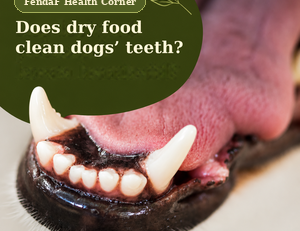
I previously said that chewing meant I did not need to brush my dogs' teeth. In reality, chewing cannot be broadly promised to remove plaque and prevent gum disease. Veterinary oral-health guidance considers regular toothbrushing the most effective home-care method.
Choose chews for your dog's size and chewing ability, supervise and count their calories. Remove a chew if it splinters into sharp pieces or the dog tries to swallow it whole. Bleeding gums, bad breath and pain need an oral examination, not simply a harder chew.
Movement: the most underrated daily habit
In my view, we talk too little about dogs' movement. My dogs have worn activity monitors for years. When they stayed outside in summer, the data showed that a day in the garden did not automatically mean much activity. Sometimes activity was only about a quarter higher than indoors. A dog may sleep peacefully in the garden while the owner imagines constant running. This was a measured observation in my dogs, not statistics for every garden-kept dog.
Muscle activity, breathing and blood-vessel-like mechanisms help lymph move. Movement supports fluid circulation, but saying inactivity makes “waste accumulate in the lymph nodes and stay there” is too simplistic. There are already plenty of good reasons to move: muscle strength, joint function, mental wellbeing and exploring the environment.
Some integrative veterinarians suggest every dog should walk for at least 30 minutes. Today I would add a qualification: no single daily distance or number of minutes suits every dog. A young, healthy, active dog has very different needs from one with severe heart disease, joint pain or age-related limitations. Several short walks may be valuable for one, a longer outing for another. Time to sniff can enrich a walk without covering many kilometres.
I too once said I could not manage separate walks with both dogs on the same day. Then I rearranged my days and eventually set aside about two hours in total for them. I am not saying everyone must manage this. It simply taught me that sometimes the question is not a lack of possibilities, but what we actually make room for in our day.
Better health does not have to start with a big resolution
My wish each New Year is really the same: that we notice our animals more. Sometimes that means a more thoughtful food bowl, sometimes practising toothbrushing, sometimes putting the phone away and letting the dog enjoy a sniffing walk. Do not compare your dog with someone else's Instagram dog. Look at what works for yours, what change is genuinely measurable and whether they feel good along the way.
Big changes often grow from small decisions. And it is easiest to start today, rather than waiting for 1 January.
Sources
- Linde A et al. Domestic dogs maintain clinical, nutritional, and hematological health outcomes when fed a commercial plant-based diet for a year. PLOS ONE. 2024;19:e0298942.
- Domínguez-Oliva A et al. The Impact of Vegan Diets on Indicators of Health in Dogs and Cats: A Systematic Review. Vet Sci. 2023. PMID 36669053.
- FEDIAF. Nutritional Guidelines for Complete and Complementary Pet Food for Cats and Dogs. 2025.
- Yagishita Y et al. Broccoli or Sulforaphane: Is It the Source or Dose That Matters? Molecules. 2019;24:3593. PMID 31590459.
- Plant sources, extraction techniques, analytical methods, bioactivity, and bioavailability of sulforaphane: a review. Food Sci Biotechnol. 2024;33:539–556. PMID 38274178.
- Kim DH et al. Modulation of the intestinal microbiota of dogs by kefir as a functional dairy product. J Dairy Sci. 2019. PMID 30827566.
- Cornell University College of Veterinary Medicine. Dental disease and home dental care.
- Veterinary Oral Health Council. Brushing.
- MSD Veterinary Manual. Garlic and Onion (Allium spp) Toxicosis in Animals. 2024.
- AAHA. Nutrition and Weight Management Guidelines for Dogs and Cats. 2021.
🐾 FendaF believes in informed choices
The purpose of the FendaF blog is not to tell you what you must do. Our aim is to share knowledge, introduce different evidence-based and integrative perspectives, and help you make more informed decisions for your pet.
Every animal is unique, and no article can replace a consultation, diagnosis or treatment provided by a veterinarian. If your pet has a health concern or you need individual advice, always contact a veterinarian.








Leave a Reply