


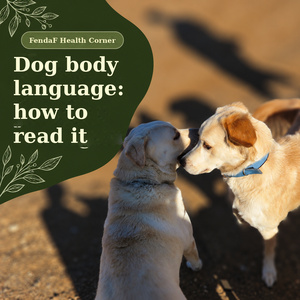
Dog body language and how to read it
Reading time: about 7 min
“My dog isn't aggressive!” is probably one of the most common things I hear on walks. The problem is that I do not know what my dog thinks about the approaching dog at that moment. And the stranger does not know what Ossu thinks either. That is why reading canine body language is not merely an interesting extra for me, but part of everyday safety.
I have spent many years training my German Shepherds with Alla Petrova. With her, I first realised how little I had actually noticed with my first dog. I have had four dogs, and each has taught me something new. The most important lesson? Do not assume. Not about your own dog, a strange dog or another owner.
A wagging tail does not always mean friendliness
Dogs communicate with more than their tails. Posture, muscle tension, gaze, ears, mouth, direction of movement and voice provide information together. A loose-bodied dog approaching in a curve and sniffing calmly differs from one walking straight towards another, stiffening and staring. Both may be moving their tails. Tail movement indicates arousal and readiness to communicate, not unambiguously happiness.
The individual dog's normal body language also matters. Ear signals in an upright-eared German Shepherd look different from those in a floppy-eared spaniel. A thick coat can hide facial expressions. No single signal should be interpreted without the situation and the rest of the body.
What do I watch for in Faddu and Ossu?
When my boys notice another dog, their tails often become still. Faddu may curl his tail over his back in a way rather unusual for a German Shepherd. I first watch posture: is movement still soft, or does the body suddenly stiffen, chest forward and weight shifted towards the front legs? Then I watch eyes and ears. If a dog freezes and stares intently, that is my cue to increase distance, not test whether he “really means it”.
Raised hackles also make me pay closer attention. But they do not automatically mean aggression. Piloerection is an involuntary arousal response that can involve fear, surprise, tension or strong excitement. Research has not convincingly established that the exact location of raised hair provides a reliable “emotion map”. I therefore look at the whole dog and what happened immediately beforehand.
A memorable example is chewing tracheas at home. Faddu was chewing, I gave Ossu another one, and Faddu began grumbling. Two male dogs about half a metre apart, both with a treat. An outsider might have heard the start of a fight. I knew their habits and that particular vocalisation. Faddu generally avoids conflict. When Ossu and Peku once quarrelled at Irene's, Faddu walked to the other end of the garden and later returned with an expression saying, “Well, everything all right here?”
That does not mean growling should be ignored or that feeding two dogs close together is universally safe. Resource guarding can cause serious conflict in some households. If eating together causes stiffness, exclusion or tension, sufficient distance and separate feeding are the sensible response, rather than testing the situation.
Quiet signals often come before a big reaction
Dogs do not always begin by barking. First you may see head turning, lip licking, yawning, gaze avoidance, stiffening, an attempt to leave or a brief freeze. These are often described as stress or calming signals. Yet yawning and sniffing also have ordinary causes. Sniffing on a walk is normal and necessary, for example, while sudden ground-sniffing during a tense encounter between two dogs may express uncertainty.
What matters most is not memorising one signal, but noticing change. Has the dog suddenly stiffened? Stopped accepting a normally welcome treat? Tried to hide behind you or move away? Those changes suggest it is time to make the situation easier.
Three encounters on walks that stayed with me
One Saturday, a person with an Irish Setter and a Cavalier King Charles Spaniel came onto our street. One dog was on an ordinary lead, the other on a long retractable lead. At first the owner was looking at their phone. On noticing us, they brought the larger dog closer, but the spaniel came, by my estimate, within about half a metre of Ossu. I do not know how the spaniel perceived it, but I know that such a small distance could have made things tense very quickly for Ossu.
That same day, two Corgis rushed out of another side street. One turned back, while the other ran towards us and only stopped about a metre away after my firm “NO!” At that moment, my voice helped stop the dog. That does not establish intimidation as a good training method. A sudden situation may require quick interruption; long-term safety is built through management, prevention and learned alternative behaviours.
The third “incident” was perhaps the most ordinary: an owner who believed their friendly dog guaranteed a friendly encounter. But Ossu is reactive. He does not seek out unfamiliar dogs, yet can react very quickly to another dog's growl. My job is to know that boundary and maintain distance, not prove every day that he can remain calm in every situation.
Distance is often the most sensible intervention
I walk Faddu and Ossu separately. That gives me more opportunity to notice changes, choose routes and calmly turn aside when needed. Consider the same if walking two dogs together makes management difficult. If someone approaches with a loose dog or a long lead, you can cross the street in advance, make an arc, step behind a car or simply ask, “Please keep your dog away.” You do not have to introduce your dog to others.
A good walk need not include greetings. My dogs have friends; they do not need to play with every stranger. Calmly passing other dogs is enough. For some dogs, that is a major and entirely worthwhile goal.
Does “putting a dog in their place” help?
When Faddu and Ossu once had a disagreement at home, my loud “NO!” ended that particular situation. That is a real experience. But a quick end to one incident does not reveal the emotion behind it or whether the same approach would work with another dog. If a dog stops growling because they fear punishment, a person may lose an important warning signal.
The American Veterinary Society of Animal Behavior, AVSAB, recommends reward-based methods for behavioural problems and warns about welfare risks from aversive techniques. This does not mean having no boundaries. It means teaching the behaviour we want and avoiding situations where a dog feels pushed to the point of defending themselves. With a reactive dog, the first question is often “why did he become so aroused?”, rather than “how do I calm him down again?”
Behaviour is not only a training issue
An important shared feature of integrative and whole-animal behavioural approaches is that behaviour is not separated from the body. Pain, sleep, past experiences, chronic stress, environmental predictability and how easily the dog can leave all influence responses. Joint or back pain, for example, can reduce tolerance of contact from another dog. A sudden behavioural change therefore warrants looking at health as well as obedience.
This does not mean every reaction can automatically be blamed on the microbiome, food or “energy”. These may be research questions, but a particular dog's aggression must be assessed through history, environment, health and observable behaviour. A hypothesis must not replace watching the dog's actual signals.
Inspector Rex does not come out of a television
I remember a child calling to their mother while I walked my first German Shepherd: “Look, Inspector Rex! Let's get one too!” At first it was sweet. Later I thought about how little a television screen reveals of that dog's training, daily work and real personality. A breed name does not guarantee a particular temperament, and dogs of the same breed can differ greatly.
I also once heard about a young German Shepherd who reportedly clashed with another family dog after changing homes and was subsequently euthanised. I do not know the full medical and behavioural background, so cannot judge the decision. Still, the story haunted me. When two dogs struggle to live together, people need early professional help, risk assessment, safe separation and realistic options. A dog's fate should not depend on whether an owner noticed the first sign of tension.
One wish of mine
I wish that when we walk our dogs, we would look less at our phones and more at them. Learn their normal state, notice small changes and avoid forcing them into situations they want to leave. A dog does not have to become friends with everyone. But we can do a great deal to help them avoid feeling constantly obliged to defend themselves.
Sources
- ASPCApro. Canine Body Language Tips.
- Purdue University. Canine Body Language, Canine Welfare Science.
- Cafazzo S. et al. Communication in Dogs. Animals. 2018;8(8):131.
- Clay L. et al. Comparison of Canine Behaviour Scored Using a Shelter Behaviour Assessment and Owner Questionnaire, C-BARQ. Animals. 2020.
- Lloyd JKF. Minimising Stress for Patients in the Veterinary Hospital. Animals. 2017.
- American Veterinary Society of Animal Behavior. Humane Dog Training position statement; current position in 2025.
- International Association of Animal Behavior Consultants. Standards of Practice (2025).
- Texas A&M University. Understanding Your Dog’s Body Language (2025).
🐾 FendaF believes in informed choices
The purpose of the FendaF blog is not to tell you what you must do. Our aim is to share knowledge, introduce different evidence-based and integrative perspectives, and help you make more informed decisions for your pet.
Every animal is unique, and no article can replace a consultation, diagnosis or treatment provided by a veterinarian. If your pet has a health concern or you need individual advice, always contact a veterinarian.





Leave a Reply