


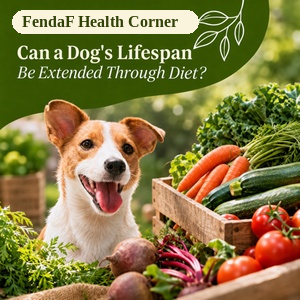
Can a Dog’s Lifespan Be Extended Through Diet? What Research Shows
Reading time: about 11 min
If our dogs could live even a little longer, and stay healthier throughout that extra time, it would already be a huge win. That is why a webinar by Karen Shaw Becker and Rodney Habib about food, the microbiome and intermittent fasting stayed with me. Several suggestions made me want to try them with my own dogs right away. But before doing that, some claims deserve a proper ‘but why?’ question. Are we really seeing longer life after a dietary change, or merely a shift in a metabolic marker?
We cannot guarantee a dog’s lifespan. Genes, illnesses, accidents, body weight, activity and many other factors affect it. However, we do have some meaningful evidence that feeding practices can influence health and age-related risks. Here I want to examine that evidence without dismissing integrative approaches or presenting an interesting hypothesis as a proven recipe.
The strongest indicator isn’t a superfood, but appropriate body condition
A long-term study published in 2002 followed 48 Labrador Retrievers. One dog in each pair received 25% less food throughout life than its paired counterpart. The restricted-fed dogs were generally leaner, developed signs of several chronic illnesses later and had a longer median lifespan. The study is often described as showing a difference of almost two years.
This is a substantial, controlled and long-term study in dogs. But what does it not prove? First, it does not say every owner should immediately cut a quarter from the dog’s current ration. The comparison occurred in a specific population and feeding plan, not among dogs of every body weight. Second, it does not show that calorie restriction is good for an underweight dog, a sick dog or a dog losing muscle. Much of its practical message concerns preventing overfeeding and maintaining an appropriate body condition.
Later, researchers examined data from more than 50,000 middle-aged, neutered family dogs across 12 breeds. Salt and colleagues found an association between overweight body condition and shorter lifespan in every breed examined. This supports the importance of weight management among real household dogs, although observational data cannot reveal the exact causal impact of a weight change for any individual animal.
- Assess body condition: are the ribs easy to feel, is the waist visible from above, and can you see an abdominal tuck from the side? Consider breed and muscle mass.
- Follow weight and muscle condition over time. Do not reduce calories if weight is falling without explanation or muscles are disappearing.
- Add up calories from food, treats and supplements. Nine small snacks can change the total daily intake.
- If your dog is overweight, agree on an appropriate calorie plan and monitor progress. If the dog is thin or ill, the goal will be different.
- Assess progress over months through body condition, muscle, wellbeing and veterinary examinations, not a single ‘longevity marker’.
Fresh additions and the microbiome: reasonable interest, not a lifespan guarantee
Dr Becker and Rodney Habib emphasise fresh food, high-quality ingredients and variety. Integrative practice sometimes uses small amounts of suitable vegetables and other fresh ingredients to provide different fibres and plant bioactive compounds. There is a sound rationale: food influences gut microorganisms, and the microbiome interacts with the body’s metabolism. This does not mean every dog eating a consistent complete diet for years must have dysbiosis or age more quickly.
One often-cited study concerns Scottish Terriers and bladder cancer. Raghavan and colleagues compared 92 dogs with cancer and 83 controls. Dogs eating vegetables at least three times a week had lower odds associated with bladder-cancer occurrence in that study (adjusted odds ratio 0.30). This is an important research direction, but the design was retrospective and case-control, focused on one breed and one tumour type. It did not prove that vegetables reduce cancer risk by 70–90% for every dog or add a set number of years to life.
Likewise, a change in one blood chemical or inflammatory marker cannot automatically be called an extension of lifespan. If someone claims that adding 20% fresh food reduced inflammation markers by ‘300%’, we must first establish what was measured, how the percentage was calculated and whether the result was replicated in dogs. A percentage can be misleading even at the level of arithmetic. This cannot become a promise of a longer life.
How much fresh food can be added to the main diet?
An earlier FendaF article mentioned that up to 25% of dry food could be replaced with fresh food without concern. Here we must distinguish grams from calories and consider the balance of nutrients in the staple diet. If a quarter of daily energy comes from unbalanced additions, a dog may not receive enough essential vitamins or minerals. WSAVA’s general guidance is that treats and nutritionally unbalanced extras should provide no more than about 10% of daily calories unless a veterinary nutrition plan says otherwise. The remainder should come from a complete diet.
In practical terms, start with a small amount of a safe, clean vegetable, lightly cooked if appropriate. Suitable examples may include carrots, certain leafy greens and blueberries, depending on individual digestion. Not every wilted plant in the fridge is safe for dogs; never feed mouldy food, and grapes, raisins and products containing xylitol are prohibited. Allium vegetables, including garlic, require careful consideration of species, quantity and preparation rather than a simplistic black-and-white claim. But that is not a reason to experiment with arbitrary amounts.
Intermittent fasting: interesting, but limits matter
Dr Becker has discussed an eight-hour feeding window with a 16-hour break. The underlying metabolic and cellular-repair mechanisms are being studied extensively, mainly in laboratory animals and humans. To recommend a schedule to dog owners, however, we need evidence about real benefits in dogs.
A 2022 cross-sectional study from the Dog Aging Project found better average cognitive scores and fewer reports of certain health problems in dogs fed once daily than in dogs fed more frequently. The large sample makes the association interesting. Yet the authors themselves stressed that cross-sectional observations cannot prove causation. Healthier dogs may simply have different feeding routines. The study did not determine whether a 16-hour fast increases canine lifespan.
For that reason, we should not automatically impose fasting on puppies, underweight, pregnant, nursing or diabetic dogs, dogs that need food with medication or otherwise ill animals. Even a healthy dog is not required to move to one meal daily. If you want to discuss a feeding window, speak with a veterinarian familiar with the dog’s health. A consistent routine, sufficient energy intake and appropriate body condition are more important than a magical time on the clock.
Does expensive, less processed or ‘human grade’ food extend life?
Ingredient origin, transparent composition, manufacturer controls and suitability for the dog matter to us. But a label saying ‘human grade’, ‘premium’, ‘veterinary’ or ‘cold pressed’ does not by itself demonstrate a lifespan-extending effect. Ask about the complete product’s nutrient profile, batch testing and the evidence supporting each specific claim. Country of origin alone is not a risk assessment either: contamination, batch and quality control matter.
Different reaction products are formed during food processing, and the possible health effects of heavily processed products deserve investigation. But the human category of ultra-processed food cannot simply be mapped onto every complete dog food. Nor has it been proven that every less-processed or raw diet extends canine life. The microbiological risks of raw animal food require separate assessment.
For treats, I continue to prefer clearly described ingredients and attention to what a dog actually receives. A single-ingredient treat can be a good choice when appropriate and safely prepared. But one item on the ingredient list does not make the product calorie-free or contamination-free. Total daily intake and production safety still matter.
There is also a useful price comparison: a large dog may eat an expensive bag for a surprisingly long time. Always calculate the monthly cost rather than only the cost per kilogram or bag. If a €100 bag lasts 40 days, the 30-day food cost is €75. When comparing this with a human’s grocery bill, remember that energy requirements, nutrient needs and body weights are not directly comparable.
Our own dogs have been the first tasters of FendaF’s food and treats, and I always notice whether a product smells and looks normal. This everyday attentiveness is valuable, but a dog’s approval and an owner’s nose do not replace microbiological testing and batch-level quality control. For us, traceability and origin matter because they help us ask informed questions, not because of an advertising slogan.
What am I taking away from this?
After the webinar I wanted to add more suitable fresh plant foods to my dogs’ meals and look more critically at how all the treats add up across a day. Those remain reasonable steps. However, cutting calories by 25% in an already lean dog, imposing a 16-hour fast on every dog or promising longer life from a raw diet are not supported with the same level of certainty. Current studies allow stronger conclusions about body condition than about any particular superfood.
Extending a dog’s lifespan through feeding is therefore not one recipe, but a collection of decisions. If appropriate nutrition helps a dog feel better, remain fit and stay active for as long as possible, that is already a worthwhile goal. We need not promise ourselves an outcome that the research never actually promised.
Sources
- Kealy et al. (2002). Effects of diet restriction on life span and age-related changes in dogs.
- Salt et al. (2019). Association between life span and body condition in neutered client-owned dogs.
- Raghavan et al. (2005). Vegetable consumption and bladder cancer in Scottish Terriers.
- Bray et al. (2022). Once-daily feeding and health in companion dogs.
- WSAVA Global Nutrition Guidelines and Feeding Treats to Your Dog.
- American Veterinary Medical Association. Raw diets for dogs and cats.
🐾 FendaF believes in informed choices
The purpose of the FendaF blog is not to tell you what you must do. Our aim is to share knowledge, introduce different evidence-based and integrative perspectives, and help you make more informed decisions for your pet.
Every animal is unique, and no article can replace a consultation, diagnosis or treatment provided by a veterinarian. If your pet has a health concern or you need individual advice, always contact a veterinarian.











Leave a Reply