


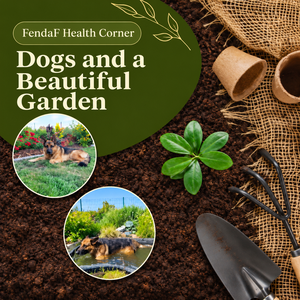
Dogs and a beautiful garden: is it really impossible?
Reading time: about 6 min
When I moved into my house and began working on the garden, I was fairly sure that dogs and a beautiful garden could not coexist. With one dog, planning was still possible. With two, gardening began to feel like a landscaping competition: one team builds and the other tests the durability of every new addition. 😄
At training I heard about owners who had built separate dog runs or fenced off the entire front garden. I understood their reasoning, but it was not what I wanted. My dogs are family, and I want them to be able to move freely around the garden. With a large elephant called Faddu, who charges through almost anything, I had nearly given up on having a beautiful garden.
Then I visited Irene for the first time with Faddu.
Irene’s garden and two very different running styles
I still remember my astonishment. Two dogs, yet such a tidy, lovely garden! At first the explanation seemed obvious. Fenton moves through the garden like a model on a runway, lightly and gracefully. Faddu is more of an elephant in a hurry. How could their effect on a garden possibly be comparable?
But after a few visits, I realised something more important. Irene’s plants were already large and clearly defined. Instead of charging straight through them, Faddu ran around them. The problem was not simply the dog. It was whether the garden gave him a clear route to follow.
My garden was practically in the middle of a field, with no mature trees and more limestone in the soil than I ever wanted to see. Planting large shrubs was hard work, so I mostly started with small plants. Looking back, that was the hardest part: the plants were tiny, while the dogs were already fully grown.
A German Shepherd’s personal racetrack
Faddu and Ossu are both large German Shepherds, and running along the fence is part of their daily routine. Cars, people and neighbours pass by. The dogs notice. And off they go, along exactly the same route every time. The result was predictable: the grass along the fence gradually became bare soil and, when it rained, mud.
Eventually I realised I could keep sowing grass seed forever or accept the route the dogs had chosen. The second option worked better for us. We covered the fence line with mulch so their running no longer destroyed the most vulnerable part of the lawn. Mulch is not a universal solution for every garden: the material, underlying layer, drainage, amount of traffic and whether your dog chews it all matter. But it made a noticeable difference in ours.
The first attempt failed Faddu’s test. Geotextile worked better
One vivid memory is the day Irene and I began tidying the bed around my spruce trees. Thin landscape fabric had worked well in her garden, so we tried the same. We laid down the fabric, covered it with mulch, and everything looked lovely.
A year later the fabric was in pieces. Faddu had continued running his usual route, and the light material could not withstand the traffic. We did the job again, this time using stronger geotextile under the mulch. In our conditions that held up much better, and the area around the spruces stayed tidy.

One important qualification: geotextile is not automatically the best choice for every flowerbed. Over time it can become exposed, tear or make plant maintenance difficult. If your dog pulls at or chews the material, reconsider using it. Choose mulch that is not toxic to dogs and contains no sharp pieces. Cocoa bean mulch, for example, can contain theobromine and caffeine and should not be used in a dog-friendly garden.
How did the little plants finally grow?
I cannot be the only person who goes outside each spring and immediately checks whether a new branch has appeared. For years I had another question: has Faddu broken it off already? Sometimes he had. I tried wire guards around the plants, ropes and every kind of barrier. A few days later Faddu would be running around with the netting or the rope would have disappeared. Not every protective solution works for every dog. 😄
I told Irene several times that I would never have a beautiful or private garden because Faddu would destroy every plant before it could grow. Irene calmly insisted that plants were resilient and simply needed time. I genuinely did not believe her.
But she was right, at least in our garden. Some plants were damaged and a few had to be replaced, yet most eventually grew. Once the shrubs and spruces became sturdy and visible, the dogs started going around them naturally. A dog does not measure a plant in centimetres. A larger, denser planting with a clear edge can nevertheless guide its movement far better than one delicate shoot in the soil.
What would I do differently now?
First, I would look at where the dogs already run. Plan the garden around the real dog who lives there, not just around a pretty design on paper. If the fence line is an established racetrack, planting fragile shrubs there and hoping your dog changes overnight is unlikely to work. Leave a running corridor, choose a more robust surface or position the plants a little farther away.
Second, I would protect vulnerable plants during their first few years. That might mean a low, clearly visible barrier, temporary supports or buying a larger plant if the soil and budget allow. A visible, safely secured barrier is better than loose netting a dog could get caught in. In my own experience, plants around 60 centimetres tall were easier for the dogs to notice, but that is not a rule for every dog or plant.
Third, I would allow myself room for mistakes. Not every plant grows back the same way after a branch breaks, and frequent pruning does not make every species grow faster. Pruning needs to suit the plant and the season. Nor would I choose thorny plants solely to deter a dog: sharp thorns can cause injuries too.
A garden should be safe for dogs as well as beautiful
I have often gardened alongside my dogs. They have watched me plant, dig and spread mulch, and that has not made them dig everything up. Another dog might see a freshly dug bed as an invitation to explore. There is no single recipe.
There is one thing I would no longer judge solely by my dogs’ past behaviour: poisonous plants. I have had plants in the garden that my dogs never touched, but that does not prove they are safe or that the same dog will never sample them. Check the safety of plant species, particularly if your dog eats plants or a puppy is joining the family. Daffodil bulbs, lily of the valley, oleander and many other garden plants can be dangerous. Watch out for fertilisers, pesticides, sharp tools, loose nets and rakes left lying around after a day’s work. Rakes are not garden furniture.

Would I build this garden the same way again?
Yes, but I would be more patient at the beginning. When I watch Faddu and Ossu in the garden today, I can see them running around the shrubs rather than straight through them. Even the spruces that Faddu bumped into and battered with his tail for years have grown tall. At one point that seemed almost impossible.
I am not saying every dog must have access to every corner. For some families a separate area works best, and that is perfectly reasonable. What mattered to me was keeping our garden a shared space. In the end, dogs and a beautiful garden are not a fantasy. Sometimes you simply need to plant a little more thoughtfully and wait a little longer than you expected.
Sources
- Cornell University College of Veterinary Medicine: Plants toxic to dogs.
- Poison Control: Cocoa bean mulch can poison dogs.
🐾 FendaF believes in informed choices
The purpose of the FendaF blog is not to tell you what you must do. Our aim is to share knowledge, introduce different evidence-based and integrative perspectives, and help you make more informed decisions for your pet.
Every animal is unique, and no article can replace a consultation, diagnosis or treatment provided by a veterinarian. If your pet has a health concern or you need individual advice, always contact a veterinarian.










Leave a Reply