


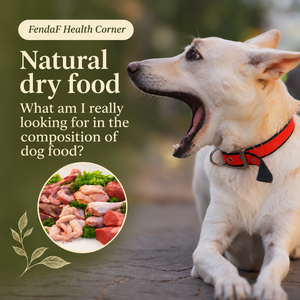
Natural dry dog food: what do I really look for in the ingredients?
Reading time: about 10 min
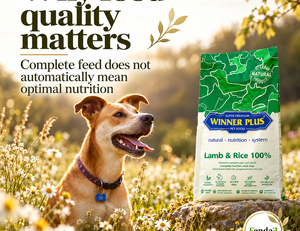
When I first came across Winner Plus food, it was hardly love at first sight with the packaging. I remember studying the ingredients, where the raw materials came from and what the manufacturer said about production, and asking myself what those words really meant. Our dogs are family members, and their food is not something I want to choose on the strength of an advertising slogan alone. I have even tasted the kibble we stock at FendaF myself. That is obviously no laboratory quality test, but it tells you something about how important it is to me to know what is in the bowl.
I remain critical of meat meal and fish meal. Not because every such ingredient is automatically bad, but because processing, the original quality of the raw material and subsequent storage can vary considerably. If a manufacturer will not explain these things, the packaging does not tell me enough to trust it blindly. At the same time, we should be honest about the difference between what is known and what is merely suspected.
Does “natural” necessarily mean better food?
The word “natural” sounds reassuring. To me, it expresses a preference for clearly sourced ingredients, a comprehensible recipe and processing that has a good reason behind it. But the word alone does not prove that a food is nutritionally complete, safe or suitable for a particular dog. The same applies to terms such as “premium”, “holistic” and “human-grade”: we need to look at the actual evidence behind them. A dog eats what is inside the bag, not the promise printed on it.
The distinction between complete and complementary feed matters too. A complete food should supply the nutrients needed by a dog at the intended life stage when fed in the recommended daily amount. A complementary product may be an excellent addition but is not automatically balanced as the sole diet. An important reference for European manufacturers is the FEDIAF nutritional guidelines. I would ask whether the recipe follows the relevant recommendations and whether the finished food is tested analytically.
Where do the ingredients come from, and what does the label leave out?
“Chicken”, “fresh salmon” and “animal protein” are not equally precise descriptions. I want to know the animal species, which parts are used, the source of the raw material, how it is stored and whether the batches can be traced. For an ingredient drawn from several sources, its origin matters especially when a dog has a suspected food allergy. Being listed first among the ingredients does not answer all these questions.
Fresh meat contains a lot of water. A large percentage of fresh meat on the label therefore does not mean the same percentage of dry animal material in the finished product. Conversely, a dried animal ingredient may provide concentrated protein. You cannot assess an ingredient by its percentage alone without considering its moisture content and the rest of the recipe.
Why am I cautious about meat meal and meat-and-bone meal?
Meat meal is produced from animal tissues by heating, removing moisture and some fat, and grinding. Meat-and-bone meal differs in part because it contains more bone. These terms should not all be treated as interchangeable. Under AAFCO definitions, meat meal does not include deliberately added hair, hooves or manure, for example. It would be inaccurate to say that meat meal inevitably consists of such materials. But a definition tells us little about the age of the raw material in a particular batch, its supply chain, nutrient availability or the exact processing conditions.
That is where my caution comes from. Rendering exposes the material to substantial heat treatment, with effects depending on time, temperature, moisture and the starting material. Heat is important for microbiological safety, but it can also affect the quality of some nutrients. In particular, the crude protein percentage printed on a bag does not necessarily tell us how available essential amino acids are to the dog. I want to see data on the starting material and the finished product, not just the words “high protein”.
Can a carefully produced, species-identified meat meal provide valuable protein? Yes. Does that mean all meat meals are equivalent or that their origins no longer matter? No. The claim that every meat meal comes from sick or dying animals would also require evidence about the specific producer and supply chain. I understand why some integrative veterinarians are wary of these materials, and my own preference remains for animal ingredients with transparent origins and less intensive processing.
Fish meal: valuable nutrients and a genuine oxidation question
Fish can supply highly usable protein and, depending on the raw material, important fatty acids. Making fish meal often involves heating, pressing, drying and grinding. The goal is to turn highly perishable fish into a storable ingredient, but the result is not the same thing as a fresh fillet. I pay particular attention to oily fish because their polyunsaturated fatty acids are susceptible to oxidation.
This is not merely a theoretical concern. Researchers at Iowa State University investigated oxidation in rendered protein meals under different storage conditions. Fish meal proteins were susceptible to oxidation at higher temperatures and also during several months of storage at 20 °C. The study did not prove that all dog foods containing fish meal cause disease. It did, however, demonstrate why the freshness of the material, antioxidants, oxygen exposure and storage duration deserve attention.
With fish meal, I therefore ask which fish species were used and where they came from, how the meal was made, how fat oxidation is checked, which preservatives are used and how long the ingredient sat in storage before becoming finished food. If those answers are missing, “fish is healthy” is not enough for me. That does not mean good fish meal is impossible. It means its quality should be demonstrated.
How do heat treatment and kibble production affect the result?
Dry food can be produced, for example, by extrusion or pressing. These are not the same process, and neither can be judged by one temperature figure in isolation. The outcome depends on the recipe, moisture, pressure, duration of heating and subsequent drying. Extrusion can make starch more digestible and reduce microbiological hazards. Excessively intensive processing, however, may damage certain heat-sensitive components.
Cold-pressed food may sound less processed, but the word “cold” does not mean raw or unprocessed, nor does it guarantee better nutrient availability. I would rather assess the entire process and the analyses of the finished product. Likewise, a strong aroma or a dog’s excitement at mealtime is not proof of quality, although taste and willingness to eat certainly matter.
Preservatives, fats and how you store the bag
Fat in food can oxidise. That is why we cannot simply dismiss all antioxidants or preservatives as “chemicals”: their purpose may be to slow the deterioration of fats. On the other hand, it makes perfect sense to ask which substances are used, why they are necessary and how shelf life is verified. My preference is for a transparent preservation system, a justified ingredient list and measurable quality control.
Everyday storage matters as well. A large opened bag of kibble may sit in a warm place for weeks. Air, light and moisture do fats no favours. I recommend keeping the amount in use tightly sealed in its original packaging and, if needed, dividing a large reserve into airtight portions for freezing. Allow a sealed frozen portion to reach room temperature before opening it so condensation does not get into the food. This also helps preserve batch details and the information on the original packaging.
What does a manufacturing certificate actually tell us?
An important point for me with Winner Plus was learning about the manufacturer’s controlled processes and FSSC 22000. This is a certification scheme for a food safety management system, not a certificate proving that a particular recipe is nutritionally superior or that every single bag is flawless. It is worth checking the certificate’s validity, the certified company and the scope of its activities. Old figures for the number of certificates worldwide should not be repeated years later as if they were still current.
ISO 9001 addresses general quality management, whereas FSSC 22000 focuses on food safety management. They are different things. Yet neither one, on its own, establishes the nutritional value or digestibility of the dog food or the origin of a particular ingredient. The strongest evidence comes from several checks taken together.
Salt, potassium chloride and other ingredients: do not judge by a name alone
I do not favour recipes in which enhancing flavour seems more important than the raw ingredients themselves. Dogs can develop learned taste preferences, and saltier food may sometimes be more appealing. But it does not follow that every food containing salt causes physiological addiction. Sodium and chloride are essential nutrients, and “no added salt” is not the same as “sodium-free”. The real question is how much is present in the complete recipe.
Similarly, the use of potassium chloride elsewhere, such as in fertilisers, does not by itself make it dangerous in dog food. Potassium and chloride are essential minerals; we must assess quality and quantity. The absence of GMOs or gluten is not, by itself, proof that a food is nutritionally better either. When discussing a risk, we should be able to identify the specific exposure, dose and supporting evidence.
What should you ask a manufacturer before trusting its packaging?
To me, a good dry-food manufacturer is one that can answer at least these questions:
- Where do the animal protein ingredients come from, and are the species precisely identified?
- Does the recipe contain fresh meat, dried meat, meat meal, meat-and-bone meal or fish meal, and exactly what do those terms refer to here?
- How are raw material storage, fat oxidation and microbiological risks monitored?
- Who formulates the recipes, and what training does the nutrition specialist have?
- Is the finished food analysed, and will the manufacturer share key nutrient and energy-density figures?
- Which life stages is the food designed for, and is it nutritionally complete?
- Which factory produces it, and what exactly does the factory’s certificate cover?
I am not demanding that every answer appear in an advertisement. I am asking for verifiable answers to the questions that matter.
What have Faddu, Ossu and Peku taught me?
In our family, Ossu has been the dog whose skin can show symptoms fairly quickly after eating something unsuitable. Faddu tolerates many changes better. Peku has vomited after certain treats even though the other dogs did not react to the same products. These experiences are why I read ingredient lists carefully and do not assume one recipe will suit every dog.
However, bad breath, itching or loose stools after a change of food do not automatically mean that the body is going through a “detox”. They may indicate a food that does not agree with the dog or another health problem. If a dog becomes intensely itchy, vomits or loses its appetite, I would not advise waiting for its body to supposedly cleanse itself. The situation needs assessment and, where appropriate, veterinary attention.
This article focuses mainly on dry-food ingredients and manufacturing quality. To read about why changing food may affect symptoms in one dog but not another, see our article “Natural dog food as a solution?”. It explains Klaus’s and Ossu’s experiences and the limitations of diagnosing food allergies.
In conclusion
What I feed my dogs matters to me. I prefer animal ingredients with transparent origins, and I am more critical than most people about meat meal and fish meal. Behind that preference are real questions about processing, oxidation, digestibility and quality control. But my purchasing preference need not turn into unsupported accusations against every other food. The best question is not “Does the label say natural?” but “What do I actually know about this food, and what can I verify?”
Sources
- AAFCO. What’s in the Ingredients List?
- WSAVA Global Nutrition Committee. Guidelines on Selecting Pet Foods (2021)
- FEDIAF. Nutritional Guidelines for Complete and Complementary Pet Food for Cats and Dogs (2025)
- Van Heugten et al. Impact of storage conditions on protein oxidation of rendered by-product meals (2020), Translational Animal Science. DOI: 10.1093/tas/txaa205.
- FSSC Foundation. Annex 1: Certification Body Scope Statements (FSSC 22000 is a management system certification, not product certification)
- FendaF. Dry Food Ingredients and Marketing Tricks
- FendaF. Amino Acids in Dog Food
🐾 FendaF believes in informed choices
The purpose of the FendaF blog is not to tell you what you must do. Our aim is to share knowledge, introduce different evidence-based and integrative perspectives, and help you make more informed decisions for your pet.
Every animal is unique, and no article can replace a consultation, diagnosis or treatment provided by a veterinarian. If your pet has a health concern or you need individual advice, always contact a veterinarian.







Leave a Reply