


Why Dried Dog Treats? What Do Dogs Really Get from Them?
Reading time: about 6 min
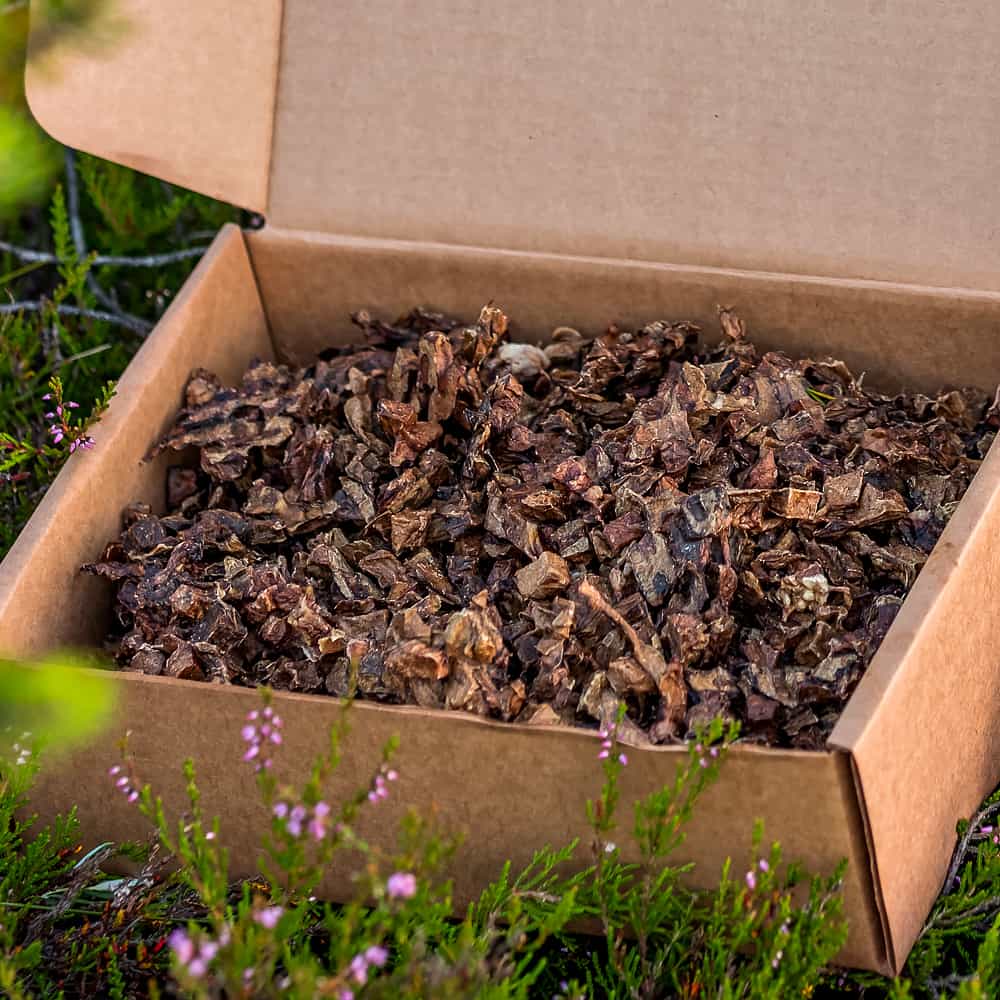
People have asked us why we give our dogs dried treats at all. Do dogs actually need them? I’ll start with the same answer I gave in my first article on this subject: no, they don’t have to. A dog eating a balanced staple diet doesn’t necessarily need a single extra treat to stay healthy. But a carefully chosen treat can offer enjoyable chewing, a convenient training reward and a small shared pleasure.
We need to distinguish three things, though: what the treat is made of, how the dog uses it and whether it suits that particular dog. Dried beef scalp, a soft meat cube and a rock-hard horn are very different experiences, even if all three are described as treats.
Why Do We Prefer Dried Treats?
I like products with simple, understandable ingredients. If a package lists one specific raw material, at least I know exactly what the dog is getting. That can be particularly useful when monitoring tolerance to certain animal proteins. But a single ingredient doesn’t automatically mean a product is suitable for every dog, or that we can ignore production hygiene and quality controls.
We prefer treats without added glycerine or sorbitol, for example. That’s our product philosophy, not proof that every use of these substances in dog treats is dangerous. Glycerine can be used to retain moisture, while sorbitol may function as a sweetener or humectant. The amount, overall formulation and individual dog all matter. We simply prefer as few unnecessary additives as possible and transparent sourcing. Personally, I always ask myself why I should choose a treat that’s been made sweeter or formulated to retain more moisture.
Another major advantage of dried treats is variety. Some dogs enjoy chewing beef skin; others prefer a softer piece. There are animal parts you rarely see at an ordinary meat counter: ears, udders, various skins and other by-products. Using these responsibly can reduce raw-material waste, provided their sourcing and processing are properly controlled.

Does Chewing Clean a Dog’s Teeth?
Chewing certainly has value for dogs. It’s a natural activity, provides entertainment, and the texture of some chews may help remove plaque from tooth surfaces. But we cannot conclude from the word “chewing” that every chew reduces tartar or keeps gums healthy. The mechanical effect depends on the shape, texture and durability of the product and on how the dog actually chews it.
We have a good example at home in Fenton. He wasn’t very keen on chewing things, and tartar started to form on his teeth when he was still young. Our veterinarian discussed whether a dental cleaning might be needed. When we started testing dried treats, Fenton began to chew more, and we felt that the visible tartar decreased. That’s our experience. It does not prove that dried treats always remove hardened tartar or mean that veterinary dental care will never be necessary.
The American Animal Hospital Association’s guidelines explain that toothbrushing at home removes soft plaque, not tartar that has already hardened. Proper tartar removal and an assessment below the gum line may require a veterinary procedure. If you specifically want a product with demonstrated dental benefits, look for one accepted by the Veterinary Oral Health Council (VOHC). Acceptance applies to a particular product and a particular claim about reducing plaque or tartar; it’s not a property of dried treats in general.
Harder Does Not Mean Better
Very hard objects such as horns, hooves and some bones can fracture teeth. An item that’s too small, or breaks into large pieces, can also pose choking or intestinal obstruction risks. Cornell University’s veterinary guidance recommends caution with hard chews even when they are natural. Being natural doesn’t make something less hard.
That’s why I wouldn’t say dried treats are always safer than raw bones. Both have risks. The dog’s size, teeth, chewing strength, habit of gulping, the size of the treat and owner supervision matter more than a label saying “raw” or “dried”. If a dog tends to swallow large pieces, I choose a different texture or way of rewarding them rather than hoping they’ll be more careful next time.
At the same time, it wouldn’t be fair to leave out our own experience with beef horns. They’re favourites in our household. All four dogs, Fenton, Süsi, Faddy and Oscar, enjoy chewing them and so far have done so without problems. The only nuisance for us is finding small pieces of horn all over the floor.

Training Treat, Chew or Just a Small Snack?
For us, treats fall into three practical groups. Training treats should be small, quick to eat and convenient to carry in a pocket, which means dry. Anyone who has forgotten a piece of sausage or cheese in a training vest knows that next time the pocket may contain something that’s started a life of its own. Dried meat treats are less likely to cause that problem, although they still need to be stored dry and according to the instructions on the package.
A chew is different: its purpose is to provide an activity, not a reward that’s swallowed as quickly as possible. It needs to match the individual dog’s chewing style. If the dog is tired of chewing, the item becomes too small or starts breaking into sharp pieces, I take it away.
The third group is a simple snack. Our dogs are used to sometimes getting something nice when we leave home or return. It can be a pleasant, predictable routine. But we shouldn’t automatically assume that a treat will calm a dog with separation-related distress. If a dog panics when left alone, that requires a separate behavioural assessment.
How Many Treats Are Reasonable?
Treats are part of the day’s food intake. A useful starting point in FEDIAF and WSAVA nutritional guidance is that treats and other extras should provide no more than about 10% of a dog’s daily calories. That doesn’t mean you should aim to use the entire 10% every day. Energy-dense dried products can contain surprisingly many calories in a small piece. Extras need particularly careful accounting if a dog must lose weight or is eating a therapeutic diet.
For example, if a dog needs 800 kcal per day, a 10% upper limit would mean about 80 kcal from treats. You cannot calculate the weight of treats in grams simply by looking at how large or small they seem. Ideally, you need to know their energy content.
- Read the ingredient list and the manufacturer’s information, not just the word “natural”.
- Choose a texture and size suited to your dog’s teeth and chewing habits.
- Supervise chewing and remove an item once it becomes too small.
- Count treats towards the daily calorie allowance.
- If bleeding, tooth pain, retching or difficulty swallowing occurs, stop giving the chew and seek veterinary advice promptly when needed.
What If the Dog Has a Food Allergy?
A treat made from one animal ingredient can make keeping a food diary easier, but it does not itself diagnose an allergy. If a veterinarian has recommended a strict elimination diet, one seemingly harmless little treat can compromise the trial. Food allergy is established through a controlled elimination-and-challenge process, not by trying one new animal species after another. During such a trial, use only rewards compatible with the test diet or leave them out for the agreed period.
So does a dog need a dried treat? Not strictly. But for us, it’s one way to offer variety and a satisfying activity. The right treat isn’t the one that looks most impressive, but the one that suits that dog’s teeth, digestion and daily diet.
Sources
FEDIAF. Chews and Treats for Dogs. View source
WSAVA Global Nutrition Committee (2024). Feeding Treats to Your Dog. View source
American Animal Hospital Association (2019). Recommending Home Oral Hygiene and Products. View source
Veterinary Oral Health Council. Accepted Products. View source
Cornell University College of Veterinary Medicine. Dental Disease and Home Dental Care. View source
VCA Animal Hospitals. Implementing an Elimination-Challenge Diet Trial in Dogs. View source
🐾 FendaF believes in informed choices
The purpose of the FendaF blog is not to tell you what you must do. Our aim is to share knowledge, introduce different evidence-based and integrative perspectives, and help you make more informed decisions for your pet.
Every animal is unique, and no article can replace a consultation, diagnosis or treatment provided by a veterinarian. If your pet has a health concern or you need individual advice, always contact a veterinarian.



Leave a Reply