


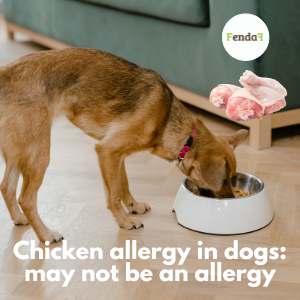
Chicken allergy may not actually be an allergy?!
This time, we are putting chicken under the microscope. Many pet owners avoid chicken almost automatically. Quite often, when a client first comes to us for advice, chicken has already been ruled out. When I ask why, the answer is usually: “this breed has a lot of chicken allergies.” Looking at all the different dogs I hear this about, you would think that 90% of breeds were predisposed to chicken allergy.
In reality, chicken allergy is not nearly as common as people often assume. We have four-legged clients whose owners originally wanted to exclude chicken, yet today those dogs eat chicken-based food perfectly well. Dr Katie Woodley also points out that we notice reactions to chicken so often partly because chicken is one of the most commonly fed proteins. The problem may not actually be chicken itself, but the microbiome. This information comes from the materials from my raw-feeding course.
Essential amino acids
To make sense of the fear surrounding chicken, we need to start at the beginning: amino acids. Chicken is one of the best sources of essential amino acids.
Dogs require 10 essential amino acids, meaning they must obtain them from food. Cats require 11, with taurine added to the list. The 10 essential amino acids for dogs are:
- Arginine
- Histidine
- Isoleucine (BCAA)
- Leucine (BCAA)
- Lysine
- Methionine
- Phenylalanine
- Valine (BCAA)
- Threonine
- Tryptophan
BCAA means branched-chain amino acids. They are important for maintaining muscle mass, recovery and energy production, especially in active or growing dogs.
Types of amino acids
- Glucogenic: can be converted into glucose and help support stable energy. These include arginine, histidine, methionine, threonine and valine.
- Ketogenic: broken down into ketones or fatty acids and do not directly raise blood glucose. These include leucine and lysine.
- Both glucogenic and ketogenic: metabolically flexible depending on need. These include isoleucine, tryptophan and phenylalanine.
Dogs are metabolically flexible and can use both fat and protein as energy sources. Glucogenic amino acids can help maintain blood glucose, while ketogenic amino acids can support energy production without glucose.
The role of amino acids
- Collagen and elastin are important structural components of cartilage, tendons and ligaments.
- Contractile muscle proteins, actin and myosin, enable muscle contraction and movement.
- Keratin is important for the structure of skin, coat and nails.
- Amino acids are needed to synthesise blood proteins such as haemoglobin, albumin and other plasma proteins.
- They provide nitrogen needed for nitrogen-containing compounds such as nucleotides and hormones.
- Amino acids can also be used as an energy source.
Arginine
Roles:
- Removes ammonia from the body
- Participates in protein synthesis
- Supports secretion of insulin and glucagon
- Participates in cell signalling, including nitric oxide production
Deficiency symptoms:
- Weight loss
- Muscle cramps
- Diarrhoea
- Loss of appetite/anorexia
Best sources: Fish, meat, spirulina.
Histidine
Roles:
- Supports haemoglobin function and oxygen exchange
- Tissue growth and repair
- Precursor of histamine, involved in immune responses and inflammation
Deficiency symptoms:
- Anaemia
- Weakness
- Growth problems
Best sources: Meat and fish. Lower biological value: soy and seeds.
Isoleucine
Roles:
- Muscle energy
- Blood-glucose regulation
- Recovery after exercise
Deficiency symptoms:
- Slow growth
- Loss of appetite
- Muscle weakness and fatigue
Best sources: Eggs and chicken. Lower biological value: legumes.
Leucine
Roles:
- Stimulates muscle-protein synthesis
- Regulates protein metabolism
- Influences insulin secretion
- Supports growth and tissue repair, especially muscle
Deficiency symptoms:
- Loss of muscle mass
- Slow growth
- Poor recovery
Best sources: Chicken, beef and fish. Spirulina can be a useful addition.
Lysine
Roles:
- Collagen synthesis and connective-tissue support
- Protein and energy metabolism
- Precursor of carnitine
- Calcium absorption
- Supports immune function
Deficiency symptoms:
- Weight loss
- Loss of appetite
- Growth problems
- Reduced muscle mass
- Reduced immune function
Best sources: Eggs, meat and fish. Lower biological value: legumes.
Methionine
Roles:
- Protein synthesis
- Normal growth
- Regulation of genes and enzymes
- Cell division and growth
- Production of antioxidants such as glutathione and support for liver function
Deficiency symptoms:
- Weight loss
- Coat problems
- Slow growth
Excess may cause disorientation, vomiting and impaired muscle coordination.
Best sources: Meat and eggs; fish is also a good source. In plant proteins methionine is often a limiting amino acid.
Phenylalanine
Roles:
- Precursor of tyrosine
- Synthesis of dopamine and noradrenaline
- Synthesis of hormones including thyroid hormones
- Melanin production and coat colour
- Protein synthesis and growth
Deficiency symptoms:
- Confusion
- Low mood/depression
- Loss of appetite
- Lethargy
- Possible fading of coat colour
NB! Dark-coated dogs require more phenylalanine and tyrosine for melanin production. Phenylalanine is particularly versatile because it affects both the nervous system and coat colour.
Best sources: Meat, fish and eggs. Lower biological value: grains.
Threonine
Roles:
- Structure and function of proteins and enzymes
- Collagen and elastin synthesis
- Antibody production
- Supports the intestinal lining through mucin production
- Normal growth
Deficiency symptoms:
- Digestive problems such as diarrhoea
- Slow growth
- Weakness
- Lameness/movement problems
- Possible mood changes
Best sources: Meat, liver and fish.
Tryptophan
Roles:
- Growth and development
- Nitrogen balance
- Precursor of niacin (vitamin B3)
- Precursor of serotonin
- Melatonin synthesis
Deficiency symptoms:
- Aggressive behaviour
- Anxiety and restlessness
- Sleep problems
Best sources: Meat, fish and eggs.
Valine
Roles:
- A BCAA important in muscle proteins
- Muscle metabolism
- Tissue and muscle recovery
- Energy source for muscles
- Helps maintain nitrogen balance
Deficiency symptoms:
- Muscle weakness
- Fatigue
Best sources: Meat, including chicken and pork, fish and milk. Lower biological value: seeds.
Why should chicken not be excluded automatically?
Very often, the real question is chicken quality. Many owners have been frightened into believing that chicken will inevitably cause problems. In reality, chicken has an excellent essential-amino-acid profile. Even when the numerical differences between proteins look small, they can matter for a pet’s overall nutrition. Many puppy foods are chicken-based for exactly this reason: chicken makes it easier to provide the amino acids needed for normal growth.
Quality can certainly be an issue. Choosing food made from human-grade raw materials and, preferably, ingredients of European origin puts you in a better position. Many European poultry producers have reduced or abandoned routine antibiotic use.
When different proteins are compared by their amino-acid content, the general ranking is: chicken has the most protein and therefore high levels of essential amino acids; beef has a very balanced profile and is rich in lysine and leucine; fish has a similarly strong profile plus omega-3 fatty acids; pork is close to beef; lamb is a good source but usually fattier, so it provides less amino acid per 100 g; duck is also fattier and therefore contains less protein per gram.
The exact values vary by animal and cut. The table below gives a general comparison in grams per 100 g of food.
| Amino acid | Beef | Pork | Lamb | Chicken | Duck | Salmon |
| Leucine (BCAA) | 1.76 | 1.66 | 1.64 | 1.89 | 1.53 | 1.64 |
| Isoleucine (BCAA) | 0.95 | 0.92 | 0.88 | 1.05 | 0.85 | 0.94 |
| Valine (BCAA) | 1.05 | 1.02 | 0.98 | 1.12 | 0.90 | 1.00 |
| Lysine | 1.89 | 1.74 | 1.70 | 2.05 | 1.58 | 1.82 |
| Methionine | 0.55 | 0.50 | 0.48 | 0.64 | 0.50 | 0.60 |
| Phenylalanine | 0.84 | 0.82 | 0.80 | 0.92 | 0.74 | 0.82 |
| Threonine | 0.88 | 0.86 | 0.82 | 0.97 | 0.77 | 0.86 |
| Tryptophan | 0.23 | 0.20 | 0.20 | 0.26 | 0.20 | 0.22 |
| Histidine | 0.74 | 0.68 | 0.66 | 0.82 | 0.65 | 0.72 |
| Arginine | 1.20 | 1.15 | 1.10 | 1.25 | 1.05 | 1.20 |
Summary
Although chicken has developed a poor reputation among pet owners, avoiding it is often unnecessary. In many cases, the issue may lie not in chicken itself but in the animal’s digestion and microbiome.
Chicken is one of the best sources of essential amino acids, supplying important building blocks for growth, muscle function, immunity and general health. This is especially relevant for growing and active dogs, whose nutritional needs are higher.
Quality matters with every protein, and chicken is no exception. Choosing food made from human-grade ingredients from a trustworthy source can reduce avoidable concerns.
Chicken should not be excluded automatically, but neither does this mean feeding only one protein. Offering different protein sources can diversify the diet and microbiome and may help reduce the chance of developing sensitivities. Feeding the same protein for a very long time may, in some individuals, contribute to increasing immune sensitivity. Dietary variety is one of the foundations of good long-term nutrition.
🐾 FendaF believes in informed choicesThe purpose of the FendaF blog is not to tell you what you must do. Our aim is to share knowledge, introduce different evidence-based and integrative perspectives, and help you make more informed decisions for your pet.
Every animal is unique, and no article can replace a consultation, diagnosis or treatment provided by a veterinarian. If your pet has a health concern or you need individual advice, always contact a veterinarian.






Leave a Reply