


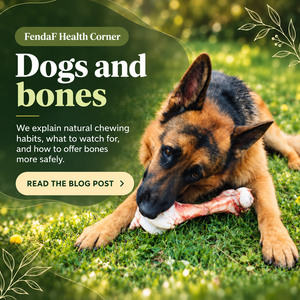
Dogs and Bones: Can a Dog Learn to Chew More Calmly?
Reading time: about 8 min
When I once told Irene I was bringing raw turkey necks for the boys to chew, she was, to be honest, rather worried. Peku had a habit of gulping down anything tasty, and the idea of a whole turkey neck, with a BONE inside, was hardly reassuring. With my German Shepherds I had seen something very different: Faddy and Oscar chew thoroughly, take their time and feel no need to finish everything in seconds. But is this difference simply a matter of temperament, or can the way a dog chews change over time?
This article focuses on the dog, their habits and what an owner can observe or teach. If you want to choose between chicken, lamb or other bones, or decide whether the goal is food, dental cleaning or prolonged chewing, see our separate guide “Bones for Dogs: Which Bone and for What Purpose?”. I will not reproduce that table here.
Chewing style is not necessarily a lifelong diagnosis
In her discussions of raw bones, Dr Karen Shaw Becker has emphasised that a calm chewer, a powerful crusher and a dog that gulps food cannot automatically be given the same type of bone. I agree. But my dogs and customers have taught me something else: saying “my dog is a gulper” may describe what the dog does today, rather than what they will always do.
The calm, thorough chewer
This dog settles down with an item, finds a comfortable position and works on it calmly. If interrupted or distracted, they may even leave the chew for a while. That does not make chewing risk-free. The final small piece can still become a choking hazard, and a hard bone can damage teeth.
The powerful crusher
This dog may not be in any hurry, but uses considerable force. Hard weight-bearing bones, antlers and other rigid items may cause fractured teeth. I therefore do not choose chews on the principle that the harder an object is, the longer it will last. My dog’s teeth should not be used as testing equipment.
The gulper
A gulper tries to swallow a large piece or an entire treat as quickly as possible. This is a serious warning sign: the item may become lodged in the throat, oesophagus or intestine. The underlying causes can vary, however. Excitement, competition, previous experiences or an established habit may play a part. I would not automatically label such a dog hopeless at chewing bones, but safety comes first; only then can we assess whether there is a less risky way to practise.
The dog with sensitive teeth or digestion
Some dogs chew cautiously because a tooth hurts, their mouth is injured or fatty bone marrow causes digestive upset. In older dogs, slower chewing should not automatically be celebrated as improved manners. If the behaviour changes suddenly, the dog chews only on one side, drops treats, starts drooling or avoids a previously favourite activity, investigate their health first.
Why I began in puppyhood
I offered my dogs things to chew as puppies, but did not start by giving them large, hard bones. I chose cartilaginous ears: soft enough for developing teeth but big enough that a puppy could not swallow them whole immediately. Of course, I watched how the puppy handled them.
My goal was for each puppy to learn to settle with an object, chew it properly and find a comfortable spot. Gradual practice has, in my dogs, contributed to very calm chewing behaviour. I cannot turn that experience into scientific proof that starting with cartilaginous ears makes every puppy a calm chewer. It is nevertheless a genuine experience that informs my belief in teaching chewing habits.
Size alone cannot make an object safe. A cartilaginous ear may break into smaller pieces, a very rigid dried chew can put pressure on teeth, and a small piece can become lodged in the throat. With puppies, teething and oral discomfort also matter. For some, a softer chew toy may be a better starting point than an edible bone.
Peku showed me that even adult dogs can relearn
Peku was used to eating quickly. When I first brought him a turkey neck, Irene was not convinced it was a good idea. We began guiding him gradually: initially we held one end of the turkey neck and calmly repeated “chew slowly”. He could not immediately swallow the whole thing and had to work on the portion within reach.
Over time, his behaviour changed. Eventually Peku chewed turkey necks just as thoroughly as our German Shepherds, and Irene was no longer afraid to offer him one. For me, that is an important example of a dog whose first impulse was to gulp but who learned another behaviour. It does not prove that the approach works for all dogs or that every gulper can safely be trained with turkey necks.
There is an important safety boundary here. Holding a bone by hand is appropriate only when the dog remains relaxed near people, does not grab forcefully and does not guard food. If a dog stiffens, growls or might bite a hand, fingers are not suitable training tools. Choose a lower-risk method and, if necessary, work with a qualified reward-based behaviour professional. Calm chewing can also be practised with suitable non-bone chews.
Does an occasional chew become too big an event?
My personal belief is that chewing behaviour may also be influenced by how rarely or regularly a dog receives something special. A highly valued treat offered once a year may generate much more excitement than a familiar, predictable chewing activity. I sometimes compare this with children and sweets, ice cream or crisps. This is an analogy, not a scientific comparison of children’s and dogs’ eating behaviour.
FendaF customers have repeatedly told me that at first their dogs demolished every chew within seconds. Some of those dogs, after six to eighteen months of being offered chews regularly, began simply carrying a beef ear around instead. The treat was no longer an event that had to be consumed immediately. I saw a similar change in Peku. Initially Irene had to put his treats away, but eventually a box of chews could stand in the room and Peku would take something when he felt like chewing, rather than emptying it all at once.
“Eventually” is the important word. Peku was not given free access to the entire box from the start. That only became possible gradually as his behaviour changed. This is not a recommendation to leave chews freely accessible to every dog. Nor do these customer stories prove that regularity alone caused the improvement. Age, training, the home environment and other factors may have contributed. They do, however, make me wonder whether a dog we call a gulper today might be a very different chewer a year from now.
A regular opportunity to chew does not mean a dog needs to eat bones every day. Overall food intake and nutrient balance still matter. Suitable edible chews, softer alternatives and toys can be chosen separately with the dog’s abilities and safety in mind.
Two dogs, two bones and just five centimetres
In multi-dog homes, it is often recommended that dogs chew separately because competition may increase rushing or resource guarding. That is a sensible precaution when their responses are not well known. But my Faddy and Oscar can chew only five centimetres apart. Each has their own bone. When one finishes first, he does not bother the other or try to take his bone.
That is a peaceful coexistence established in our home, not a sign that every pair of dogs should chew so closely together. If one dog stiffens when the other approaches, holds an item tensely, growls or suddenly starts rushing, I would give them more space and a separate quiet place straight away. Resource guarding is not resolved by forcibly taking a bone away or punishing the dog.
Do you always have to supervise?
The general and safer recommendation is to supervise dogs chewing bones and any other objects that could be swallowed in large pieces. Even an experienced chewer can fracture a tooth, injure the mouth or attempt to swallow the final piece whole. The risk can never be eliminated completely.
After observing my dogs for a long time, I have occasionally left Faddy and Oscar outside to chew bones calmly on their own. I know how they usually chew and interact. This is my considered personal practice, not a general safety recommendation. Knowing your dog helps you assess risks; it does not remove them.
If you notice choking, repeated retching, breathing difficulties, severe pain or inability to swallow, seek veterinary care immediately. Vomiting, abdominal pain, lethargy, straining to defecate or blood in stools after eating a bone also require prompt veterinary assessment, even if the dog initially seems fairly normal.
Before offering the next bone or chew
- Observe whether the dog really chews or tries to swallow the item whole; choose for their current behaviour, not weight alone.
- Begin with a softer, appropriately sized chew that cannot be gulped whole immediately, and supervise throughout.
- If the dog tenses up, guards food or grabs forcefully, stop and choose a safer approach with a professional.
- In multi-dog homes, consider the dogs’ actual relationship: peaceful chewing together can work, but competition or guarding calls for separation.
- Remove pieces that become too small; seek veterinary help for signs of choking, difficulty swallowing or digestive problems.
I like to think chewing style is not written on a dog’s forehead. We cannot promise every dog will learn a new approach, but we should not assume from the outset that change is impossible. Peku, Faddy, Oscar and our customers have taught me one thing: before asking which bone to buy, look at how your dog actually handles it.
Sources
ASPCA. Position Statement on Dog Chews/Treats: https://www.aspca.org/about-us/aspca-policy-and-position-statements/position-statement-dog-chewstreats
ASPCA. Food Guarding: https://www.aspca.org/pet-care/dog-care/common-dog-behavior-issues/food-guarding
Cornell University College of Veterinary Medicine. FDA bone treat warning, 2017: https://www.vet.cornell.edu/about-us/news/20171129/fda-bone-treat-warning-cornell-veterinarian-explains-how-you-can-protect-your-dog
Waltham Petcare Science Institute. Long-Lasting Chews Elicit Positive Emotional States in Dogs during Short Periods of Social Isolation. Animals, 2023. Research on chewing and wellbeing, not evidence for retraining gulping behaviour: https://pubmed.ncbi.nlm.nih.gov/36830339/
FendaF. Bones for Dogs: Which Bone and for What Purpose?: Bones for Dogs: Which Bones and Why?
🐾 FendaF believes in informed choices
The purpose of the FendaF blog is not to tell you what you must do. Our aim is to share knowledge, introduce different evidence-based and integrative perspectives, and help you make more informed decisions for your pet.
Every animal is unique, and no article can replace a consultation, diagnosis or treatment provided by a veterinarian. If your pet has a health concern or you need individual advice, always contact a veterinarian.





Leave a Reply