


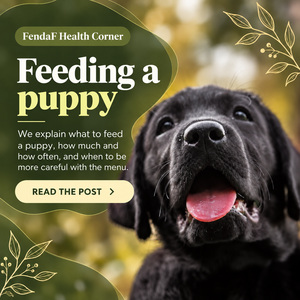
Feeding a Puppy: Choosing Food, Portions and Supporting Healthy Growth
Reading time: about 14 min
There are many recommendations about feeding a puppy. Some say that the food received from the breeder should not be changed. Others recommend immediately eliminating chicken, giving only one protein, or switching to raw food as soon as possible. But what does a puppy really need and how do you make decisions so that its growth does not depend on random advice?
I have also learned a lot in this area from my own dogs. When Faddu was a puppy, I changed his food quite quickly because I felt it was not the best choice for him. With Ossu, I initially left the food he came with from the breeder for a longer period of time. He later had more health problems than I have had with other puppies. I cannot prove in retrospect that the food was the cause of these differences. However, these experiences taught me how important it is to consciously evaluate a puppy’s menu, and not simply continue out of habit because someone else says it is right.
In this article, we will look at feeding a puppy as a whole: choosing the right food, food amounts, monitoring growth, combining different foods, and when variety is beneficial and when we should be more careful.
How is feeding a puppy different from feeding an adult dog?
A puppy is not just a smaller adult dog. His body is growing bones, muscles, a nervous system and other tissues at the same time. To do this, food must provide enough energy and the right amount and ratio of proteins, fats, essential fatty acids, vitamins and minerals.
Calcium and phosphorus are particularly important. Both a deficiency and excess of calcium can damage the skeleton of a growing dog. In large and giant breed puppies, controlling calcium and energy intake is especially important, as too rapid growth and excess weight can increase the risk of skeletal developmental disorders.
For a puppy, I would therefore first choose a complete food formulated for growth, with nutrients balanced for the puppy’s needs. If the puppy grows into a large dog, the suitability of the food must also be confirmed for large-sized puppies. Complete food for an adult dog is not automatically the right choice for the growing period.
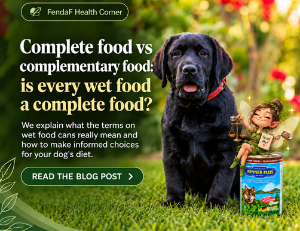
The difference between the words “complete feed” and “supplementary feed” is particularly important here. If you want to read more about it, I explain it in a FendaF article. “Complete food vs. complementary food: is all wet food complete food?”.
How to choose quality food for a puppy?
I wouldn’t choose puppy food based solely on price, pretty packaging, or advertised meat percentage. I would look at whether the food is intended for a growing dog, what its nutritional values are, whether the manufacturer has proper quality control, and whether they can answer questions about their recipe and feeding guidelines.
Complete food should cover the nutritional needs of a puppy if given in an appropriate daily amount. For European producers, the FEDIAF nutritional guide is an important starting point here. At the same time, the complete food label does not mean that all products are of the same quality or are equally suitable for every puppy.
Is 60% fresh meat better than 24% dried meat?
This is one place where percentages on packaging can be misleading. Fresh meat contains a lot of water. If the ingredients list says “60% fresh meat,” it doesn’t make sense to directly compare that to “24% dried meat.” After drying, the fresh meat weighs less, and the ingredient ratios may not describe the actual protein content of the finished food as the advertisement suggests.
Watch together list of ingredients, analytical components, energy content of the feed and manufacturer’s explanations. Dividing the ingredients into several names can also make the list more impressive at first glance. However, the word “meat meal” alone does not prove poor quality, just as the word “fresh” does not guarantee good quality. What is decisive is the actual origin of the raw material, its processing, control and the nutritional value of the finished feed.
It is important for a puppy to get all essential amino acids in sufficient quantities This does not mean that he should necessarily eat several types of meat in the same meal. A properly formulated complete food can provide the necessary amino acid profile even with selected limited protein sources.
How much and how often to feed a puppy?
I always start with the manufacturer’s feeding guide. For a growing dog, the chart may be based on age, current weight, or expected adult weight. It’s worth reading this carefully: a 10 kg, three-month-old puppy does not have the same nutritional needs as a 10 kg adult dog.
The manufacturer’s daily allowance is a starting point, not a fixed rule. A puppy’s energy needs change as they grow, and two puppies of the same weight may need different amounts. That’s why I regularly monitor weight, waist, rib palpability, energy levels, and stool. The goal for a large breed puppy is not to grow as fast as possible, but to grow evenly and stay in a lean body condition.
For example, if the package says your puppy’s initial daily allowance is 600 grams and he eats three times a day, one meal would be 200 grams. If you also feed wet food or use a significant amount of treats during training, these should be included in the daily total. You can read more about the calculation in our article “Food quantities and how to calculate them?”.
How many meals a day?
As a practical starting point, a puppy aged 2-3 months can be fed four small meals, around 3-6 months three, and an older puppy usually two meals. This is not a rigid age limit: a very small breed, a young puppy, or a puppy with health problems may need more frequent feedings.
I do not recommend conscious fasting for puppies. A growing animal needs regular energy intake, and long meal intervals can be particularly problematic for small puppies. In the event of vomiting, diarrhea, or refusal to eat, leaving a puppy without food for a long time on your own is not a good treatment plan. If necessary, consult a veterinarian immediately.
Can dry food, wet food and fresh food be combined?
My own dogs have been eating what I call a combo for years: dry food, wet food, and selected fresh ingredients. I like the opportunity to offer a variety of flavors, textures, and ingredients. However, it is more important for a puppy than for an adult dog that: Does the overall diet remain balanced for the puppy’s growth needs?
If I combine two complete foods suitable for a growing dog, it is easier to calculate the proportions based on their daily allowances. However, it is worth checking that the foods used are suitable for the same life stage and growth rate. If part of the menu comes from a single meat, egg, kefir or vegetable, this part is not automatically a balanced complete food.
If fresh supplements only make up a small portion of the daily energy intake, menu planning can be easier. If a lot of them are added, you need to check the actual intake of energy, calcium, phosphorus and other nutrients. In the case of a puppy, I do not recommend relying on the idea that he will get what he lacks from somewhere else. Long-term balance is important, but in a growing animal, it is not worth leaving major nutritional deficiencies to chance.
I write more about combining different foods and the proportions of daily allowances in a FendaF article. “Dog food and how to combine different foods?”.
What about raw meat and bones?
The potential value of raw food is also worth talking about in a positive light. Integrative veterinarians, including Karen Becker and Judy Morgan, consider it important to offer fresh and less processed raw materials and thoughtful variety. This issue has also been studied in science: in a 2021 observational study by the University of Helsinki’s DogRiski, which included 4,022 dogs, eating certain unprocessed animal foods, such as raw rumen and offal, during puppyhood was associated with a lower incidence of allergy and atopy reported by later owners. As a possible explanation, the researchers discuss the connections between the early food environment, the gut microbiome, and the development of the immune system. The study does not prove that raw food caused these differences, but it provides reason to study the topic further. I have also written more about this in an article on FendaF “Allergies in puppies: can allergy risk be influenced at an early age?”.
However, when weighing the potential benefits of raw and fresh foods, personal feeding preferences, nutritional balance, and food safety must be considered. Raw meat can contain pathogens such as salmonella or listeria, and young animals are more vulnerable to infection. Raw bones also pose a risk of dental injuries, choking, and gastrointestinal problems.
Therefore, I would not make a universal recommendation to feed raw necks or other bones to a puppy, nor would I recommend a single frequency for all puppies. If an owner wishes to raise a puppy on a raw diet, the diet must be carefully formulated and balanced for the puppy’s growth stage and expected adult size, with hygiene risks also taken into account. For this, it is wise to involve a veterinarian familiar with dog nutrition or a competent veterinary nutritionist.
Chewing food is a natural need for a puppy, but you can also choose safer, more suitable chewing activities. Chew treats should also be appropriate for the puppy’s size, bite, and skills, and their use should be supervised.
Should chicken be excluded from a puppy’s diet just in case?
I have met many owners at FendaF who want to exclude chicken as a precaution. I understand this because there is a lot of talk about food allergies. But Chicken is not an allergen for all dogs. and there is no need to remove one protein source from your puppy’s diet just out of fear.
Skin reactions to food do exist, but itching, ear problems and soft stools can have many other causes. If a food is truly not suitable for your puppy, the specific recipe, ingredients and symptoms should be evaluated. Food allergies cannot be reliably confirmed based on single blood, saliva or fur tests. The basis for diagnosis is a carefully planned elimination diet and, if necessary, controlled re-challenge.
Poultry is not a single protein either. Chicken, duck and turkey are not identical in composition. Some dogs allergic to chicken may tolerate duck, but this cannot be guaranteed: individual reactions and possible cross-reactivity must be investigated if necessary. My experience that some dogs tolerate duck better than chicken is not a rule that applies to all dogs.
Also, avoiding one type of meat does not automatically cause an amino acid deficiency if the puppy eats a suitable and balanced complete food.
Should a puppy’s food be changed regularly?
I like the idea of rotating foods. Different flavors and ingredients can make a menu more interesting, and some dogs find that a well-thought-out rotation works well. Lew Olson, a dog nutrition writer, recommends rotating different animal protein sources, both for the sake of variety and to prevent potential allergies. His reasoning is that prolonged exposure to only one or two protein sources can promote sensitivity in some dogs. A similar possibility has been discussed by integrative veterinarian Karen Becker, who recommends finding several suitable protein sources and rotating them periodically after the dog with a food intolerance has stabilized. Judy Morgan also advocates rotating proteins and foods, among other things, from the perspective of microbiome diversity. These are valid integrative views and practical experiences, but we currently do not have convincing controlled evidence that, for example, changing proteins every three to four months will prevent food allergies. Similarly, eating one well-suited complete food for years does not automatically mean that allergies will develop.
So there is no one rule here. If your puppy is growing well, eating well, and has good digestion, you don’t necessarily need to change the food. If you want to offer variety, make changes thoughtfully, monitor tolerance, and make sure that each new staple food is suitable for your puppy’s growing period.
A sudden change in food can cause digestive upset, even if the new food is of high quality. For a more sensitive puppy, it is usually wise to transition over a period of a few days to a week.
When to switch to adult dog food?
This depends on the breed size and when the dog stops growing. Many small and medium breed dogs may be ready to switch to adult dog food around the first year of life. Large breed dogs may continue to grow until about 15-18 months, and giant breeds sometimes until 24 months. Skeletal maturity is important, not just the date of birth on the calendar. Therefore, some large and especially giant breed dogs may need a food suitable for the growing period for longer than 18 months.
I have preferred to use puppy or junior food for longer periods of time for my larger breed dogs. I have already discussed the reasons for this in a separate FendaF article. “Puppy food and how long should it be given?”. There I refer to Bark & Whiskers’ 2025 Puppy Growth Guide, which describes the development of large and giant breeds up to 24 months of age. The same principle is supported by the VCA and Purina Institute’s growth guidelines. This does not mean that all large dogs automatically need to eat puppy food for two years. The growth, body condition of the individual dog and whether the selected food is appropriate for his growth stage should be monitored.
What have my own dogs taught me?
Faddy and Fenton are brothers, but their tolerance and energy needs differed significantly. Faddy’s stools became soft and he developed gas easily when fed fatty foods (over 16% fat). Fenton tolerated much fattier foods and was rather thin. Such differences have reminded me that even dogs of the same breed and litter do not necessarily need the same food or the same daily amount.
I had another experience with Oscar. His paw pads became tender and pink when he was young, sometimes bleeding when he walked. Tests, including a separate zinc level, were normal. At the same time, when I started giving him nori sheets due to his great interest, the paw pads improved over the following months. Whether the improvement was related to the nori, other concomitant factors, or the natural course of the disease, I do not know. I would not take this as evidence of zinc deficiency or as a recommendation to give your puppy seaweed: the iodine content can vary significantly between products.
For me, these cases confirm one principle above all: we don’t feed the average dog in the table, but a real puppy, whose body, appetite and tolerance need monitoring.
How do you notice that your puppy’s food needs to be changed?
Normal growth does not just mean an increase in weight. It is worth monitoring whether the puppy is in good condition, whether the stool is normal, the coat and skin are in good condition, whether it has enough energy, and whether the food amounts correspond to the growth rate.
Consult your veterinarian if your puppy has persistent or severe diarrhea, repeated vomiting, significant growth failure, unintentional weight loss, worsening itching, severe lameness, or refusal to eat. These symptoms cannot be automatically resolved by changing the food or protein alone.
FendaF’s practical guide to feeding your puppy
- Choose a complete food that is appropriate for your puppy’s growth stage.
- Divide the daily allowance into age-appropriate meals.
- Monitor weight, waist and growth rate and adjust amounts.
- Include wet food, fresh supplements, and treats in your daily ration.
- Don’t exclude proteins or add minerals just in case; if your puppy has persistent health problems, investigate the underlying cause.
In conclusion
Feeding a puppy doesn’t have to be complicated, but it does require more attention than choosing a ready-made food bag based on a picture. The most important thing is to choose a basic food that is suitable for growth and nutritionally complete, monitor the actual puppy, and make changes when necessary.
I am an advocate of thoughtful variety and high-quality ingredients. At the same time, not every puppy needs to eat exactly the same way as my dogs. A good feeding plan is one that covers the needs of a particular puppy, suits his digestion, and helps him grow evenly.
Sources
FEDIAF (2025): Nutritional Guidelines for Complete and Complementary Pet Food for Cats and Dogs
AAHA (2021): Age-specific and Breed-specific Diets
AAHA (2019): Canine Life Stage Guidelines, a guide to puppy feeding and growth monitoring
WSAVA: Global Nutrition Guidelines and Feed Selection Tools
Tufts Petfoodology (2017): What every pet owner should know about food allergies
Mueller et al (2016): Common food allergen sources in dogs and cats
CDC (2025): About Pet Food Safety, Including Risks Associated with Raw Food
WSAVA: Frequently Asked Questions and Myths, Raw Food and Bone Handling
Lew Olson. Digestibility of Animal Proteins for Dogs: Is There Any Difference? — https://k9nutritionwithlew.com/digestibility-of-animal-proteins-for-dogs-is-there-any-difference
Bark & Whiskers (2024). How to Tell If Your Pet’s Allergy Is Environmental or Food, an integrative rotation approach — https://www.barkandwhiskers.com/2017-10-21-nl-pet-environmental-food-allergy/
Dr. Judy Morgan. The Importance of a Healthy Microbiome in Your Pet — https://drjudymorgan.com/blogs/blog/the-importance-of-a-healthy-microbiome-in-your-pet
Hemida MBM et al (2021). Puppyhood diet as a factor in the development of owner-reported allergy/atopy skin signs in adult dogs in Finland. J Vet Intern Med. DOI: 10.1111/jvim.16211 — https://doi.org/10.1111/jvim.16211
Bark & Whiskers (2025). Your Puppy’s Size Secret Is Hiding in Their Bones — https://www.barkandwhiskers.com/2025-08-13-puppy-growth/
VCA Animal Hospitals. Nutritional Considerations for Large and Giant Breed Dogs — https://vcahospitals.com/know-your-pet/nutritional-considerations-for-large-and-giant-breed-dogs
🐾 FendaF believes in informed choices
The purpose of the FendaF blog is not to tell you what you must do. Our aim is to share knowledge, introduce different evidence-based and integrative perspectives, and help you make more informed decisions for your pet.
Every animal is unique, and no article can replace a consultation, diagnosis or treatment provided by a veterinarian. If your pet has a health concern or you need individual advice, always contact a veterinarian.






Leave a Reply