


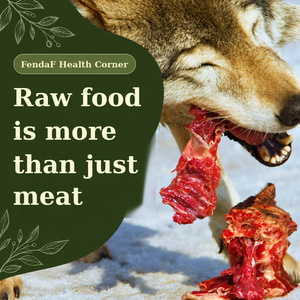
Raw food is more than just meat
Reading time: about 9 min
Some time ago I heard someone say, “We're putting our dog on raw food because it's trendy.” Honestly, I was briefly speechless. I have completed a raw-feeding course and received a certificate. Yet the course that might have turned me into an enthusiastic advocate left me with more questions. Not because raw meat is inherently bad, but because a meat mixture does not become a good, nutritionally complete diet simply by being raw.
I am not saying every dog must eat dry food or that raw feeding is wrong for everyone. My question is much more practical: how do I know my dog really gets everything they need from their food? If we do not know, why should a trend be enough to justify a decision affecting an animal's health for years? Someone else's assurance that “I feed it to my own dog” is not enough for me either.
Raw does not automatically mean balanced
Dogs need protein and essential amino acids, fats and fatty acids, vitamins, minerals, sufficient energy and, of course, water. Meat provides many valuable nutrients, but muscle tissue does not contain everything in the right amounts and proportions. Calcium-to-phosphorus balance is a common concern. Others include iodine, manganese, zinc, vitamins D and E and certain fatty acids. Too much can be as problematic as too little. Rapidly growing puppies are especially sensitive, but long-term imbalance is no good for adults either.
This does not mean raw diets can only be balanced with jars of supplements. Many nutrients can come from thoughtfully selected animal and plant ingredients. Some require more precise calculations or a suitable supplement. But decisions must be based on the whole ration, not one ingredient's reputation. A complete home-prepared diet can use raw or cooked components. Processing method does not replace nutrient calculations.
In Europe, FEDIAF guidelines are among the tools used to assess nutrient requirements for complete feeds. They describe required nutrient levels and help check whether a diet meets a dog's needs. Even a comprehensive spreadsheet remains a prediction: ingredient composition varies and individual requirements can differ. Monitor body weight, muscle condition, stools, skin and overall health, and adjust the diet when necessary.
Why does even a “whole animal” offer no guarantee?
I have previously said that true raw feeding should involve a whole animal: meat, organs, cartilage, skin and other suitable parts. The idea is that prey is more than muscle. Yet feeding whole prey does not automatically guarantee balance. Nutrient content depends on species, the proportions of parts, fat content and what the dog actually eats. Not every part can be offered safely, and bones still bring risks of broken teeth, choking, constipation and intestinal injury.
The 80/10/10 principle, for example 80% meat, 10% organs and 10% bone, is still only an ingredient ratio. It does not tell you how many milligrams of manganese or international units of vitamin D the dog receives. Integrative veterinarian Judy Morgan has emphasised that ratio-based diets may lack iodine, manganese, zinc and some fatty acids and vitamins. This is not an argument against all raw feeding, but for formulating it properly.
What have the dogs coming to me taught me?
Dogs arriving at FendaF include those raw-fed for years, those receiving raw food only partly, and those clearly helped by a diet change. None of these stories is a clinical trial, but they explain why I do not want to recommend feeding through slogans.
Rottweilers with a recurring skin problem
One family's raw-fed Rottweilers repeatedly had yeast-related problems. According to their owner, the problem came under control after switching to Winner Plus dry food. That was a real observation, not proof that raw food caused the yeast problem or dry food cured it. Skin problems can involve allergy, moisture and the skin barrier, another disease or several factors together. Changing an entire diet changes not only processing but also fat content, protein sources, carbohydrates and potential irritants.
A Staffy who no longer wanted raw food
Another customer described a Staffy who suddenly refused raw food. I initially wondered whether something was missing from the diet, although appetite alone could not prove that. The dog ate dry food eagerly, later tried raw again, but developed diarrhoea on it. The specific recipe, fat content, ingredients, quantity or feeding method may not have suited the dog. Illness also needs to be ruled out when appropriate. Still, I find it striking when a mainly raw-fed dog goes wild for dry food. It makes me wonder whether the raw diet really provides everything the dog needs.
Three Jack Russells, one diet
The third story particularly stayed with me. Three Jack Russells ate the same raw food. One had an abnormal urine result, and the vet discussed the diet's protein content among other factors. After some food was replaced with dry and wet food, the owner reported better follow-up results. A second dog initially remained on the same diet and some kidney and liver markers worsened. The third dog's results were normal. These are different measured outcomes, not proof that excessive protein caused all the changes. Urine protein, creatinine and liver enzymes need clinical interpretation alongside water intake, urine concentration, other tests and the dog's condition.
Some dogs are more sensitive than others, and some may tolerate ingredients separately but not together. We do not know exactly why, and cannot turn this into a general rule. It does reinforce the value of watching a dog's actual response even when the ingredient list looks entirely appropriate.
Have the benefits of raw feeding been studied?
Research has examined digestibility, stool characteristics, gut microbial communities and some inflammatory and metabolic markers. A 2025 review describes possible positive changes, including stool quality and microbiome composition. But studies are often small, short or compare diets that differ in many ways. They also examine specific foods: their findings cannot automatically be transferred to every food.
When processing, ingredients, fat content and owner habits all change together, the difference cannot be attributed solely to “raw”. The same caution applies to studies identifying risks. One recipe does not represent every raw diet, just as one dry food does not represent every dry food.
To me, the honest conclusion is that a well-formulated raw diet may suit some dogs, but “natural” or “less processed” alone does not make it better than a good complete feed. Nor is it reasonable to claim another feeding method suits every dog equally well.
Bacteria, bones and safety at home
Raw food also raises a microbiological issue that cannot be ignored. The US Food and Drug Administration tested 196 commercial raw pet-food samples: Salmonella was found in 15 and Listeria monocytogenes in 32. This does not mean every raw food contains pathogens or assess every manufacturer's current batch. It does demonstrate a real contamination risk affecting the dog, the person handling food and other family members. Dry and wet foods are not automatically contamination-free either, although the nature of the risks and processing can differ.
Take particular care in households with young children, pregnant people, older adults or immunocompromised people. Store and thaw raw meat in the refrigerator, use a separate chopping board, clean surfaces, and wash hands and dishes. Freezing does not sterilise food. Bone-related risks depend on size, shape, chewing habits and dental condition: “raw bones are always safe” is not a rule.
My 41-column Excel sheet and why it helped
My raw-feeding course provided a spreadsheet tracking 41 separate nutrient measures or calculation lines. What I liked was that it made the diet visible. Instead of “it looks right”, the question became whether nutrient amounts and ratios added up. The sheet itself is no clinical guarantee, because input data, requirements and bioavailability vary. Still, it is a substantial step beyond blindly rotating ingredients.

Published recipes also deserve caution. Stockman and colleagues' 2013 analysis found nutrient deficiencies in many home-prepared recipes examined. The study covered homemade dog-food recipes, not a random sample of every commercial raw product. It therefore does not prove all raw foods are deficient, but does show that “the recipe is online” is insufficient nutritional quality control.
Why can a deficiency remain unnoticed for a long time?
I have previously illustrated this with a story about Faddu. During a cold-weather walk he once rubbed his scrotal area raw until it bled. I contacted the vet, who thought it could be very painful and recommended local care. Faddu himself showed almost no interest in the area. That does not prove dogs generally have a higher pain threshold, but reminds us that behaviour does not always reveal precisely how a dog feels. The same caution applies to nutrient deficiencies. Some develop quietly and early signs may not be visible.
An ordinary annual blood test does not measure every nutrient reserve either. Nutritional risk is assessed alongside the actual diet, body condition, medical history and targeted tests where needed. I do not want us to start looking only after a late health problem for a cause that diet formulation might have prevented.
Does every bowl have to be balanced?
We need not pit two extremes against each other. Some nutrients in a healthy adult dog's diet can be assessed over several days to a week, while energy, water and certain essential nutrients need ongoing provision. Judy Morgan describes this as “balance over time” for healthy adults, stressing that it is unsuitable for growing or sick animals. This is an integrative veterinarian's practical framework, not evidence that randomly changing raw foods makes a diet balance itself within a week.
If I chose a fully home-prepared diet for a dog, I would favour precise formulation and periodic review with a veterinary nutrition specialist. Especially for a dog with kidney, liver or gastrointestinal disease, one that is growing, or one taking medication that changes nutritional requirements.
If you want to add some raw food
A small amount of suitable fresh food does not require rebuilding the entire diet. If the main feed is complete, account for extras primarily by energy: a “small extra” that grows can dilute a balanced ration and quietly add calories. A common practical guide is to keep unbalanced extras to about a tenth of daily calories. Integrative veterinarians have raised that limit to 25%, but this is not a universal threshold for every animal. Such a guideline can nevertheless help stop extras from unknowingly displacing important nutrients. Seek individual advice for major diet changes and chronic illness.
I do not support ideological battles over food. I have seen dogs do well on different diets and others improve after changing in the opposite direction. Feeding good-quality dry food does not make you a bad owner. Choosing a carefully considered raw diet does not automatically mean you are doing something dangerous. But please do not choose a feeding method for years of your dog's life simply by what looks prettiest on Instagram.
Sources
- FEDIAF. Nutritional Guidelines for Complete and Complementary Pet Food for Cats and Dogs, 2025.
- Stockman J, Fascetti AJ, Kass PH, Larsen JA. Evaluation of recipes of home-prepared maintenance diets for dogs. JAVMA. 2013;242:1500–1505. PMID 23683013.
- Lyu Y, Wu C, Li L, Pu J. Current Evidence on Raw Meat Diets in Pets: A Natural Symbol, but a Nutritional Controversy. Animals. 2025;15:293. DOI 10.3390/ani15030293.
- Tufarelli V, Bozzo G. Raw meat based diets for dogs and their nutritional and One Health implications. Discover Animals. 2026;3:84.
- FDA Center for Veterinary Medicine. Get the Facts! Raw Pet Food Diets can be Dangerous to You and Your Pet. FDA contamination study.
- Morgan J. Balance Over Time for Dogs. Dr Judy Morgan’s Naturally Healthy Pets. 2025. Integrative veterinary perspective.
🐾 FendaF believes in informed choices
The purpose of the FendaF blog is not to tell you what you must do. Our aim is to share knowledge, introduce different evidence-based and integrative perspectives, and help you make more informed decisions for your pet.
Every animal is unique, and no article can replace a consultation, diagnosis or treatment provided by a veterinarian. If your pet has a health concern or you need individual advice, always contact a veterinarian.








Leave a Reply