


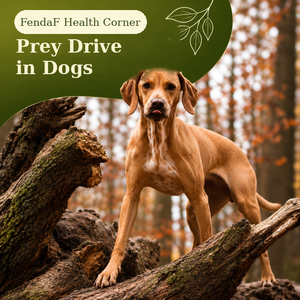
Prey drive in dogs: why they chase and how to keep them safe
Reading time: about 6 min
“But mine isn’t a hunting dog.” I sometimes hear that when someone describes a dog disappearing into the woods after an animal’s scent. A breed label does not decide on its own whether a moving animal or a fresh trail will set a dog in motion. Irene and I each have a dog with an exceptionally strong urge to chase: mine is Faddy and hers is Fenton. And no, a German Shepherd is not a typical hunting breed. Faddy has never considered that a particularly convincing argument.
Prey drive does not always mean a dog wants to kill an animal. It encompasses parts of a behavioural sequence that have been emphasised differently through domestication and selective breeding. For one dog, searching for a scent is the most rewarding part. Another loves stalking, chasing or carrying something in its mouth. Understanding that difference helps us provide suitable activities and, above all, protect dogs and other animals.
What do we mean by prey drive?
Predatory behaviour is often described as a sequence: searching or noticing, orienting and fixing attention, stalking, chasing, grabbing, shaking or delivering a killing bite, and eating. Not every dog expresses every stage. A dog’s passion for chasing does not automatically mean it will go on to the final stages.
Herding, retrieving objects and some kinds of play can draw on elements of the same behavioural sequence while serving a very different purpose.
Sighthounds have been bred to notice and pursue moving prey with their eyes. Retrievers have been selected for finding and bringing back game. Some terriers show a pronounced tendency to grab and shake. Herding dogs also use elements of predatory motor patterns to influence movement, but that is not the same as attacking a prey animal.
These are tendencies at breed level, not reliable predictions about an individual dog. That is why I do not consider a ranking that assumes every Husky or Malamute will always have a stronger prey drive than every dog of another breed particularly useful. Genetics matters, but so do temperament, previous experiences, the environment and whatever the dog is seeing or smelling right now.
How can you tell that your dog is switching into pursuit mode?
Owners often notice only the moment their dog takes off. Earlier signals may be quite subtle: the dog freezes, turns its head or ears in one direction, fixes its gaze, leans forward or changes its breathing or pace.
For a scent-driven dog, exactly the same change may begin with the nose. The dog has not seen the animal, but a suddenly fascinating scent on the ground or in the air makes everything else fade into the background.
Faddy can catch a scent and become completely absorbed in it in the blink of an eye. At that point he no longer hears me. Oscar, or Ossu, can notice a trail too, but he responds to my recall much more readily. Those are differences between my two dogs, not evidence about all German Shepherds.
Once a dog is already chasing at full speed, recalling it becomes much harder than getting its attention at the first sign of interest. This is why learning to recognise early signals and rewarding a turn towards the owner is often more useful than trying to shout over a chase that is already under way.
Can prey drive be trained away?
Dogs can learn cues and self-control, but it may not be realistic to eliminate a strong instinct completely. Dogs Trust explains that chasing can be managed and redirected through training, yet dogs with a powerful tendency to pursue may still need ongoing safety measures.
That distinction matters. Success does not necessarily mean that a dog will never again be interested in wildlife. It may mean that we can prevent dangerous situations and help the dog work with us.
Training can include a consistent recall cue, a signal to stop or turn towards the owner, and rewards that are genuinely valuable to that particular dog. Start in an easy, quiet environment and introduce distractions gradually. The fact that a dog comes running for a treat in the kitchen does not prove it will respond beside a running deer. Letting it off the lead in the woods is not a sensible way to find out.
Punishing a dog for having a natural reaction does not automatically teach it a safe alternative. Managing access to triggers, reinforcing the behaviour we want and offering acceptable activities are more helpful. When chasing is repeatedly dangerous, an experienced, humane dog trainer can help develop an individual plan.
Safety: a long line can offer more freedom than being off lead
We use long lines of about 5–6 metres. They allow the dogs to sniff, move and choose a route without being able to disappear after the next unexpected scent. A long line is not punishment. Used correctly, it can provide greater freedom to explore than a short lead.
Equipment matters. Attach a long line to a well-fitting harness rather than a collar: an abrupt stop after several metres of running can injure the neck. Keep control of the line, never wind it around your hand and do not let a dog accelerate to full speed before the line suddenly comes tight. Shorten it near roads and other people.
Safe off-lead exercise requires a genuinely secure place, such as a properly fenced area where neither your dog nor anyone else can be put at risk. A GPS tracker may help locate a missing dog, but it does not prevent an accident. I learned that the frightening way.
Why I no longer let Faddy loose in the forest lightly
When Faddy was younger, he once ran into the woods following a scent and came back only about twenty minutes later. He was wearing a GPS tracker. That did not make the experience less stressful; in some ways it was worse, because I could see him getting closer and closer to a major road.
A dog focused on a trail does not necessarily stop to consider a road, a steep ditch or a branch that could cause an injury.
I do not want to go through that again. So Faddy’s woodland walks are now generally on a lead, and I do not see that as giving him a poorer life. He can still move, run with me, sniff and enjoy things he genuinely loves. My choice need not be every owner’s choice, but the risks should be considered honestly before giving a dog that kind of freedom.
How can we give the instinct an acceptable outlet?
Scent work, tracking exercises, hidden treats, search games, tug and appropriate retrieving games can engage natural abilities without chasing wildlife.
For an athletic dog, lure coursing or another controlled activity with an artificial lure may also be suitable. However, intense chasing games leave some dogs overstimulated, so watch whether the dog can end the activity and settle afterwards.
Not every dog needs the same game. For a dog that loves using its nose, a calm scent trail may be more satisfying than a hundred ball throws. For a dog inclined to rush after a moving animal, begin by practising a turn towards the owner at a safe distance from the trigger. Avoid repeatedly setting exercises that are simply too difficult.
Write down what triggers your dog: an interesting scent, a running animal, a bicycle or a flying bird. Learn to notice the first moment of fixation and calmly ask for attention then. Practise recall first in a secure place, with a reward your dog truly values. If the response is unreliable around distractions, use a long line attached to a well-fitting harness and shorten it near roads. Offer appropriate sniffing and play activities. If chasing is repeatedly dangerous, reduce exposure and work with a qualified trainer.
In conclusion
Prey drive does not make a dog bad, and it does not make its owner a bad trainer. It is part of the dog’s behavioural inheritance, expressed differently from one individual to another. Our responsibility is to make room for those abilities without putting anyone at risk.
I do not think every dog needs to run off lead on every walk. Sometimes a long line, a good sniffing route and getting home safely are the much bigger victory.
If a dog does go missing in the woods, it helps to respond thoughtfully. Our earlier FendaF article about a dog entering survival mode (in Estonian) explores why a lost dog’s behaviour may differ from its behaviour at home.
Sources
- Dogs Trust. How to stop your dog chasing cars, bikes and animals.
- Dr Karen Becker (2023). Prey Drive in Dogs. Bark & Whiskers.
- FendaF Tervisenurk. Ellujäämisrežiimil koer.
🐾 FendaF believes in informed choices
The purpose of the FendaF blog is not to tell you what you must do. Our aim is to share knowledge, introduce different evidence-based and integrative perspectives, and help you make more informed decisions for your pet.
Every animal is unique, and no article can replace a consultation, diagnosis or treatment provided by a veterinarian. If your pet has a health concern or you need individual advice, always contact a veterinarian.










Leave a Reply