


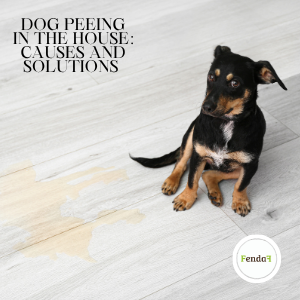
Dog peeing in the house: why it happens and what to do
Reading time: about 5 min
When a puppy pees in the house, there is usually nothing mysterious about it. They are still learning when and where to go, and how long they can hold it. But if an adult dog who has been reliably house-trained for years suddenly starts peeing indoors, that is a different situation.
In that case, I would not start with the question “why is my dog doing this?” I would start with: “is their body trying to tell me something?”
Peeing in the house is not always a behavior problem. Possible causes include cystitis, a urinary tract infection, bladder stones, kidney disease, diabetes, Cushing’s disease, urinary incontinence, pain, or medication that increases thirst and urine production. In older dogs, mobility problems or cognitive changes may also play a role. So if a previously house-trained dog suddenly changes their habits, a health problem should always be ruled out first. Cystitis is one possible example.
First, look at what kind of urination you are dealing with
Not every puddle on the floor tells the same story.
If your dog leaves a larger puddle, it may simply have been too long since the last toilet break, or they may have developed a greater need to urinate than usual. If this starts happening in a dog who did not have the problem before, pay particular attention to whether they are drinking more, asking to go out more often, or urinating small amounts at a time.
Urine marking often looks different. A dog leaves smaller amounts of urine in specific places or on certain objects. Both males and females can mark, whether intact, spayed, or neutered. Marking is one form of scent communication, and it can be intensified by a new animal or person in the home, unfamiliar smells, anxiety, or other environmental changes.
Then there is urination during greetings. Some dogs leak a little urine when they are extremely excited. Others do it when a situation creates both a desire to interact and a sense of uncertainty. This is often called excitement or submissive urination, but the important thing to understand is that the dog is not doing it on purpose. Scolding only adds another layer of stress to an already emotional situation.
When the cause is medical
Sometimes a puddle on the floor is the first clue that something has changed with your dog’s health.
Bladder and urinary tract problems can cause frequent urination or pain. Kidney disease, diabetes, and Cushing’s disease may increase thirst and urine production. A dog in pain, or one with mobility problems, may simply no longer reach the door quickly enough. In an older dog, age-related changes in the brain can also affect previously reliable toilet habits.
That is why there is little point in trying to “retrain” a dog who has always been house-trained before a medical cause has been ruled out.
When the cause is behavior or the environment
Sometimes the problem is not the bladder, but what is happening around the dog.
A dog may not yet understand that the same house-training rule applies in every room and every situation. They may have too few opportunities to go outside, or their daily routine may have changed. Some dogs start urinating indoors when they are frightened, anxious, or frustrated. Changes at home can also play a role.
Here it is more useful to look for a pattern than for someone to blame. When does it happen? When the dog is left alone? When visitors arrive? In one particular room? At night? After drinking more water than usual? Immediately during greetings?
A pattern can tell you far more than one isolated puddle.
How can you help your dog?
Punishment does not teach a dog where they should pee. At worst, it teaches them that urinating in front of their owner is dangerous. That is why a reward-based approach makes far more sense for house-training.
Give your dog enough opportunities to go outside and reward outdoor urination as soon as they have finished. If accidents keep happening in the same places, clean those areas thoroughly because lingering urine odor can attract the dog back to the same spot. Enzyme-based cleaners are generally more effective for this than ordinary surface cleaning.
If marking is the problem, you can temporarily limit access to favorite marking spots and redirect the dog before the leg comes up. A belly band for male dogs may protect furniture, but it does not treat the reason for the marking. A wet band should be changed promptly because prolonged skin contact with urine can cause irritation.
The most important tools are still rather unexciting: consistency, plenty of opportunities to get it right, and reinforcing the behavior you want. But those are the things that work.
Our “piss-piss-piss”
There is one piece of advice I still give puppy owners because I used it myself with Ossu: teach your dog a toilet cue. Irene and I have actually used this with all of our dogs. Pekwa, Faddy, Fenton, and now Süsi have all grown up with the same training.
Our cue was the wonderfully imaginative “piss-piss-piss”. Within a week or two, Oscar had started connecting the words with the action, and even on a nighttime toilet trip he understood why we were standing outside.
It may sound like a tiny detail, but later it can be surprisingly useful. When you are travelling, at a dog show, or about to start a long car journey, you may not have half an hour to wait while your dog searches for the universe’s most perfect blade of grass.
When should you definitely check your dog’s health?
If a previously house-trained dog suddenly starts peeing indoors, urinates very frequently or only in small amounts, strains to urinate, has blood in the urine, drinks noticeably more, leaks urine while sleeping, or develops pain, lethargy, or another new symptom, I would not treat it as a training problem first.
A puddle on the floor can be annoying. But sometimes it is simply a very direct health message.
Sources:
- VCA Animal Hospitals – Dog Behavior Problems: House Soiling
- VCA Animal Hospitals – Submissive, Excitement, and Conflict Urination
- VCA Animal Hospitals – Marking Behavior
- VCA Animal Hospitals – Testing for Inappropriate Urination
🐾 FendaF believes in informed choices
The purpose of the FendaF blog is not to tell you what you must do. Our aim is to share knowledge, introduce different evidence-based and integrative perspectives, and help you make more informed decisions for your pet.
Every animal is unique, and no article can replace a consultation, diagnosis or treatment provided by a veterinarian. If your pet has a health concern or you need individual advice, always contact a veterinarian.










Leave a Reply