


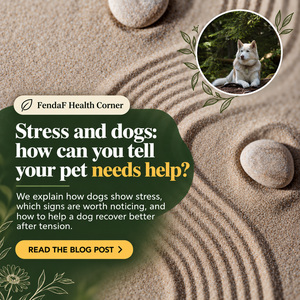
Stress and dogs: how can you tell your pet needs help?
Reading time: about 6 min
Eva Selhub’s book on stress management made me think about how dogs experience stress. We often associate stress only with fear, but excitement, change, too little rest and frustration can also put a strain on a dog. For me, the question is not how to remove all stress from life, but how to recognise when the effort of adapting begins to cost a dog too much.
I have learned that recognising stress starts with knowing your own dog. Some dogs show tension very clearly; others become quieter, withdraw or seem unusually obedient. A single yawn or lick of the lips does not tell the whole story. What matters is the situation, the combination of signs and how quickly the dog recovers afterwards.
Stress is not always bad
A short stress response helps the body adapt: the heart beats faster, attention sharpens and muscles prepare for action. That can be entirely appropriate. Trouble begins when a dog remains constantly on alert, cannot move away from an uncomfortable situation or does not get enough time to recover between events.
Even pleasant experiences can add to the load. Visitors, a long outing, new smells and a lively training session may all be enjoyable, yet still leave a dog tired. An older dog, a dog in pain or one recovering from illness may reach their limit sooner than a young, healthy dog.
How do dogs show stress?
Faddu has some very recognisable signs: jumping up against me, barely noticeable trembling, ears pulled back close to the head, whining in a particular tone and long, intense yawns. With Ossu, I have to pay more attention to the whole picture. One dog’s signals are not a universal dictionary for every dog.
Possible signs include pacing, panting without heat or recent exercise, licking the lips, drooling, turning the head away, avoiding eye contact, sniffing the ground, freezing, tucking the tail, hiding or trying to leave. You may see more of the whites of the eyes, or hear changes in the pitch and frequency of whining or barking.
None of these signs is a diagnosis on its own. A dog may pant because they are hot, yawn because they are tired and lick their lips because they expect food. I look for changes from that dog’s usual behaviour and for several signs appearing together in a particular situation.
Faddu, for example, likes going to the vet, yet starts shedding an astonishing amount as soon as we enter the clinic. That reminds me that enthusiasm and a physiological stress response can coexist. I would not automatically blame seasonal shedding or grooming when the change is so clearly linked to one place. Shedding alone, however, cannot tell us whether the arousal is pleasant or unpleasant.
First ask: what changed?
Before reaching for a calming product, I would review recent changes: a different daily routine, a new family member, a move, building work, less sleep or a change in exercise. Sometimes several small demands accumulate rather than one dramatic event causing the problem.
Pain and illness matter too. Dental trouble, sore ears, digestive discomfort, joint pain or declining hearing and eyesight can all change how secure a dog feels. Sudden restlessness, irritability or withdrawal deserves a veterinary assessment rather than an automatic label of “stress”.
A short diary can be surprisingly useful. Note what happened, how your dog responded and how long recovery took. “He cannot cope with other dogs” is less useful than “after a close encounter in this narrow street, he pants and cannot settle for half an hour”. Also consider what happened earlier that day.
What actually helps?
I would start with the environment rather than a product. Increase distance from the trigger, offer a quiet place to retreat and give the dog choices wherever possible. A dog who can step away often copes better than one who has to endure the situation until we decide it is over.
Comforting a frightened dog does not automatically teach them to be afraid. If your dog seeks contact and finds it reassuring, you can offer it. If they prefer space, respect that. A worried dog should not have to earn reassurance by sitting or performing another command first.
For recurring fears, gradual desensitisation and counterconditioning can help: keep the experience below the level at which the dog becomes overwhelmed and build positive associations. Panic, aggression or severe separation distress calls for a reward-based behaviour professional working with a veterinarian.
Movement, sniffing, chewing, predictable routines and sufficient sleep all have a place. But more vigorous exercise is not always the answer. A dog who is already overtired or constantly stimulated may need fewer demands and better recovery, not another intense ball session.
Can nutrition and integrative support make a difference?
The gut–brain axis is a real area of research, and links between the microbiome, stress and behaviour are being studied in dogs. This does not mean that every anxious dog needs a probiotic or that one supplement treats the cause. L-theanine, alpha-casozepine and specific probiotic strains have been studied, but the evidence depends on the product, dose and situation. Results cannot simply be transferred to every product with a similar label.
For me, an integrative approach means considering sleep, movement, pain, nutrition, the environment and a sense of safety together. I would not automatically start with a calming product, but neither would I dismiss nutrition or appropriate supportive options. Their safety, evidence and suitability for the individual dog still need examining.
Medication can also be necessary and helpful; using it is not a failure. Discuss supplements and other products with the veterinarian, because “natural” does not rule out side effects or interactions. This includes essential oils and products marketed as gentle calming support.
When should you speak to a veterinarian?
Seek advice when behaviour changes suddenly or is accompanied by pain, digestive problems, disturbed sleep or other changes in health. If a dog panics when left alone, injures themselves or repeatedly fails to recover after stressful situations, I would not wait for the problem to resolve by itself.
The aim is not to make every dog behave in the same way. It is to understand what this particular dog is communicating and what would help them feel safer and recover better. The owner’s observations are an important part of that work.
FendaF’s practical suggestion. Over one week, choose three situations in which your dog usually becomes more alert: preparations for leaving home, a car journey or meeting an unfamiliar dog, for example. Notice the ears, posture, breathing and recovery time. If the number of signs increases, first change the distance or duration of the situation. If behaviour changed suddenly or pain is present, start with the veterinarian.
If you use food rewards in training, it is also worth understanding the ingredients in soft dog treats.
Sources
VCA Animal Hospitals. Signs Your Dog is Stressed and How to Relieve It.
American Veterinary Society of Animal Behavior. Position Statements: Humane Dog Training.
Merck Veterinary Manual. Prognosis of Behavior Problems in Animals.
Dietary Strategies for Relieving Stress in Pet Dogs and Cats (2023).
Eva Selhub. Stressijuhtimise käsiraamat (the book that prompted the original discussion).
🐾 FendaF believes in informed choices
The purpose of the FendaF blog is not to tell you what you must do. Our aim is to share knowledge, introduce different evidence-based and integrative perspectives, and help you make more informed decisions for your pet.
Every animal is unique, and no article can replace a consultation, diagnosis or treatment provided by a veterinarian. If your pet has a health concern or you need individual advice, always contact a veterinarian.








Leave a Reply