


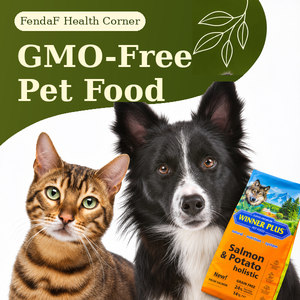
GMO-free pet food: meaningful promise or just a slogan?
Reading time: about 3 min
When a pet food package or manufacturer’s website says “GMO-free”, what does that actually mean to a customer? Has the manufacturer tested its ingredients in a laboratory? Is there independent certification? Or is the claim based on a supplier’s assurance that its raw materials are non-GMO?
And what should customers think if the familiar GMO-free statement suddenly disappears from the packaging? Has the recipe or its quality changed, or has the manufacturer changed what it is willing and able to formally substantiate?
These questions are not nearly as simple as they first appear.
The use and labelling of genetically modified feed are regulated in the European Union. However, a manufacturer’s voluntary GMO-free claim does not automatically mean the product is independently certified or that every production batch has been laboratory-tested.
Equally, a lack of independent certification does not automatically make the claim unfounded. Manufacturers can support a non-GMO claim with documentation of ingredient origin, supplier declarations, manufacturing controls and, where appropriate, laboratory analysis.
The crucial question is not simply whether “GMO-free” appears on the packaging, but what evidence supports it and how the manufacturer can demonstrate that evidence.
What does GMO-free actually mean?
A genetically modified organism (GMO) is an organism whose genetic material has been changed in a way that does not occur through conventional crossing or natural recombination.
The EU regulates the use and labelling of genetically modified food and feed. In general, feed that contains genetically modified ingredients, or is produced from them, must be labelled accordingly.
An exception applies where genetically modified material accounts for no more than 0.9% of the relevant ingredient and its presence is accidental or technically unavoidable. Importantly, this is a threshold for mandatory GMO labelling, not automatic proof that the product is GMO-free.
There is no single separate EU-wide standard that applies identically to every voluntary GMO-free claim. That does not mean manufacturers may say anything they like: claims about feed must be truthful, understandable and capable of substantiation where necessary.
Does excluding maize and soy make a food GMO-free?
No.
Maize and soy are among the world’s major genetically modified crops. Genetically modified varieties are also grown in crops such as rapeseed and sugar beet. But that does not mean every maize-, soy- or rapeseed-based ingredient is genetically modified.
Nor can we assume that a food is GMO-free simply because it contains none of those ingredients. All relevant raw materials and their origins need to be considered.
Take maize, for example. One manufacturer may exclude it entirely. Another may use maize backed by a supplier’s declaration that it comes from a non-GM crop. These are different sourcing approaches, but maize’s presence or absence alone cannot establish the GMO status of the whole food.
An ingredient list tells us what a food contains. It does not always tell us how those ingredients were grown or verified.
How can a manufacturer substantiate a GMO-free claim?
If you want to know what lies behind a manufacturer’s GMO-free promise, ask some more specific questions.
FendaF’s practical checklist: the GMO-free claim
- Does the manufacturer merely avoid certain ingredients, or does it also check the origin of the ingredients it uses?
- Are suppliers required to provide written declarations of GMO status?
- Does the manufacturer use laboratory analysis where needed, and how does it decide which ingredients or batches to test?
- Are all relevant ingredients covered, and can the manufacturer trace their origins?
Laboratory testing is one way to detect genetically modified material, but it is not always sufficient on its own. In some heavily processed ingredients, DNA may no longer be detectable in a suitable form. Supplier records, traceability and manufacturing controls therefore matter too.
The more precisely a manufacturer explains its processes, the better customers can assess the strength of its GMO-free claim.
Does a food safety certificate prove a product is GMO-free?
These are two different things.
ISO 22000 is a food safety management system standard designed to help businesses identify and control food safety hazards. The FSSC 22000 certification scheme adds further requirements to a food safety management system.
These are important indicators of food safety management, but they do not, on their own, certify that a particular product is GMO-free. That requires information about how the company checks this specific characteristic.
GMO-free is not the same as glyphosate-free
Another important distinction concerns glyphosate, a herbicide used in agriculture.
Some genetically modified crops have been developed to tolerate particular herbicides. However, glyphosate is also used in the cultivation of non-genetically modified crops.
A GMO-free label therefore does not, by itself, establish that ingredients are free from pesticide residues. These are separate questions requiring different evidence.
We discuss GMOs, glyphosate and potential health risks in more detail in our article “GMOs: carcinogenic to pets?” Read more.
What about Winner Plus foods?
We have first-hand experience of this issue with Winner Plus.
Earlier packaging stated that the food was produced without genetically modified raw materials. At some point that statement disappeared, while other claims about the product remained.
We noticed the change and asked the manufacturer directly whether the recipe, sourcing practices or quality principles had changed.
The manufacturer assured us that its established principles were unchanged. What had changed was the production location, namely the manufacturing plant.
According to the manufacturer’s explanation, removing the GMO-free statement was therefore not linked to a decision to start using genetically modified ingredients. We still do not know the exact reason why the wording was removed.
Winner Plus also states on its official website that it does not add genetically modified raw materials to its foods. This is a public statement from the manufacturer, not in itself proof that every batch has undergone independent laboratory testing.
It is important to distinguish a manufacturer’s assurance from independently verified GMO-free status. The explanation we received concerned continuity of production principles; it does not mean we possess laboratory reports for every batch or an independent GMO-free certificate.
At FendaF, we consider it essential to be able to ask the manufacturer questions when something changes on a package or in product information. We believe customers deserve the information we actually have, with a clear distinction between a manufacturer’s assurances and independent test results.
Does GMO-free automatically mean better food?
Not necessarily.
GMO-free describes one attribute of an ingredient. It does not provide a complete picture of a food’s nutritional value, balance, digestibility or suitability for an individual pet.
Nor does the label alone prove that the food is healthier or that any genetically modified ingredient would necessarily harm a pet.
That does not make ingredient origin or production methods unimportant. Quite the opposite: thoughtful decisions require the bigger picture, including the recipe, ingredient quality, the manufacturer’s controls and how well the food suits our animals.
Our advice is simple: do not stop at the claim printed on the bag. Ask for more information when needed and look at what the manufacturer actually does to support its promises.
A good decision comes from reliable information, not the largest words on the package.
Sources
European Commission: GMO traceability and labelling
Regulation (EC) No 1829/2003: genetically modified food and feed, Article 24
Regulation (EC) No 767/2009: feed marketing and claims
ISO 22000:2018 food safety management
Winner Plus: philosophy and ingredient sourcing
🐾 FendaF believes in informed choices
The purpose of the FendaF blog is not to tell you what you must do. Our aim is to share knowledge, introduce different evidence-based and integrative perspectives, and help you make more informed decisions for your pet.
Every animal is unique, and no article can replace a consultation, diagnosis or treatment provided by a veterinarian. If your pet has a health concern or you need individual advice, always contact a veterinarian.




Leave a Reply