


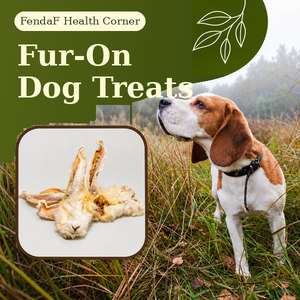
Furry dog chews: natural treats with more benefits than you might expect
Reading time: about 6 min
When we first introduced furry beef ears, rabbit ears and deer legs to the FendaF range, customers weren’t always enthusiastic. More than one person exclaimed, “Yuck!” I can understand that. To human eyes, an ear still covered in fur looks quite different from a neatly packaged, bone-shaped chew. But removing the hair does not make a beef ear any less part of an animal. And dogs don’t have the same emotional reaction to fur that people do. :)
One question has always intrigued me: if fur doesn’t digest like meat, what might it do as it passes through a dog’s digestive tract? In nature, predators often consume prey with its skin and fur. So perhaps we should see furry chews as more than an odd-looking snack.
What does a dog get from a furry chew?
A furry ear or other animal-based chew offers smell, taste and an opportunity to gnaw. For many dogs, chewing is a pleasurable, natural activity. Hair consists mainly of keratin, a strong structural protein that is harder to break down than muscle protein. That is what makes its potential role interesting: alongside the enjoyment of chewing, hair may function to some extent as animal-derived fibre. Of course, the nutritional value of the treat as a whole depends on much more than the hair alone.
Integrative veterinarians and advocates of natural feeding describe fur as animal fibre that may also have a mechanical effect, supporting the passage of intestinal contents. The idea has a biological basis. Hair keratin resists digestion, and a 2020 study found that the chemical structure of hair that had passed through a jackal’s digestive tract remained largely unchanged. That gives us a reason to investigate what hair might do as it moves through the gut.
The intestinal wall is covered by a protective mucus layer that is constantly renewed. Microorganisms live in its outer regions, where particles of intestinal contents also come into contact with mucus. It is therefore an interesting possibility that hard-to-digest hair influences the movement of intestinal contents and helps naturally shed loose mucus and associated material. This particular mechanism has not yet been measured directly in dogs. But that is not evidence that the effect is impossible. We must distinguish the normal protective mucus layer from material that the body is already shedding.
A study of cheetahs offers another reason to pay attention to animal fibre. Compared with a meat-based diet, cheetahs eating whole rabbits produced faeces containing lower levels of certain compounds associated with microbial protein breakdown, including indole and phenol. Researchers suggested that difficult-to-digest animal tissues may have a fibre-like effect. The study could not isolate the contribution of fur from the rest of the prey, but it illustrates why the indigestible parts of a whole animal deserve study.
I have also spoken about fur’s possible intestinal “cleaning” effect and its potential to support digestion. I would put that more precisely this way: if hair helps move intestinal contents and loose material along, it may support the gut’s normal functioning. A healthy intestinal lining is essential for nutrient absorption and immune health. Whether furry chews directly improve nutrient absorption in dogs has not been adequately studied. The possible mechanism is still worth exploring without suggesting that one chew solves every digestive problem.
Could furry chews help with parasites?
It is sometimes suggested that fur moving through the intestines could carry parasites or their eggs along with it. That mechanical possibility raises questions worth researching. At present, however, good clinical evidence that furry ears act as a deworming treatment is lacking. A chew therefore cannot be considered a replacement for parasite control.
Parasite prevention should be guided by the dog’s actual exposure risk, faecal testing where appropriate and veterinary treatment when needed. Furry treats can still be part of a varied diet. These approaches are not mutually exclusive.
Chewing enjoyment, teeth and digestion
Chewing a furry treat gives a dog something enjoyable to do and may mechanically remove soft food residue from tooth surfaces. Fur can also change the surface texture of certain chews, making the furry version softer than the same product without fur. The actual hardness depends on the product and drying process. A chew does not have to carry an official dental-care claim to provide a satisfying chewing experience.
Because hair is relatively resistant to digestion, it may also influence stool volume and consistency. When stool has a suitable firmness, it can support the natural emptying of the anal sacs. The effect depends on the dog, the amount eaten and the rest of its diet. Watching your own dog’s response is the best way to learn which chew suits them.
How should you offer furry chews?
Choose a furry ear, leg or other chew that suits your dog’s size and chewing habits. Some dogs nibble slowly; others are inclined to swallow large pieces. Fur alone does not tell you whether a chew is hard or soft. A furry ear, for example, may be softer than its hairless equivalent. As with all animal chews, ingredient quality, drying and storage matter.
Offer a smaller portion the first time and observe how your dog’s digestion responds. Stay nearby while your dog chews, especially if they tend to gulp large pieces. That way chewing remains an enjoyable activity rather than an anxious inspection exercise.
FendaF’s practical advice
- Choose a chew suitable for your dog’s size and chewing style; take care if they swallow large pieces.
- Start with a small amount and observe digestion and wellbeing over the following days.
- Supervise chewing and remove any small leftover piece that could be swallowed whole.
- Count the treat’s calories towards daily intake. A common guideline is to keep treats to no more than around 10% of daily energy alongside a complete diet.
- Do not use a furry chew instead of toothbrushing, appropriate faecal testing or justified parasite treatment.
Could “yuck” turn into “more, please”?
To me, furry chews are a worthwhile and fascinating part of a dog’s treat selection. They offer natural chewing activity, and their hard-to-digest hair may play a role similar to animal fibre in the gut. Research in this field is still at an early stage, but that does not make possible benefits disappear. I like the idea of looking at a furry ear through a dog’s eyes rather than a human’s.
If your dog enjoys furry chews and tolerates them well, there is no reason to dismiss them because of their appearance. Choose a quality product, consider the way your dog chews and pay attention to their wellbeing. Who knows, one day the person saying “yuck!” may become the biggest fan of furry ears. :)
Sources
FEDIAF: dog chews and treats, safety and serving size
WSAVA Nutrition Committee (2024). Feeding treats to your dog.
ESCCAP. Guideline GL1: Worm Control in Dogs and Cats.
Tintner et al. (2020). Molecular Recalcitrance of Hair Passing the Digestive System of a Canid.
🐾 FendaF believes in informed choices
The purpose of the FendaF blog is not to tell you what you must do. Our aim is to share knowledge, introduce different evidence-based and integrative perspectives, and help you make more informed decisions for your pet.
Every animal is unique, and no article can replace a consultation, diagnosis or treatment provided by a veterinarian. If your pet has a health concern or you need individual advice, always contact a veterinarian.


Leave a Reply