


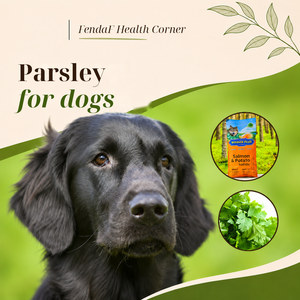
Can dogs eat parsley? Benefits and precautions
Reading time: about 6 min
I first began writing in more detail about parsley because of two customers' dogs. The first had blood in its urine, a higher-than-usual urine pH and, according to its owner, a small amount of struvite stones. The owner was worried about having to change the dog's existing food. The dog still eats Winner Plus, and no new problems had been reported to us.
The second story involved a senior Jack Russell that had started urinating indoors while its owner was away. The owner had added a little food intended for urinary problems to the existing diet. When asked about an alternative from our range, I recommended a holistic food containing parsley. Later, the owner reported that the indoor urination had stopped on this food and that the special food was no longer being added.
These two experiences are worth keeping. But they do not yet answer whether parsley caused the improvement. We do not have the complete medical histories, urine culture results, stone composition analyses or descriptions of every change made at the same time. Parsley may be an interesting plant ingredient, but we cannot promise that it treats a dog's urinary tract infection or dissolves struvite stones.
For a quick answer: parsley's role in food can be discussed, but bloody urine needs veterinary assessment. Repeated straining without passing urine is an emergency. Below, we explain where claims about parsley's benefits come from and which remain unresolved in dogs.
What parsley adds to food
Parsley contains chlorophyll, vitamin K, carotenoids, vitamin C and minerals. The herb is also interesting for its polyphenols, including apigenin and myricetin. This gives reason to investigate its use in food and herbal medicine. However, when considering a nutrient's benefits, we must look at the amount actually eaten: a small herbal addition is not the same as a large serving of vegetables or a standardised extract.
“Contains vitamins” and “treats disease” are also different claims. A handful of parsley cannot replace building a nutritionally adequate main diet for a dog, and a small amount of herb in a complete food does not establish a therapeutic effect. My interest in parsley remains, but I would now ask more precise questions.
There is real research behind the diuretic effect
In herbal medicine, parsley is used, among other things, to support urine output. In a 2002 experiment by Kreydiyyeh and Usta, an aqueous parsley seed extract increased urine output in rats; the authors also investigated its effect on renal ion transport. This is a specific mechanistic finding, rather than merely a traditional belief.
However, the experiment used rats and seed extract. Our customers' dogs ate a prepared food containing parsley. Leaves, roots, seeds, tea, tincture and essential oil produce exposures with different compositions and concentrations. A result for one form cannot be turned into a treatment promise for another. In particular, it does not mean we should give dogs seeds ourselves to obtain a diuretic effect.
Diluting urine and providing enough fluid are meaningful issues for urinary health. Increased urination does not, however, prove that a bacterial bladder infection has cleared or that stones have dissolved. These outcomes need to be assessed with their own measures.
Urinary infection and struvite are not one problem
In dogs, struvite stones are often associated with urinary tract infection caused by urease-producing bacteria. In that situation, identifying and treating the infection is central both to dissolution and to preventing recurrence. Higher pH or crystals in urine alone do not give the whole diagnosis; crystals are not automatically the same as stones either.
The ACVIM treatment consensus recommends medical dissolution for suitable struvite stones, including appropriate nutrition and treatment of infection where present. A diet's purpose is to change urine properties, rather than merely carry the word “urinary” on its packaging. Its suitability must be assessed according to composition, intended use and the dog's condition. A major brand is not independent proof of quality, but parsley in the ingredient list does not establish dissolving ability either.
For antibacterial effects, it is worth following the reference all the way back. The 2010 paper by Wahba and colleagues cited in the original discussion of parsley examined plants' effects on the microbial quality of Kareish cheese. It supports an antibacterial effect in that experimental system. It was not a study of treating bladder infections in dogs and did not show that active compounds obtained through food reach a dog's urine at concentrations needed for treatment.
Urinating indoors can accompany various problems. Causes can include inflammation, incontinence, increased urine volume, pain, anxiety or a change in daily routine. The Jack Russell's improvement remains our experience, but it does not justify regarding future indoor urination as parsley deficiency.
If something is wrong with urination
- If a dog repeatedly strains but passes no urine or only drops, seek emergency veterinary care immediately. Do not try a course of herbs first.
- For bloody urine, painful urination or newly frequent small urinations, contact a veterinarian the same day and describe the symptoms.
- Ask whether urine culture, imaging and clarification of stone type are needed. pH alone does not select treatment.
- Arrange follow-up: disappearance of symptoms does not prove that infection or stones have gone. Do not change a dissolution diet or treatment plan solely because the dog seems better.
Chlorophyll and claims about cleansing the body
Integrative materials also describe parsley as supporting breath and digestion. Chlorophyll, responsible for its green colour, is a real compound, but “cleanses cells” or “cleanses all systems” does not yet say what measurably happens in the animal. The liver and kidneys perform metabolic and excretory work every day. Parsley cannot, however, be credited with a universal cleansing programme.
One interesting research direction concerns the chlorophyll derivative chlorophyllin. In a human study by Egner and colleagues, chlorophyllin reduced the urinary level of an aflatoxin-related DNA adduct. This is a biomarker of a specific contaminant, not evidence of removing all toxins. Chlorophyllin, the chlorophyll in parsley and a dog's daily amount of herb are not the same interventions.
“Renewing” red blood cells, increasing oxygen consumption, strengthening immunity and improving wound healing each also require separate evidence. It is not justified to present them all as confirmed outcomes of feeding parsley. Persistent bad breath should be assessed in terms of oral and dental health, rather than endlessly disguised with herbs.
Joints and different forms of vitamin K
Parsley has also been linked to vitamin K research on rheumatoid arthritis. This idea has a scientific starting point: vitamin K2 menaquinone-4 has been studied in rheumatoid arthritis synovial cells and an experimental rat arthritis model. The results were interesting as a research direction.
Parsley leaves, however, mainly contain vitamin K1. Administering K2 like a medicine cannot be regarded as a trial of feeding parsley leaves. Immune-mediated rheumatoid arthritis also differs from the osteoarthritis common in dogs. There remains reason to investigate plant compounds, but these findings do not yet establish a therapeutic effect of parsley tea for a dog with joint pain. Pain, lameness and difficulty moving must be addressed according to the actual problem.
Apigenin and myricetin in cancer research
In a 2012 experiment, apigenin slowed growth in a model of human hormone-dependent breast tumours transplanted into mice. This was a trial of a particular compound in a specific model, not a study of eating parsley or treating cancer in dogs.
Further research shows why one positive result is not enough for a universal recommendation. A 2013 study of dietary apigenin produced different results, and the authors advised caution when considering supplementation to prevent hormone-dependent breast cancer. Route of administration, dose and model matter.
For myricetin, an inhibitory effect on tumour formation was found in a mouse model of UVB-related skin tumours, but the substance was applied to the skin. This does not prove that adding parsley to a dog's bowl prevents skin cancer. These are valuable research directions, but alone they are insufficient for a sick dog's treatment plan.
A food ingredient and a herbal preparation need different limits
The Dogs Naturally article describes using parsley as leaves, tea and tincture, and also cites Tilford and Wulff's herbal book “Herbs for Pets” as background. These are herbal medicine recommendations, not equivalent to clinical treatment trials in dogs.
There is also a safety qualification. The ASPCA lists a furanocoumarin-related photosensitivity risk for common parsley, Petroselinum crispum, specifying that large amounts are needed to produce this effect. This must neither be hidden nor interpreted as meaning that every small amount of parsley in prepared food causes poisoning. A small food ingredient is not permission to use large quantities or concentrates.
In this article, we do not recommend parsley seeds, essential oil or tincture of unspecified strength for home treatment. Especially during pregnancy, with kidney or heart disease, or when diuretics are used, a herbal preparation requires assessment by a veterinarian familiar with the dog's treatment plan. A homemade mixture should not be the only drinking water; fresh, clean water must remain freely available.
How much fresh parsley can you give a dog
An integrative veterinary article on DogCancer.com, medically reviewed by veterinarian Jessica Tartof, gives approximately ½ teaspoon of freshly and finely chopped parsley per 10 pounds, or about 4.5 kg, of body weight as an example of a small dietary addition. For a 9 kg dog, for example, this would correspond to about one teaspoon. This is a published practical quantity recommendation, not a safe upper limit established by clinical trials in dogs or a treatment dose for urinary disease. The source also stresses that recommendations vary and that the amount must be considered in relation to the dog's health.
If you wish to add parsley to food, use washed, finely chopped fresh leaves, begin with less and monitor tolerance. Prefer a small dietary addition to a large daily serving of herbs. This recommendation should not automatically be applied to a pregnant dog, a dog with kidney or heart disease, or one taking diuretics. Parsley does not replace urine tests or prescribed treatment.
What to take away for food choices
A food containing parsley may fit a dog's diet, and customer experiences can provide a reason to investigate more closely what suits that dog. All the benefit cannot, however, be attributed to a single herb. Nor does “holistic” establish a food's particular therapeutic effect or its ability to change urine properties.
When looking at fluid intake, consider drinking water and water in food together. Requirements change with weather, activity, food and health. Measure actual intake where necessary, and discuss both low drinking and new excessive drinking with a veterinarian. More water does not replace treatment for urinary obstruction or infection.
If you would like to explore our range of holistic dry foods, read the specific product's composition. Parsley may be one part of the choice. It cannot take responsibility for a urinary diagnosis and follow-up.
Sources
- Kreydiyyeh and Usta 2002 — Diuretic effect and mechanism of action of parsley.
- Wahba et al. 2010 — Antimicrobial effects of pepper, parsley, and dill in Kareish cheese.
- Lulich et al. 2016 — ACVIM Small Animal Consensus Recommendations on Uroliths. DOI 10.1111/jvim.14559.
- Egner et al. 2001 — Chlorophyllin intervention reduces aflatoxin-DNA adducts.
- Okamoto et al. 2007 — Anti-arthritis effects of vitamin K2 menaquinone-4.
- Mafuvadze et al. 2012 — Apigenin and BT-474 xenograft tumors.
- Mafuvadze et al. 2013 — Effects of dietary apigenin on mammary tumors.
- Jung et al. 2008 — Myricetin suppresses UVB-induced skin cancer by targeting Fyn.
- ASPCA — Parsley Petroselinum crispum.
- Jessica Peralta and Dogs Naturally 2024 — Can Dogs Eat Parsley. The original article’s herbal medicine background; not a clinical treatment trial in dogs.
- DogCancer.com — Parsley, Basil, Oregano: Herbs That Are Good For Dogs (2023); medically reviewed by Jessica Tartof, DVM. Source of the fresh parsley quantity recommendation: https://www.dogcancer.com/articles/diet-and-lifestyle/parsley-basil-oregano/.
🐾 FendaF believes in informed choices
The purpose of the FendaF blog is not to tell you what you must do. Our aim is to share knowledge, introduce different evidence-based and integrative perspectives, and help you make more informed decisions for your pet.
Every animal is unique, and no article can replace a consultation, diagnosis or treatment provided by a veterinarian. If your pet has a health concern or you need individual advice, always contact a veterinarian.








Leave a Reply