


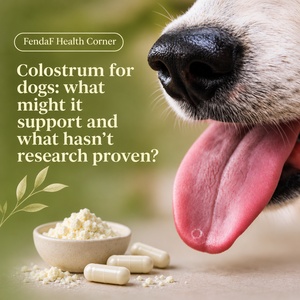
Colostrum for dogs: what might it support, and what has research not shown?
Reading time: about 10 min
I first became seriously interested in colostrum when I was trying to understand whether Ossu’s problems were caused by food intolerance, an allergy or something else entirely. It was a familiar situation for a dog owner: you want to help, but you also want to understand why a particular remedy is recommended. Online you can find all sorts of intriguing claims about colostrum, from supporting the intestines to promises of ‘rebooting’ the immune system. That last one sounds impressive, but the immune system does not have a reset button.
Colostrum does contain biologically active substances. Dogs have also been studied in a long-term immune-function trial and, more recently, a controlled study involving atopic dermatitis. Both deserve attention. But a change in one immune marker does not prove that the same powder treats allergies, yeast infections or cancer. Let us look at the difference.
What is colostrum, and why does a newborn need it?
Colostrum is the first milk produced by a mammal after giving birth. Its proportions of proteins, immunoglobulins, growth factors and other bioactive compounds differ from those in ordinary milk. Maternal colostrum is particularly important for puppies, because only a small proportion of maternal antibodies reaches them through the placenta before birth. During the first hours of life, a puppy’s intestine can absorb antibodies from maternal milk into the circulation. That opportunity diminishes rapidly.
Bovine colostrum given to an adult dog is a very different situation. The adult digestive system does not absorb antibodies in the same way as a newborn puppy’s. Immunoglobulins in bovine colostrum may influence intestinal contents and mucosal processes, but they do not automatically become new infection-protective antibodies in the dog’s blood. The biology of a newborn therefore does not demonstrate a treatment effect in an adult dog.
Which ingredients make colostrum interesting?
The immunoglobulins most often discussed are IgG, IgA and IgM. They are antibody classes with different functions. Mucosa-associated IgA helps the body manage contact with microbes; IgG is important in systemic immune defence. Yet a higher faecal IgA level measured in a study does not by itself mean that a particular dog will stop getting diarrhoea or that an allergy has been cured.
Lactoferrin is an iron-binding protein that has shown antimicrobial and inflammation-modulating effects in laboratory studies. Growth factors participate in signals involved in tissue development. Proline-rich polypeptides are being investigated for their potential role in immune regulation. These are reasonable research avenues, but the mere presence of a substance in a supplement does not establish a clinical effect in dogs: the amount, processing, digestion and outcome measured all matter.
Some older descriptions also list MSM as an active component of colostrum. MSM is used as a separate supplement, but possible joint-related effects of MSM cannot be transferred to colostrum powder. Likewise, an effect of lactoferrin on cancer cells in a laboratory is not evidence that colostrum cures cancer in dogs.
What did the studies in dogs actually show?
Satyaraj and colleagues divided 24 dogs into two groups. After an eight-week preparation period, one group received a complete food supplemented with 0.1% dried bovine colostrum for 40 weeks and the other received a comparison diet. Researchers measured antibody responses to canine distemper vaccination, faecal IgA levels and the diversity and stability of intestinal bacterial communities. Several measures differed favourably between groups receiving and not receiving colostrum.
That is a meaningful finding: this was not merely a mouse experiment or a marketing slogan. But it involved healthy dogs averaging around 2.5 years of age, not patients with chronic itching, autoimmune disease, cancer or kennel cough. It did not show fewer diagnosed infections, resolution of allergies or longer life. Nor did it test every commercially available colostrum powder; it investigated a particular preparation added to food. The work had a product-development connection, so clinical claims would benefit from independent replication.
A very different, clinically relevant study was published in October 2026. Twenty dogs with environmental atopic dermatitis participated in a double-blind, placebo-controlled trial. They received bovine colostrum at 0.2% of dietary dry matter or placebo for four weeks, followed by four weeks of observation. Researchers assessed itching, skin lesion severity, quality of life and several immune markers. Compared with placebo, colostrum did not produce statistically significant changes in the clinical or immunological outcomes. This does not rule out every possible use or a different dose or preparation, but it does not support a claim that this colostrum supplementation treats canine atopic dermatitis. The sample was small and the supplementation period short, so the result should not be generalised to all diseases and formulations. (Schäfer et al., 2026)
What should we take from these studies?
Colostrum may affect measures of immune function and the intestinal microbiome in dogs. That is not the same claim as ‘colostrum cures allergies’ or ‘colostrum replaces vaccination’. Distinguish a measured biological change from the health outcome you actually hope to see in your own dog.
Allergies, intestines and diarrhoea: where is there reasonable hope?
For allergies, colostrum attracts interest because it may influence immune responses associated with mucosal surfaces. Integrative veterinary practitioners sometimes use it as supportive care for itching and digestive problems. This describes a practice, not proof that colostrum is an allergy treatment. Allergies may involve foods, but environmental allergens, parasites, yeast and bacterial skin infections can cause similar symptoms. Trying one supplement cannot distinguish these causes.
Intestinal permeability is a real physiological phenomenon, and some diseases or medicines can alter it. The popular term ‘leaky gut’, however, often bundles different mechanisms under what sounds like a single diagnosis. Findings about bovine colostrum and lactoferrin affecting intestinal barrier function in other species or experimental models do not establish treatment of chronic intestinal disease in adult dogs. When diarrhoea occurs, consider its duration, stool characteristics, weight, diet, parasite exposure and medicines rather than placing all hope in one powder.
If digestive problems recur, a dog loses weight or there is blood in the stool, the cause needs investigating. Colostrum does not replace treatment of dehydration, infection or chronic intestinal disease.
What do integrative veterinarians actually say about colostrum?
Veterinarian Judy Morgan includes colostrum among the tools she uses with her own animals to support immune function. She has also discussed its use in the context of supporting muscle tissue in older animals and mentioned it as a possible addition to a broader plan for chronic conditions. These are her practical recommendations and interpretations of biological mechanisms, not proof that a colostrum powder restores muscle or cures a particular disease.
On Judy Morgan’s podcast, integrative veterinarian Matthew Muir described using colostrum as one part of his supportive approach for dogs with intestinal problems, alongside other measures. He related his interest to the intestinal barrier, the microbiome and the gut-skin axis. This helps explain why colostrum receives attention in integrative practice, but experience described in a podcast is not a controlled treatment trial. Nor does a hypothesis about inadequate colostrum at birth prove that giving powder to an adult dog compensates for any earlier deficit.
Karen Becker has written about the importance of assessing diet, the microbiome and possible intestinal barrier dysfunction in allergic dogs, with an emphasis on individualised, comprehensive care. This fits the broader context for investigating colostrum, but the source reviewed does not provide direct evidence or a specific recommendation that colostrum treats canine allergies. I therefore do not attribute that claim to her. With an allergic dog, the diagnosis and possible contributing causes still need to be established first.
What about teeth, yeast, joints, ageing and cancer?
The list of claims associated with colostrum is long. Oral bacteria and tissue healing, potential digestive irritation from non-steroidal anti-inflammatory drugs, joint mobility, muscle mass in senior dogs and autoimmune conditions are all topics in which bioactive proteins are scientifically interesting. But an intriguing mechanism is not the same as a canine clinical study of treatment for those conditions.
Periodontal disease requires an oral examination and, when appropriate, professional dental treatment; colostrum does not remove tartar. In yeast problems, we need to determine why the skin or ears are inflamed. A possible laboratory antifungal effect does not establish that the powder treats an infected dog’s ear. It would be unjustified to claim that colostrum treats or prevents cancer or autoimmune diseases. Nor is the claim that it prevents canine flu or kennel cough better than vaccination supported by the kind of comparative canine trial such a conclusion requires.
Equally, it would be incorrect to declare that colostrum definitely has no effect of any kind. There are mechanisms worth investigating, immune-related changes measured in dogs and a clinical trial that found no benefit for atopic dermatitis symptoms. Disease-specific treatment claims must be kept separate from those findings.
How can you choose and use colostrum sensibly?
If you are considering colostrum as a supplement, first check whether it is bovine colostrum, a blended product or a purified fraction; how much active material it contains; and what quality and microbiological testing the producer reports. It is also reasonable to ask about origin, processing and whether the needs of newborn calves are considered. ‘Pasture raised’ may matter to your buying preferences, but it does not replace independent safety checks.
For example, the instructions for BioStar Colostrum-38 sold through Judy Morgan’s shop give roughly 1/16 to 1/2 teaspoon per day depending on body weight. The included 1/4-teaspoon measure represents 472 mg of powder. This is product-specific guidance, not a scientifically established universal dose. Powder density, composition and IgG levels differ. Clinical trials used defined percentages of dietary dry matter instead. It is better to follow the specific animal product’s instructions and a veterinary assessment, particularly if the dog is ill or takes medicines. The idea that colostrum must always be given on an empty stomach is likewise not an established universal rule from canine clinical studies.
A dog sensitive to milk proteins may also react to colostrum. Tolerance of beef and of milk proteins is not necessarily the same. Mixing an oral powder with water and applying it to open wounds, abscesses or inside ear canals is not sterile wound care, and I would not recommend that without a specific veterinary indication.
FendaF’s practical trial rule
Begin with a clear goal: are you monitoring appetite, stools or another specific sign? Record it before you start. Introduce only one new supplement at a time and follow the directions for that specific product. Watch for changes in the skin, ears and digestive tolerance as well as the outcome you hope for. Stop the trial if itching, vomiting or diarrhoea occurs. If the underlying symptom persists or worsens, investigate the cause instead of blindly increasing the dose.
What happened with Ossu?
When I first offered colostrum to our dogs, Ossu, Faddu and Fentu all ate it happily. Ossu had been receiving it for about two weeks when I noticed a change in his appetite. Previously he often needed encouragement to eat; now he demanded his food and one evening even asked for more after his usual portion. I felt that colostrum might have helped. At the time, I also wondered whether Ossu’s earlier intensive courses of medication had affected his intestines.
That observation still matters to me, but the conclusion must be narrower. We did not measure intestinal barrier function or run a controlled trial, so we cannot confidently attribute the change in eating to colostrum. But an experience like this offers a good reason to ask the next question rather than announce that the answer is already known.
Colostrum deserves research and, for some dogs, may be a reasonable supportive option. Its proper place is in a considered nutrition and health plan, not a list of promises in which one powder is expected to solve every problem at once.
Sources
- Satyaraj E. et al. (2013). Supplementation of diets with bovine colostrum influences immune function in dogs. British Journal of Nutrition. DOI: 10.1017/S000711451300175X
- Dogs Naturally Magazine. Colostrum Benefits for Dogs
- WSAVA. Global Nutrition Guidelines (complete diets and nutritional assessment)
- Schäfer L., Büttner K., Paßlack N. (2026). Effects of a Dietary Supplementation of Bovine Colostrum in Dogs With Atopic Dermatitis. Veterinary Dermatology. https://doi.org/10.1111/vde.70132
- Judy Morgan (2018). Why Do Traditional Veterinarians Shun Alternative Therapies? https://drjudymorgan.com/blogs/blog/why-do-traditional-veterinarians-shun-alternative-therapies
- Judy Morgan (2021). Geriatric Hind Limb Tremors TCVM Therapy. https://drjudymorgan.com/blogs/blog/geriatric-hind-limb-tremors-tcvm-therapy
- Judy Morgan and Matthew Muir (2024). Naturally Healthy Pets Podcast, EP 35: Bacteria and Brains. https://www.drjudyu.com/podcasts/naturally-healthy-pets-podcast/episodes/2148676881
- Judy Morgan’s online shop. BioStar Colostrum-38: ingredients and product-specific directions. https://drjudymorgan.com/collections/allergy-immunity-wellness-dog/products/biostar-colostrum-38
- Karen Shaw Becker (2016). Natural approaches to allergies. https://animalwellnessmagazine.com/natural-approaches-to-allergies/
🐾 FendaF believes in informed choices
The purpose of the FendaF blog is not to tell you what you must do. Our aim is to share knowledge, introduce different evidence-based and integrative perspectives, and help you make more informed decisions for your pet.
Every animal is unique, and no article can replace a consultation, diagnosis or treatment provided by a veterinarian. If your pet has a health concern or you need individual advice, always contact a veterinarian.









Leave a Reply