


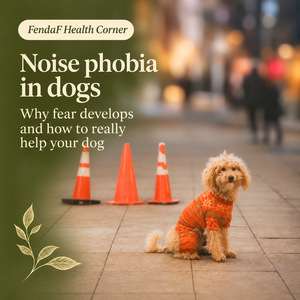
Noise phobia in dogs: why fear develops and how to help
Reading time: about 9 min
For some dogs, fireworks are simply loud noises that make them twitch their ears. For others, the same sound can mean genuine panic. They tremble, frantically search for somewhere to hide, drool or try to escape through a door or window. Thunder, construction work, traffic, a vacuum cleaner or a smoke alarm that suddenly starts beeping may also be enough to trigger fear. This is not stubbornness or an attempt to get attention. At that moment, the experience is truly frightening for the dog.
When it comes to noise sensitivity and noise phobia, I want to understand two things: why a dog’s reaction becomes so intense, and what we can do to make the next noisy event easier for them. I do not want to reduce the entire problem to a bottle of calming supplements, nor claim that training is the only answer. Sometimes we need to adjust the environment, sometimes change learned associations, and sometimes involve veterinary treatment.
When is it a normal startle response, and when is it something more serious?
A brief startle at a loud sound is a normal protective response. The dog may jump, listen and then return to what it was doing. It is more concerning when the reaction lasts a long time, happens repeatedly, worsens or begins to affect everyday life. Some dogs hide quietly; others pace or attempt to flee. We cannot judge the severity of fear solely by how much noise a dog makes.
Veterinary behaviourist Karen Overall has described sudden, intense avoidance and anxiety responses associated with severe noise fears. What matters in that description is the animal’s inability to adapt normally to the situation. A dog that chews through a crate or lunges towards a window during panic can seriously injure itself. Turning up the noise in an attempt to ‘get it used to it’ is not sensible in that state.
Signs of fear may include panting, trembling, hiding, watchfulness, pacing, vocalising, ears held back, lip licking, loss of appetite or a desire to withdraw from people. Some dogs seek closeness instead. If a dog refuses treats, that does not automatically mean treats are useless; fear may simply be so intense that eating is impossible at that moment.
Why is one dog afraid while another is not?
Several causes may be involved at once: inherited predisposition, earlier frightening experiences, what happened during puppyhood, the ability to escape or hide, age-related changes, and sometimes pain or another health problem. If a previously relaxed dog suddenly reacts strongly to sounds, we should ask whether only the environment has changed or the dog’s health as well. A dog living with pain may have a different tolerance for noise than before.
Researchers have explored relationships between sex hormones and fear-related behaviour, but findings are not uniform across breeds, ages and types of fear. A hypothesis is not enough to claim that early neutering caused a particular dog’s noise phobia. The timing of such surgery requires individual assessment of its risks and benefits in any event.
Nor is it established that repeated vaccination is a direct cause of noise phobia in dogs, or that the problem can be addressed only by holistic treatment for ‘vaccine injury’. If symptoms appear after a particular event, the timing is worth investigating, but timing alone does not prove causation. Other explanations and the dog’s individual health need to be assessed. Vaccination decisions should reflect disease risks, indications and individual circumstances rather than an unproven causal assumption.
What can we do during a noisy event?
First, we should not deliberately intensify a dog’s fear. Where possible, bring the dog inside before fireworks or a storm, close windows and curtains, and offer a familiar place to hide. Some dogs choose a crate when it is already a pleasant, safe place for them; to others a crate feels like a trap. Do not force a dog into one if it does not enter voluntarily. A quiet room, soft background music or steady ambient sound may partly mask outside noise.
Some dogs feel safer when their person stays nearby, but how we respond to fear also matters. Calm presence and closeness chosen by the dog can offer support. That does not mean every fear response needs to be met automatically with praise, treats or overexcited comforting.
Dogs learn from the consequences of their actions too. If whining or seeking attention is repeatedly followed by attention that the dog finds rewarding, that behaviour may become more frequent. This does not necessarily mean the underlying fear grows, but we need to distinguish emotional reactions from learned behaviour.
For that reason, I prefer behaving calmly and naturally around a frightened dog. I neither punish the dog for being afraid nor intentionally leave it alone if it seeks support. But I do not praise every startle, either. The aim is to help the dog feel more secure and, where possible, encourage settling and confident behaviour.
Before an expected noisy evening, take the dog on a calm walk and allow time for toileting. There is no need for extra exercise just to ‘wear the dog out’. Do not take a frightened dog among fireworks to test its courage. When escape is a risk, check the collar or harness and use a secure lead. Even a normally obedient animal can act very differently in panic.
FendaF’s practical plan for a noisy evening:
Check doors, windows and a familiar hiding place during the day. Walk the dog before the loudest sounds begin. Let the dog choose closeness or privacy. Offer a suitable activity or treat only if the dog is able to engage. If the dog tries to escape, injures itself, cannot settle or experiences very severe fear, contact your vet and discuss a treatment plan before the next event.
Can desensitisation and counterconditioning help?
In long-term work, it is important to separate two goals. Adjusting the environment helps the dog get through the next thunderstorm or New Year’s Eve safely. Behavioural training aims to change the dog’s response to sounds over time. Approaches include desensitisation, using sounds at very low intensity, and counterconditioning, pairing sounds with something the dog enjoys.
Sound volume is the key consideration. If a recording already causes panic, it is not an appropriate starting level. Instead, start quietly enough that the dog notices the sound but can still eat, play or rest calmly. Increase volume slowly, and only when the dog’s body language shows that the previous level was manageable. Do not attempt this training during an actual storm when the dog is already terrified. A recording may not reproduce the whole experience either: thunder brings other sensations, and the dog may be reacting to the combination.
Stefanie Riemer’s 2023 review brought together evidence on prevention and treatment of noise fears. Environmental management, safe counterconditioning and, when needed, anxiety-reducing medicines prescribed by a veterinarian have more practical evidence behind them than many over-the-counter ‘calming’ products. The review does not say all dogs respond alike or that medication replaces environmental management and learning. Often several measures are needed together.
If the fear is severe or worsens each year, there is no need to wait indefinitely for training to work. A vet can assess pain, other illnesses and whether medication could help. That does not mean automatically prescribing the strongest drug. It means taking the dog’s suffering seriously.
Can integrative approaches help?
Integrative practitioners sometimes use gentle massage, pressure, familiar scents, herbal products, pheromones or other supportive techniques. What I appreciate about this approach is the intention to consider the entire environment and the dog’s wellbeing, not only a symptom. A safe room chosen by the dog or a familiar, calm routine may help without any additional product.
However, these methods have not all been studied equally. Riemer’s review found little robust support for homeopathy, Bach flower remedies or essential oils as effective stand-alone treatments for severe noise phobia. That does not prove that every instance of calming observed by an owner is false, but such observations do not establish that a product treats a phobia or suits every dog.
For lavender and other essential oils, I consider safety as well as any scent experience. Concentrated oil is not the same as the mild scent of a plant. It can irritate and may be unsuitable for some animals. I would not put essential oil on a dog’s skin, in its mouth or in a diffuser in a closed room merely on the assumption that ‘natural means safe’. If the dog can move away, at least we can see its choice. Even voluntary approach does not show that a substance is safe at any dose.
The dog’s own response is also important with pressure vests and similar products. If a dog relaxes and moves freely, the vest may be welcome support. If the dog freezes, tries to remove it or becomes more anxious, there is no reason to persist solely because the product promises calm.
What can salivary cortisol tell us about canine stress?
Cortisol in a dog’s saliva is an interesting research measure: cortisol is involved in the body’s stress response, and saliva collection can be less invasive than a blood draw. However, one measurement is not a direct gauge of how happy or frightened an individual dog feels at a given moment.
A 2016 systematic review of studies measuring salivary cortisol in dogs found substantial variation across dogs, research conditions and interpretations of measurements. Timing, sample collection, environment, events and individual differences all matter. Some studies associate the owner’s presence with different cortisol levels, but that does not create a simple rule of ‘low cortisol equals a calm dog’. Biological responses to chronic stress can also change in complex ways; one number is not a diagnosis.
At home, a dog’s actual behaviour often tells me more: can it rest again after the noise, move normally, eat, recover between events, and does the fear begin spreading to other situations? Together with veterinary assessment and measurements when needed, those observations provide a fuller picture.
In conclusion
Noise phobia is not a sign of bad training. It can be a serious welfare problem, and neither punishment nor ‘just ignore it’ is an adequate answer. First we make the situation safe; then we assess whether further help is needed; only then do we build new, more positive experiences gently. A pretty ‘calming’ label is no substitute for watching the dog’s body language.
Above all, I would not wait for the next New Year’s Eve. If you know your dog is frightened, make a plan before the bangs start. And if it wants to come and sit beside you during a storm, it should not have to prove how brave it is first.
Read also: How capable is your dog?.
Sources
WSAVA. Guidelines for the Control of Reproduction in Dogs and Cats (2024).
FendaF. Original article on noise phobia in dogs and references to Karen Shaw Becker.
🐾 FendaF believes in informed choices
The purpose of the FendaF blog is not to tell you what you must do. Our aim is to share knowledge, introduce different evidence-based and integrative perspectives, and help you make more informed decisions for your pet.
Every animal is unique, and no article can replace a consultation, diagnosis or treatment provided by a veterinarian. If your pet has a health concern or you need individual advice, always contact a veterinarian.








Leave a Reply