


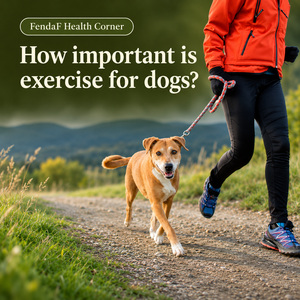
Why Exercise Matters for Dogs: Muscle, Age and Daily Life
Reading time: about 7 min
I have long thought that some dogs living in flats are much more active than dogs with large gardens. A dog in a flat must at least be taken out for walks. A private garden makes life convenient, but it can also create an illusion: the dog has fresh air, so surely they have had enough exercise. In reality they may spend most of the day guarding the same corner of the garden.
One September I finally changed our routine and started moving much more consistently with Faddy and Oscar. Our Sunday forest walk was already a long-standing habit, but once a week was not enough. I began walking them separately: one went running with me in the morning, the other walked in the evening. At first Faddy’s muscles were stiff and Ossu could only run about two kilometres ahead of me. Later he was up to three to three and a half kilometres. The change reminded me that muscles need use, but also time to adapt to a new workload.
Why exercise is about more than burning calories
Movement helps maintain muscle strength, coordination, joint mobility, balance and a suitable body weight. It also gives dogs opportunities to sniff, investigate and engage with their surroundings, none of which can be replaced by simply being in a garden. Variety matters: calm walking, different surfaces, turns, a few brief faster stretches and adequate rest challenge the body differently from endlessly chasing a ball.
But more kilometres do not automatically mean better health. Repeated sudden starts and stops can strain joints and tendons. An overweight dog or one recovering from illness or surgery needs a different plan from a young, healthy working dog. The important question is not how tired we can make our dog, but what kind of movement makes this particular dog stronger.
Muscle atrophy and sarcopenia: what is the difference?
Muscle atrophy means loss of muscle tissue. It can occur after restricted movement due to injury or pain, long periods of rest, certain illnesses or inadequate nutrition. Sarcopenia generally refers to age-associated loss of skeletal muscle mass and function. These processes can overlap, but they are not identical.
An older dog does not lose muscle simply because another birthday has passed. Activity, appetite, digestible protein, chronic disease, inflammation, pain and sometimes medication all play a role. A dog may have a perfectly ordinary number on the scale while losing muscle over the back, thighs or head. That is why body weight alone is not enough.
I could see the change in Faddy’s hind legs. As a young dog, he was very muscular because we moved a lot. When my own priorities shifted and regular exercise slipped into the background, his hind legs gradually looked thinner. It was an uncomfortable reminder: a dog’s former fitness does not preserve itself.
How can you recognise a loss of muscle strength?
Some signs are fairly obvious. A dog finds stairs, jumping into a car, lying down or standing up more difficult. They lag behind on walks, avoid play, take shorter steps or favour one leg. Other signs concern body shape: the back, thighs or shoulders look narrower than before. These are not merely “old age”. They may also reflect pain, neurological disease, joint problems or another medical condition.
Veterinarians use, among other measures, body condition score (BCS) and muscle condition score (MCS). BCS helps estimate body fat; MCS evaluates muscle loss. They can tell very different stories in the same dog: an overweight dog can also be losing muscle. This is particularly important with seniors and dogs with chronic illness.
If a dog suddenly starts limping, drags a paw, collapses or loses muscle rapidly, I would not simply start a new exercise programme. First we need to find out why. A dog who no longer wants to walk is not necessarily lazy. They may be in pain.
How much and how often should a dog move?
I do not believe in a universal rule that every dog must walk exactly thirty minutes or five kilometres. A small senior with a spinal problem, a young working dog and an active middle-aged German Shepherd are not the same. Weather, terrain, coat and current fitness also change how much activity a dog can handle.
For a dog that has been inactive for a long time, a reasonable starting point may be a couple of short, gentle walks each day. For some very weak or painful dogs, even 200–300 metres may initially be enough. That is an example of a small first step, not a scientifically established daily requirement or a target to pursue at any cost. The dog’s response is what matters.
I would increase the workload gradually and only if recovery is good. Measure not just the distance, but how the dog moves the following morning. Mild adaptation is one thing; obvious limping, stiffness, heavy panting or reluctance to move are reasons to scale back and consult a veterinarian. For seniors, short regular walks can be more helpful than an occasional long hike.
FendaF’s checklist for starting to move more
- Choose a walk that suits the dog’s current abilities, not their former personal best.
- Make movement a routine: a little every day is usually better than one very long walk a week.
- Include relaxed sniffing and varied surfaces, but avoid sudden workload jumps.
- Check your dog that evening and the next morning: are their gait, appetite, rest and willingness to move normal?
- Stop and seek advice if there is limping, severe stiffness, unusual weakness or excessive panting.
- Look and feel for muscle loss around the thighs, shoulders and back rather than relying only on the scales.
Are swimming and physiotherapy better than walking?
Swimming and water-based exercise can give some dogs a way to move that loads the joints differently from running. But not all dogs can or want to swim; cold water, fatigue, heart disease and breathing problems can make it unsuitable. Rehabilitation works best when exercises are chosen for an actual diagnosis and the individual dog.
One dog may benefit from balance exercises, another from calm uphill walking and a third simply from shorter outings with more rest. Owners should not unilaterally remove post-operative or injury-related exercise restrictions. At the same time, endless immobility is rarely a good long-term solution. A properly planned rehabilitation programme can help find the middle ground.
Massage may help a dog relax if they enjoy it, but it does not replace activity that actually uses muscles. Do not forcefully massage painful, swollen or unexplained areas. And if the dog pulls a paw away, that is an opinion worth listening to.
Food supports muscle, but cannot exercise instead of the dog
Adequate calories and high-quality, digestible protein are prerequisites for maintaining muscle tissue. A dog that eats too little or loses appetite during illness may lose muscle even if they would like to stay active. Conversely, no “muscle supplement” alone restores strength if the dog remains inactive and the underlying problem is untreated pain.
Omega-3 fatty acids may benefit some joint and inflammatory conditions, but effects depend on dose, product and condition. It would be an exaggeration to claim that fish oil builds muscle in every older dog. A complete nutritional assessment must also consider energy needs, body condition and any disease-specific treatment plan.
I would not automatically reduce a senior dog’s food simply because they have grown older. Some seniors are less active and need less energy; others remain active, and adequate nutrient intake is more important for maintaining muscle. Visible weight loss or muscle wasting requires an explanation, not only a larger food bowl.
If your dog no longer wants to move, ask “why?”
It was wonderful to see Faddy and Ossu become fitter when we started exercising regularly again. But our experience does not prove that every limp or weakness can be fixed with longer walks. It describes changes I noticed in our own circumstances. Serious pain, a heart condition or neurological symptoms must not be ignored in the hope that training alone will solve them.
People sometimes say, “He’s old, that’s why he can’t keep up.” I would always ask what exactly changed. Is the dog exhausted or in pain? Has muscle disappeared while body weight stayed the same? Does fatigue appear only in hot weather, after meals or right at the start? Different answers may point towards very different needs.
My simplest conclusion is that a dog’s muscles and enjoyment of movement need consistent attention. Not more exercise at any price, but enough of the right movement for the dog to feel good the following day too. A garden is not a walk, and a long distance is not, in itself, proof of health.
Sources
- AAHA (2023): Senior Care Guidelines for Dogs and Cats
- AAHA (2023): Nutrition, Senior Care Guidelines
- AAHA (2021): Nutrition and Weight Management Guidelines
- AAHA (2019): Body and Muscle Condition Score in Dogs
- AAHA (2023): Evaluating the Unhealthy Senior Pet
🐾 FendaF believes in informed choices
The purpose of the FendaF blog is not to tell you what you must do. Our aim is to share knowledge, introduce different evidence-based and integrative perspectives, and help you make more informed decisions for your pet.
Every animal is unique, and no article can replace a consultation, diagnosis or treatment provided by a veterinarian. If your pet has a health concern or you need individual advice, always contact a veterinarian.









Leave a Reply