


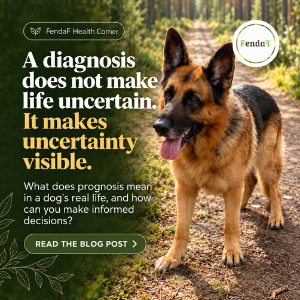
A Diagnosis Doesn’t Make Life Uncertain. It Makes the Uncertainty Visible.
August was a very different time for Faddy. Around 2.5 litres of fluid had accumulated in his abdomen and had to be removed. His heart was enlarged. He had very little stamina, and our walks were mostly 1–1.5 kilometres, slow, with pauses and entirely at his pace.
Then came the medication, the monitoring, the better days and the worse ones.
Slowly, Faddy began to move again. First a little more. Then several kilometres. Then without breaks. At one point we walked 6.7 kilometres in the forest, and looking at the dog beside me, it was hard to believe that not so long ago he barely had the strength to move.
At the same time, the disease has not disappeared. It simply gained a name and a prognosis: dilated cardiomyopathy with heart failure.
The risks are still the same. His abdomen can enlarge again. Fluid needs to be monitored. Medication may need adjusting. His heart has to be taken into account in every decision.
The cardiologist’s prognosis was that Faddy might have a few months, six months, or at most a year. And of course that immediately triggered one thought: I need to truly appreciate every day I have with him now.
But a little later, another question appeared. Why only now? Why only when someone places a time limit on a life?
We humans have a strange relationship with time
When a dog is healthy, tomorrow somehow feels like a given. There will be another walk. Another summer. Another birthday. We do not consciously think about it. We simply live as though there will always be more time.
Then a doctor says one sentence.
“Maybe a year.”
And suddenly everything changes.
An ordinary walk is no longer just a walk. Your dog wandering into the kitchen to see what you are doing is no longer meaningless background noise. The way he curls up in his bed in the evening becomes something you want to watch for a moment longer. And before going to sleep, you think: I’ll go and give him a kiss.
Because I do not know how many evenings like this we still have.
I talked about it with a friend. And she asked, “What about Ossu?” It was such a simple question that it completely disarmed me for a moment. Because yes. What about Ossu?
When a prognosis changes the choices we make
Why should Faddy suddenly get a more deliberate good-night kiss simply because the uncertainty of his life now has a name and his lifespan has been given a possible limit?
In Faddy’s case, a veterinarian has named one possible time frame. No one has done that for Ossu. Or Fentu. Or Süsi.
But nobody has promised any of them next year.
Faddy may, in reality, outlive one of them. It is not a pleasant thought. But it is not a thought we should pretend does not exist.
The fact that a dog has no diagnosis does not mean we know for certain what is happening inside their body. And even something completely unexpected can happen to an animal who seems perfectly healthy.
The difference is not that one life is uncertain and the others are secure. The difference is that Faddy’s uncertainty suddenly got a name.
And that brought me to a thought that has stayed with me ever since: a diagnosis does not make life uncertain. It makes the uncertainty visible.
A prognosis is not an expiry date
It is very easy to take the number a doctor gives you and place it on an imaginary calendar.
A year. Twelve months. 365 days. And then, without even meaning to, start counting.
But Faddy knows nothing about that number.
He does not wake up in the morning knowing that, statistically, he may have only so much time left. He wakes up and checks what is happening today. Is there food? Are we going outside? Can we go to the forest? Is there anything interesting to sniff?
When Faddy walks several kilometres without a break, he does not care what is written next to his diagnosis on a piece of paper.
That does not mean the diagnosis should be ignored. Quite the opposite.
I watch his abdomen. His breathing. His appetite. His movement. His sleep. His drinking. His urination. His normal behaviour. His medication and his heart condition are now part of our everyday life.
But alongside all of that there is something else that cannot be measured only in numbers. How is he actually doing today?
Sometimes the diagnosis speaks about the future. The dog speaks about the present. We need to listen to both.
Illness does not automatically mean a bad day
Over the past few months, Faddy has shown me very clearly how poorly a diagnosis and a dog’s quality of life on one particular day can sometimes line up.
In August, his disease may already have been moving toward the same diagnosis on paper, but Faddy himself was in a much worse state. Today there may once again be some fluid in his abdomen and his heart is not healthy, yet the dog beside me can still be energetic, eager to move and explore, and able to walk three or four kilometres without it feeling like the end of the world.
That makes monitoring the disease more complicated. But perhaps also more honest.
Because quality of life cannot be judged only by how frightening the name of a diagnosis sounds. And a good day cannot be defined simply as a day when every test result is perfect.
A good day can be a day when appetite is good. A day when paws carry him into the forest. A day when he wants to come with you. A day when he sleeps peacefully. A day when he is simply himself.
Don’t turn love into a countdown
There is another risk after a diagnosis. The desire to appreciate every moment can turn into a need to monitor every moment.
Was he a little quieter today? Did he sleep an hour longer? Is his abdomen bigger? Was today’s walk slower than yesterday’s? Is he worse? Is this a sign?
And without noticing it, an invisible stopwatch can begin ticking above all the time you spend together.
I do not want to live with Faddy like that.
Yes, his disease needs monitoring. Yes, I need to notice changes. Yes, I know something now that I did not know before.
But I do not want the rest of his life to become one long wait for the prognosis to finally prove itself right. Because then the disease would have taken a much larger piece of his life than it actually deserves.
Today Faddy is here. Today he eats. Today he wants to go for a walk. Today he can potter around the forest while I look at him and think about how, not that long ago, the same dog could barely manage a kilometre.
That day is not less real simply because somewhere in a medical prognosis there is a number.
And then there is Ossu
Perhaps the most important thing Faddy’s diagnosis is teaching me is not actually how to live with a sick dog.
It is teaching me how to live with everyone we love.
Because my friend’s question stayed with me. “What about Ossu?”
If I now go and give Faddy a kiss at night because I do not know how many such evenings we still have, why would I not do the same for Ossu?
Why should someone’s value to me change at the moment a doctor gives their life a possible end point?
Ossu does not have a number attached to him. That does not mean he has more time. It only means I do not know. The truth is, I never have. But uncertainty is easier to live with when we can pretend there will always be more time.
The limit did not create the value
Perhaps the strangest thing is that a diagnosis can make an entirely ordinary day feel extraordinarily valuable, even though the day itself has not changed.
The same dog. The same home. The same walking route. The same evening kiss.
Only my knowledge has changed.
And maybe that is the biggest lesson in Faddy’s journey right now. Not that I should frantically record everything as a ‘last time’. Not that every day needs to become a special event. And certainly not that I should start crossing days off a calendar.
But that ordinary days have always been valuable.
We simply do not always notice it.
Faddy’s diagnosis did not create the value of our walks. It did not make an evening cuddle important. It did not make Faddy more precious. It simply pulled back the curtain on a truth that is easier not to look at: we never know in advance how much time we have with anyone.
A diagnosis does not make life uncertain. It makes the uncertainty visible. But maybe the point of knowing that is not to make us more afraid.
Maybe the point is to teach us to be a little more present.
With Faddy.
With Ossu.
With Fentu.
With Süsi.
And right now.
🐾 FendaF believes in informed choices
The purpose of the FendaF blog is not to tell you what you must do. Our aim is to share knowledge, introduce different evidence-based and integrative perspectives, and help you make more informed decisions for your pet.
Every animal is unique, and no article can replace a consultation, diagnosis or treatment provided by a veterinarian. If your pet has a health concern or you need individual advice, always contact a veterinarian.


Leave a Reply