


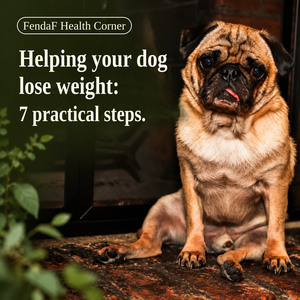
Helping Your Dog Lose Weight: Seven Practical Steps
Reading time: about 6 min
Just as in people, weight gain can make life harder for dogs. It adds stress to the joints, makes movement more difficult and increases the risk of certain diseases. An overweight dog is not necessarily the owner’s fault, but the owner is the person who can take action. Illness, medication, age and changes in energy requirements after neutering can all play a part.
We can monitor food portions, treats and exercise. I know someone who changed dog food but kept feeding the old portion out of habit. With the new food, that meant roughly one third more than the dog needed. No wonder the weight slowly increased.
Spaying or neutering can reduce energy requirements and increase the risk of weight gain, but gaining weight after surgery is not inevitable. Adjust feeding and monitor body condition. Some integrative veterinarians discuss the wider role of sex hormones in health, but that does not mean surgery is always a bad choice. Decisions should reflect the individual animal’s health and circumstances.
I read veterinarian Ernie Ward’s advice on gradually improving a pet’s weight. His seven practical suggestions make a useful starting point. I have added newer nutrition guidance and observations from my own dogs, because a calorie figure alone does not tell the whole story.
Weight loss: seven practical steps
Calculate calories
Feeding instructions on a bag are a starting point, not a fixed prescription for every dog. Activity, body condition, age, health and neuter status can all change energy needs. Importantly, a less active or neutered dog does not automatically need 20–30% LESS food. Calculate a reasonable starting amount, monitor weight and adjust as necessary.
Dr Ward recommends starting with energy requirements. A veterinarian or veterinary nutrition specialist can calculate and adapt them. You can also make an initial calculation at home, provided you understand that it is not a final feeding prescription. Alongside the formula, I prefer to look at body condition, muscle mass and the actual weight trend.
A commonly used estimate of resting energy requirement is RER = 70 × body weight (kg)^0.75. For dogs weighing approximately 2–45 kg, a simplified formula is sometimes used: RER = 30 × body weight (kg) + 70. For a 20 kg dog, this gives about 670 kcal per day. This is a RESTING estimate, not automatically the daily feeding allowance or a weight-loss target. Actual needs and a suitable plan depend on the dog’s condition.
Online calculators can be convenient, but check whether they calculate resting or maintenance requirements, whether they use current or target weight and whether they account for neutering. If the result does not match the dog’s actual weight trend, adjust the plan rather than forcing the dog to fit the formula. :)
I find the integrative approach useful here because it looks beyond the number on the scale. Is the dog constantly hungry? Does moving hurt? Are the muscles weak? Is the dog getting enough sleep and opportunities to sniff? These questions do not replace an energy plan; they help make it workable.
Measure the food
I suspect many people measure dog food by eye. But a measuring cup can contain very different weights of different kibble. Kitchen scales give a much clearer picture. Faddu and Ossu have never been enthusiastic overeaters, but not every dog regulates its own intake. And even those little “just a few pieces of kibble” snacks count, particularly for small dogs.
Have a sensible treat strategy
Dr Ward emphasises counting treats. What matters is not only whether a treat is “natural”, but also its calories and safety. During weight loss, small pieces of lean treats or part of the dog’s regular food often work well. Avoid accumulating too many extra calories. So-called functional treats are not automatically proven treatments for joints or teeth. Always check the ingredients, particularly for xylitol and other substances dangerous to dogs.
Dr Ward also advises against giving treats out of guilt. We, too, give our dogs a little something when leaving home. Faddu and Ossu have loved chicken gizzards and beef sticks, while Peku and Fentu used to search for training treats scattered on the ground. This treat-search game is a lovely way to put the nose to work, but every piece must count towards the daily allowance.
Useful vegetables
Instead of conventional treats, try small pieces of dog-safe vegetables, such as carrots, cucumber or cooked green beans. Peas and broccoli may also be suitable in small amounts if they do not upset digestion. Not all human foods are safe: avoid onions, grapes, raisins and xylitol, among other hazards.
Fruit can sometimes be a small treat, but remember its sugar content and portion size. There is no need to feed large amounts of banana or apple to help a dog lose weight. Cats have very different nutritional requirements, so do not automatically apply canine treat tips to them.
Make daily movement part of the journey to health
Exercise is an important companion to weight loss, but it usually cannot compensate for excessive food intake on its own. A brisk 20–30-minute walk may suit one dog and be too much for another. Start at the dog’s current level. For an overweight or older dog, or one with joint or heart problems, manageable walking or appropriate rehabilitation is often wiser than suddenly starting running sessions.
Do yourself and your dog a favour: make walks part of the daily routine and allow time for sniffing. Consistency matters more than one huge workout. And the benefits of walking still extend to both ends of the lead. :)
Consider supplements carefully
Integrative veterinary medicine sometimes considers weight loss alongside joint health, digestion and supplements. This wider view can be valuable, but no supplement replaces an appropriate calorie intake. Omega-3 fatty acids may be justified for certain conditions, but they are not universal weight-loss products. The same applies to L-carnitine: it may be worth discussing in specific circumstances, but the evidence does not support promising that it will help every dog lose weight. Remember that fish oil adds calories.
Consider carbohydrate intake
Reducing carbohydrates may suit some dogs, but weight does not fall simply because food is “low carb”. Total energy intake, together with adequate protein and other nutrients, is decisive. I like the idea of combining high-quality complete dry and wet food, but the entire daily menu must remain balanced. If you add homemade or raw components, account for their calories and the proportion of nutritionally unbalanced additions. Raw animal products also carry microbial risks that should not be ignored.
In conclusion
Our job is to help dogs maintain a suitable body weight and muscle mass without making their lives revolve around hunger. That means appropriate feeding, movement, good sleep and, where needed, investigating health problems rather than blaming the dog.
AAHA and WSAVA nutrition guidance generally recommends keeping treats and other non-complete additions within 10% of daily energy intake. That includes chews, table scraps and training treats. Too many extras leave less room for a balanced staple diet. Better still, use some of the regular kibble as training rewards.
If a dog seems constantly hungry, compare suitable complete foods with different energy densities and fibre contents. For example, Irene felt that our food-loving Labrador Peku was less hungry on Light Senior than on Hill’s Metabolic. That was our experience, not proof that one food is better for every dog.
Fresh water must always be available. Chewing can provide enrichment and satisfaction, but it is not a weight-loss treatment by itself. Choose safe, moderately caloric chews and include them in the daily total.
Weight loss is not simply about putting less and less food into the bowl. Even with fewer calories, a dog needs enough essential nutrients and protein to preserve muscle. Assess weight changes together with body condition score (BCS) and muscle condition score (MCS). Cornell recommends checking weight at least every two weeks during a weight-loss programme. Approximately 1–2% weight loss per week is often considered suitable for many dogs, but targets must be individualised.
Persistent tiredness, vomiting, diarrhoea or rapid muscle loss during weight reduction are not “normal parts of dieting”. Review the plan promptly and investigate possible illness if necessary.
For an overweight dog, thoughtful weight reduction can be one of the best gifts to their health. Do it gradually and with their individual needs in mind!
Sources and further reading
AAHA, Nutrition and Weight Management Guidelines (2021): https://www.aaha.org/resources/2021-aaha-nutrition-and-weight-management-guidelines/feeding-plans-for-healthy-appropriate-weight-cats-and-dogs/
Cornell University College of Veterinary Medicine, Obesity and Weight Loss in Dogs: https://www.vet.cornell.edu/departments-centers-and-institutes/riney-canine-health-center/canine-health-topics/obesity-and-weight-loss-dogs
Pet Nutrition Alliance, Creating a Nutritional Plan: https://petnutritionalliance.org/resources/nutritional-assessment-procedure/creating-a-nutritional-plan/
WSAVA Nutrition Committee, Feeding Treats to Your Dog: https://wsava.org/wp-content/uploads/2024/06/Feeding-treats-to-your-dog-v2.pdf
Merck Veterinary Manual, Overview of Integrative Veterinary Medicine: https://www.merckvetmanual.com/therapeutics/integrative-complementary-and-alternative-veterinary-medicine/overview-of-integrative-veterinary-medicine
Original article: Ernie Ward, Pet Health Network: https://www.pethealthnetwork.com/dog-health/dog-checkups-preventive-care/7-surprising-ways-help-your-pet-lose-weight-and-why-its
🐾 FendaF believes in informed choices
The purpose of the FendaF blog is not to tell you what you must do. Our aim is to share knowledge, introduce different evidence-based and integrative perspectives, and help you make more informed decisions for your pet.
Every animal is unique, and no article can replace a consultation, diagnosis or treatment provided by a veterinarian. If your pet has a health concern or you need individual advice, always contact a veterinarian.







Leave a Reply