


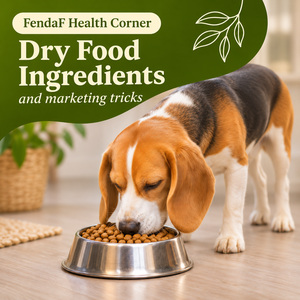
Dry Dog Food Ingredients and Marketing Tricks: Read the Label
Reading time: about 7 min
When a bag of dog food proudly says ‘60% fresh meat’, it is easy to imagine a food made mostly of meat. But does this figure describe the finished product, or the recipe before drying? And if the ingredient list starts with ‘lamb’, does that mean most of the protein in the finished product comes from lamb? These are exactly the questions that interest me when I look at dog foods.
I have no quarrel with any particular manufacturer. I have always said that each owner decides what to feed their dog. But I want to understand what people are paying for. For my own dogs, I prefer food with clearly identified ingredient sources and am cautious about vague descriptions. That is a conscious buying preference, not proof that every food sold in a supermarket has poor nutritional value. A brand, shop or colourful package cannot replace reading the ingredient list.
Why does ingredient order matter, but not tell the whole story?
In the European Union, feed labelling, including pet food labelling, is governed by Regulation (EC) No 767/2009. Ingredients are generally listed in descending order of weight according to their inclusion in the recipe. The first ingredient therefore tells you something important: more of it was added by weight than any other individually listed ingredient. But that does not prove there is more of it than all the other ingredients combined, or that it contributes most of the food’s protein.
Packaging can identify ingredients precisely or use permitted broader categories. The phrase ‘meat and animal derivatives’ does not tell a customer as much as naming the animal species and tissue used. However, using a general term alone does not prove the food is dangerous or nutritionally deficient. The issue is transparency: to evaluate a particular recipe, I need enough information.
The same ingredient under several names
One common trap when assessing an ingredient list is that similar raw materials may be listed separately: oats, oat flour and oat flakes, for instance, or peas, pea protein and pea starch. There can be valid manufacturing reasons, because these are not chemically or functionally identical ingredients. But this separation may also obscure the fact that the combined amount of components derived from one plant is greater than that of the meat ingredient listed first.
We need to be both critical and fair. Listing them separately does not, by itself, demonstrate deliberate deception. But as a buyer, I can ask what their combined share is, especially if the advertising strongly suggests that one animal ingredient predominates.
In Facebook dog groups, I have repeatedly seen two simple suggestions: ‘buy the one that lists meat first’ or ‘choose food with lots of fresh meat’. Both can be useful starting points, yet both can mislead if you do not examine the recipe further. First place, or even an entire first line, does not describe the whole formulation.
Fresh meat and dried meat are not the same calculation
Fresh meat contains a lot of water, often approximately two thirds to three quarters of its weight. If a recipe includes 60 kilograms of fresh meat containing, for example, 70% water, that ingredient supplies about 18 kilograms of dry matter. But those 18 kilograms are not yet the percentage of meat in the finished food, because the mass of all the other ingredients also changes during drying. For an exact percentage, we would need to know the starting amounts, moisture contents and final yield of the entire recipe.
A simple conversion has sometimes circulated claiming that 60% fresh meat becomes 24% meat in the finished food. There is no such universal precise rule. It is correct that the input percentage of a water-rich ingredient must not be read as an equivalent percentage in the finished kibble. It would be wrong, however, to replace a marketing figure with another seemingly precise number calculated without the underlying recipe data.
Much of the water has already been removed from dried meat or meat meal before it is added to the recipe. Therefore, 30% dried chicken and 30% fresh chicken are not equivalent amounts of animal dry matter. With dried raw material, it is also worth asking precisely what the name includes. Personally, I always have questions about the quality of dried ingredients as well.
How can you estimate carbohydrates when the package does not list them?
Most dry-food analytical tables give crude protein, crude fat, crude fibre and crude ash, and sometimes moisture. When moisture is known, you can calculate an approximate proportion of carbohydrates and other nitrogen-free extractives using the so-called difference method. The formula is simple:
FendaF’s practical label calculation
Estimated NFE (%) = 100 − crude protein (%) − crude fat (%) − crude fibre (%) − crude ash (%) − moisture (%).
Example: protein 26%, fat 15%, fibre 3%, ash 7% and moisture 9%. NFE is then approximately 100 − 26 − 15 − 3 − 7 − 9 = 40%.
This is not a laboratory measurement of pure starch or ‘sugar’. If the actual moisture or ash value is unknown, label your result as an estimate, not a precise fact.
NFE, or nitrogen-free extract, is a calculated remainder rather than a direct laboratory test of carbohydrates. It includes primarily more readily soluble carbohydrates, as well as the effects of measurement and rounding errors. Crude fibre does not measure all dietary fibre. An analysis of 51 dog foods published in 2021 showed that crude-fibre and total-dietary-fibre figures can differ substantially. So a value of 40% should not be interpreted as ‘40% grain’, and certainly not as ‘40% sugar’.
If moisture is missing from the label, it is not reasonable to state that ‘it is always 10%’ as a fact. That may be a realistic example for dry food, but the actual figure varies. Likewise, 7% ash is an illustrative value, not an official substitute for missing data. If you want to compare two foods seriously, ask the manufacturer for the missing analytical figures.
Does a higher protein percentage mean more meat?
Not necessarily. Crude protein encompasses nitrogen-containing compounds from both animal and plant sources. A food with 30% crude protein can be made with very different recipes. Much of the protein may come from meat, but some may be supplied by pea or potato protein, for example. Even when the total protein percentage is identical, the amino-acid profile and digestibility may differ.
Nor can we assume that two foods containing 28% crude protein provide the same amount of animal protein. We would need more information about ingredient proportions and the origin of the amino acids or raw materials. Again, one number helps you ask the right question, but does not answer it on its own.
Energy density is another consideration. One food may contain 15% fat and another 12%, but depending on the daily amount in grams and the calorie content, the dog may ultimately receive different quantities of both fat and protein. A high protein percentage alone does not make one recipe a better choice for a dog that needs fewer calories.
What does ‘complete’ actually mean?
A complete feed is intended to meet the daily nutritional needs of its target animal group in line with the relevant requirements. This is an important checkpoint when the food forms the main diet. But it does not prove that all raw materials are of equal quality or that all dogs digest the food equally well. Even a manufacturer’s clinical data may address a specific aim rather than answer every question about ingredient origin or long-term tolerance.
In my own assessment, I consider not only the label but also the manufacturer’s transparency, ingredient traceability, quality control and how an individual dog tolerates the food. If a manufacturer claims that a food ‘supports gut health’ or ‘contains especially high levels of meat’, it is reasonable to ask how the claim is measured. European feed-labelling rules require such claims to be objective and verifiable.
Three questions before the next bag
If all food bags were white tomorrow, with no brand name, breed picture or luxury colours, would we still choose the same recipe on the basis of the ingredients and analysis? I recommend asking: what raw materials are actually used, what do the percentages mean, and does this recipe meet the needs of this particular dog? These questions do not force anyone to buy one specific brand. They do reduce the chance that a cleverly designed number or package makes the buying decision for us.
Related reading: Should you change your dog’s food?
Sources
European Parliament and Council (2009). Regulation (EC) No 767/2009 on feed marketing and labelling
European Commission. Feed marketing: EU animal feed marketing and labelling rules
FEDIAF. Code of Good Labelling Practice for Pet Food (2019)
Mineral Composition of Cereal and Cereal-Free Dry Dog Foods versus Nutritional Guidelines (2020)
🐾 FendaF believes in informed choices
The purpose of the FendaF blog is not to tell you what you must do. Our aim is to share knowledge, introduce different evidence-based and integrative perspectives, and help you make more informed decisions for your pet.
Every animal is unique, and no article can replace a consultation, diagnosis or treatment provided by a veterinarian. If your pet has a health concern or you need individual advice, always contact a veterinarian.





Leave a Reply