


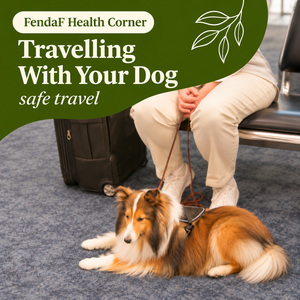
Travelling with Your Dog: Safe Car and Air Travel
Reading time: about 7 min
I am one of those people for whom taking two large dogs on holiday does not sound like a dream vacation. If I have to, I can certainly manage it, but every now and then I prefer to travel without them. I joke that this way I get a break from the dogs and they get a break from me. Many people, on the other hand, consider taking their dog on holiday as natural as packing hiking boots. Neither choice makes someone a better or worse owner. The real question is which situation is better and safer for that particular dog.
I have previously shared integrative veterinarian Karen Shaw Becker’s view that flying with dogs should be avoided where possible, especially when the animal has to travel in the aircraft hold. That is a precautionary recommendation, not proof that every flight is dangerous. Modern air transport has strict requirements, and many animals travel safely. At the same time, the risks depend on the dog, the airline, connections, temperature, transport crate and how the animal is handled before and after the flight.
Does the dog actually want to come along?
This should be the first question, not the last. Can the dog cope with unfamiliar places and car rides, feel relaxed in a new sleeping area, and eat and rest there? Does the dog have health conditions that make heat, stress or prolonged restriction of movement especially risky? Some dogs are far better off staying at home with a familiar carer than passing through a crowded airport and taking a long journey. Others genuinely enjoy hiking beside their owner.
So make the decision for the dog, not merely for the holiday photos. A dog does not always need to accompany you on a short weekend trip. If you are moving away for a longer period or planning a relaxed road holiday, however, the journey can also be enjoyable for a dog when arranged properly.
Car journeys: your dog needs to be secured
A dog roaming freely inside a car may distract the driver, get near the pedals or be injured during sudden braking. The front seat adds the risk of airbag deployment. Allowing a dog to stick its head out of a window is also unsafe, because flying debris can injure the eyes and ears. The American Veterinary Medical Association (AVMA) recommends securing dogs safely during car travel and not letting them sit on the driver’s lap or travel with their heads outside the window.
For a large dog, I prefer a strong transport crate that is properly secured in the vehicle. My dogs have been familiar with crates since they were young. On a couple of occasions when the crate had been left at the office, we had to make a very slow seven-minute drive without it. The dogs simply did not know how to settle: rather than sitting or lying down, they tried to balance while standing. This does not prove that every dog feels comfortable only in a crate, but it certainly taught me the value of a familiar, stable place to travel.
A crate’s material is not the only important consideration. Check how it is attached to the vehicle, where it is positioned and whether the manufacturer provides meaningful crash-test data. ‘Crash tested’ alone says little about the methods or loads used. The crate should be large enough for the dog to lie down naturally and change position, but not so spacious that the dog can be thrown uncontrolled across it in a crash. For smaller dogs, a properly fitted car harness with independent safety testing may be an alternative. A normal collar attached to a seat belt by a leash is not equivalent.
Take a break before your dog desperately needs one
On longer drives, it is sensible to stop roughly every couple of hours so your dog can move, drink and relieve itself. This is a guideline, not a competition in waiting until exactly two hours have passed. Puppies, older dogs and dogs with medical conditions may need more frequent stops. Offer water, monitor temperature and avoid a large unfamiliar meal immediately before a long drive.
Never leave a dog unattended in a parked car. The cabin can heat up rapidly even when the weather is not sunny, and cold weather poses different risks. A temperature sensor or phone notification can add protection, but neither automatically makes a dog left alone in a car safe. If you plan to visit attractions that do not allow dogs, arrange appropriate care in advance.
Air travel: the biggest questions are often on the ground
The International Air Transport Association (IATA) establishes standards for transporting live animals, and airlines may apply their own additional restrictions. Before booking, check whether the specific airline allows a dog of your breed and size in the cabin or aircraft hold, what carrier is required, how transfers are handled and whether summer or winter temperature restrictions apply. A small dog that fits in a carrier under the seat is not in the same situation as a large dog travelling separately.
From an animal-welfare perspective, a flight is not just the time spent airborne. Waiting in the crate, loading into vehicles or onto the aircraft, transport between the terminal and plane, and baggage collection also matter. I therefore prefer direct flights when possible, enough time for transfers, and an operator with clear animal-handling instructions. Dogs with heart or respiratory disease, advanced age or severe anxiety need veterinary assessment before flying. Sometimes the best decision is not to fly, or to choose another form of transport.
The advice to ‘give the dog something calming before a flight’ can do harm. IATA and AVMA do not recommend routinely administering sedatives or tranquilising drugs for air transport because they may affect breathing, cardiovascular function, balance and temperature regulation. If a dog needs treatment for anxiety, discuss the specific medicine, its safety and airline rules with a veterinarian ahead of time. Veterinarian-guided non-sedating anxiety treatment and gradual crate training are very different from giving a random sedative at the last minute.
Can essential oils help with travel stress?
Integrative practice sometimes discusses pheromones, herbal scents and essential oils as supportive measures for anxiety. A familiar scent and calm surroundings may help some dogs, but that is no reason to spray concentrated essential oil into an enclosed crate, apply it to a dog’s skin or give it by mouth. A dog cannot escape a strong smell during a flight, and there is insufficient dog-specific information about the dose and safety of many oils. Especially in confined spaces, it is better to choose controllable, lower-risk measures.
My first choice is always gentle crate training: going into the crate voluntarily at home, treats and resting there, short trial drives, and only then a longer journey. If the dog adapts slowly, I give it time. Anxiety does not disappear because someone says ‘don’t be scared’.
Check border documents before booking
When travelling within the European Union, dogs generally need a microchip, valid rabies vaccination and an EU pet passport. After a first rabies vaccination, a waiting period of at least 21 days normally applies; the microchip must be in place before vaccination. Some destinations, including Finland, Ireland, Malta, Norway and Northern Ireland, also require dogs to receive treatment against the tapeworm Echinococcus multilocularis between 24 and 120 hours before arrival. Requirements may depend on the country of origin, the dog’s age and the itinerary, so always consult the destination country’s official rules rather than relying only on social-media advice.
For travel outside the EU, additional health certificates, rabies antibody testing and longer timelines may apply. Check the rules for returning home before leaving as well.
Before leaving, check four things: (1) is your dog healthy and able to cope with the journey; (2) is the travel area or crate suitable and securely attached; (3) are the destination’s documents, vaccinations and, if needed, parasite treatments valid at the required times; and (4) have you packed familiar food, sufficient water, medicines, a leash, a spare collar with ID details and first-aid supplies? If anything is missing, deal with it before reaching the border crossing or airport.
What belongs in the dog’s travel bag?
The traditional packing list has not become outdated: a first-aid kit, an extra collar and identification details, a long leash, copies of medication and health records, a bed or familiar blanket, a couple of toys, bowls, regular food, treats and plenty of drinking water. I would also pack waste bags, cleaning supplies, contact details for an emergency veterinary clinic and a few extra days’ worth of medication. A stressed dog may not be enthusiastic about unfamiliar food or water.
If the trip takes longer, familiar food is especially valuable. A journey is not the ideal time to experiment with a new dry food, a concentrated supplement or several changes to routine at once. And if the dog stays at home this time, make equally careful preparations for the carer: food, medication times, familiar walking rules and a contact person to call immediately if something goes wrong.
A good journey starts long before boarding
For me, the most important principle is that a dog should not have to endure a human holiday plan regardless of its own needs. Sometimes leaving the dog at home is the best decision. At other times it is worth choosing a road trip, stopping more frequently or taking several short practice outings before a long journey. Safety is not just one purchased crate or a clever temperature sensor. It is a series of thoughtful decisions made before and during travel. When those decisions are sound, the trip can genuinely become a shared experience rather than one enormous logistical headache.
Related reading: Changing your dog’s food safely
Sources
American Veterinary Medical Association. Traveling with your dog or cat: travel by car and air
International Pet and Animal Transportation Association (2025). Sedatives policy
European Commission (2026). EU rules on travelling with pets and other animals
European Commission (2025). Travelling with your pets in Europe
🐾 FendaF believes in informed choices
The purpose of the FendaF blog is not to tell you what you must do. Our aim is to share knowledge, introduce different evidence-based and integrative perspectives, and help you make more informed decisions for your pet.
Every animal is unique, and no article can replace a consultation, diagnosis or treatment provided by a veterinarian. If your pet has a health concern or you need individual advice, always contact a veterinarian.






Leave a Reply