


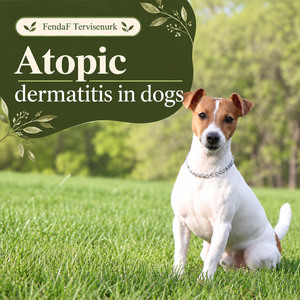
Atopic dermatitis in dogs: itch treatment and Hugo’s story
Reading time: about 9 min
A dog that scratches its skin raw is suffering from more than just a skin problem. It cannot sleep peacefully, licks its paws, scratches its ears and may seek relief day and night. I do not consider this kind of itching trivial, and I do not think owners should simply accept it. Equally, I do not believe that every itchy dog needs one particular bag of food, one medicine or one “cleansing course”. Atopic dermatitis develops through several interacting factors, which is precisely why it needs a good plan.
This article also tells the story of FendaF customer Hugo, which attracted considerable attention years ago. As a young Jack Russell, Hugo had been itchy for a long time, and his owner had tried several approaches. After food changes and several months of observation, she reported that his itching had greatly decreased and medication was no longer needed. That is valuable experience, but one dog’s story is not a clinical trial and does not mean the same plan suits everyone. Still, even a single case suggests to me that a clinical diagnosis of atopic dermatitis need not automatically mean strong medication for life.
What is atopic dermatitis and why does the skin itch?
Canine atopic dermatitis is a chronic, itchy inflammatory skin disease, often associated with allergic environmental factors. Changes in the skin barrier, immune responses, heredity and environment all contribute. Pollen, dust mites and other environmental allergens may be involved in flares. Damaged skin loses more moisture and is more vulnerable to irritation and secondary bacterial or yeast infections, which can further intensify itching.
Dogs typically lick their paws and between their toes, rub their faces and scratch their armpits, ears and abdomen. Later, the skin may darken and thicken, with changes in the coat. Recurring ear infections may not be fully addressed by ear drops alone. But itching by itself cannot establish a diagnosis of atopy.
What should be checked before diagnosis?
Other causes of itching must first be excluded: fleas and other parasites, bacterial and yeast skin infections, contact irritation and food allergy. A veterinarian may perform skin cytology, scrapings when needed and other investigations. A positive allergy test is not itself an “atopy test” that establishes the diagnosis. Testing environmental allergens is primarily useful when planning allergen-specific immunotherapy.
Suspected food reactions require a properly conducted diagnostic elimination diet followed by a controlled food challenge. Four weeks followed by randomly trying another food may not give a reliable answer. An exclusion period of around eight weeks is often used, adjusted by the veterinarian to the dog’s condition. This is not the same as using a 300-gram food sample, and no ordinary food is automatically free of allergens.
What treatment options are available today?
The updated international ICADA guideline of 2026 distinguishes two needs: first control active itching and inflammation, then reduce the risk of future flares. Suitable treatment depends on severity, concurrent infections, the dog’s health and the owner’s circumstances. No medicine or natural remedy is equally best for everyone.
Rapid relief from itching
For a severe flare, a veterinarian may consider short-term glucocorticoids, oclacitinib (Apoquel), lokivetmab or other suitable medicines. Their mechanisms and possible adverse effects differ. Steroids act quickly and broadly against inflammation, but repeated or prolonged use requires careful monitoring. Oclacitinib is not simply an immune-system off switch, and lokivetmab is not a universal allergy treatment: flare type and risks matter when choosing medication. When a dog has scratched itself bloody, relieving pain and itching is an animal-welfare need, rather than merely hiding symptoms.
Integrative veterinarians also emphasise that starting medication does not mean the search for underlying causes is finished. These are two separate tasks.
Skin care and infections
Rinsing, a suitable dog shampoo, moisturising and skin-barrier support can substantially improve comfort. Itchy, damaged areas may need cleaning, and a veterinarian should assess whether bacterial or yeast infections require treatment. Antiseptic washing is not the same as strong daily disinfection just in case. Highly concentrated medicated shampoos need specific instructions and can irritate some dogs’ skin.
Long-term prevention of flares
Allergen-specific immunotherapy aims to change the body’s response to identified environmental allergens. It requires time, consistency and an individual plan. Regular skin care and sometimes ongoing medication are also used when needed. The goal is not necessarily zero medication at any cost, but a dog with good quality of life whose treatment side effects are reasonably controlled.
Hugo: what actually happened?
Hugo’s owner contacted FendaF because her roughly one-year-old Jack Russell had been itching since puppyhood and medicines had been tried for almost nine months. She had tried home-prepared food, including carrots, broccoli, cauliflower and minced pork and beef, various Winner Plus foods and fish oil. An initial small food sample of about 300 grams had not produced a clear change. A dermatologist had diagnosed atopic dermatitis, with problems particularly affecting paws, face and ears.
The plan shared with us included Apoquel, Medrol, topical Cortavance, previous Cyclavance use, chlorhexidine washing and Bravecto for external parasites. The dermatologist had also planned allergy tests and possibly immunotherapy. Earlier food exclusions had lasted up to four weeks, which is not enough to rule out food reactions in every case. In hindsight, that detail seems more important to me than it did at the time.
With Hugo’s owner, we tried changes whose effects were difficult to reduce to a single factor. His diet eventually moved towards Winner Plus Lamb and Rice because Lamb and Potato did not seem to suit him. At different times, his owner also tried chlorella, apple cider vinegar, coconut oil, colostrum and other supplements and skin-care methods. Trying so many things together naturally made causal assessment very difficult.
At one point, Hugo became much worse. Three days after medication was stopped, the areas around his mouth and eyes reddened, his ears itched and he stopped during walks to scratch. Later, scratching had damaged an eyebrow and his ears too. His owner temporarily used Medrol previously prescribed by the veterinarian and gradually reduced it. Such a regimen must not be copied independently for another dog. This period caused real suffering for both Hugo and his owner.
At one stage, his owner also saw a worm in his stools. This is an important finding that requires ordinary parasite assessment and appropriate treatment. We still do not know exactly what caused the worm to be expelled, but afterwards we noticed a gradual reduction in itching and calmer paws. After about three months, according to his owner, he was no longer receiving daily medication. That was a very welcome outcome.
But what caused it? There was no control group, the disease could have changed naturally, and several factors were altered at once. We can honestly say Hugo improved during a period when food, skin care and medication use changed. We cannot confidently claim that medication caused the disease or that chlorella, apple cider vinegar or one particular Winner Plus recipe cured him. It is equally honest to remain curious about why he seemed to cope better on that diet.
What happened when Hugo’s food later stopped suiting him?
Hugo still eats Winner Plus. Some time ago, he began itching more again on the previously suitable Lamb and Rice food, so we changed the animal protein source once more. Hugo switched to Duck and Potato, and his skin settled again. He has now been eating the holistic Winner Plus Duck and Potato food for quite a long time.
For me, this raises an important question: if Hugo’s itching changed alongside dietary changes on two separate occasions, why should we not seriously investigate the role of nutrition in his disease?
What about integrative skin care?
Integrative veterinarians often consider food quality, the skin microbiome, digestive health, fatty acids, environmental allergens, stress and avoiding excessive washing. I see value in this when it complements a more precise diagnosis. Our article Not every itch is an allergy also explains why distinguishing causes is essential. Omega-3 and other essential fatty acids provide a useful example: a small randomised study in 2024 found that fish oil helped some atopic dogs reduce their oclacitinib dose. ICADA 2026 regards it as a useful addition, rather than the only treatment for a flare. Possible effects of some probiotics are also being studied, but evidence varies between products and studies.
Spraying apple cider vinegar onto skin, baking-soda paste, diatomaceous earth and essential oils are not proven standard treatments for atopic dermatitis. Acidic and other homemade mixtures may sting or irritate damaged skin.
Integrative animal-health approaches also describe a so-called healing crisis or Herxheimer-like reaction: itching and other symptoms may worsen for a few days after changes in diet, skin care or a yeast-related treatment plan, then subside. Integrative practitioners, including Julie Anne Lee, have described such changes. I observed a similar pattern with Ossu and wrote about it in FendaF’s separate article on the Herxheimer reaction. It is a clinically interesting observation that need not be hidden from readers.
It is important to distinguish the observation from its explanation. The medically established Jarisch–Herxheimer reaction occurs during treatment of certain infections, but the same mechanism has not been demonstrated for a temporary canine skin flare after diet or treatment changes. That does not mean individual dogs cannot react in a similar-looking way. Sometimes this may involve adjustment; sometimes loss of a medication’s effect, infection, irritation or an unsuitable product. Temporary worsening alone proves neither cleansing nor treatment failure. If a dog scratches its skin raw, itching worsens rapidly or wellbeing deteriorates, reassess treatment with a veterinarian rather than waiting for a presumed healing crisis to pass.
FendaF’s practical recommendation
If your dog itches week after week, record the affected areas, severity, seasonality, ear infections, medicines, parasite prevention, foods and treats. Ask the veterinarian which other causes have been excluded and how food allergy is being distinguished from environmental allergy. Do not abruptly stop effective itch treatment without discussion. If you want to try reducing medication, ask the veterinarian for a specific revised regimen. A nutrition and skin-care plan can be developed alongside this.
When should you seek help particularly quickly?
Contact a veterinarian promptly if the dog scratches its skin open, develops bleeding or pus-filled areas, severe ear pain, swelling or marked lethargy. A sudden increase in itching after a treatment change is not automatically a normal stage of recovery. If the whole family’s nights revolve around an itchy dog, that alone is reason to make the treatment plan more effective.
Conclusion
Hugo’s story matters to me because I saw his owner’s efforts and the joy of improvement. Over time, though, one thing has become clearer in my own approach: good outcomes do not oblige us to draw excessive conclusions. I want to know what helps the dog, on what evidence and at what risk. With atopy, that often means combining effective veterinary treatment, individual nutrition and consistent skin care. The aim is a dog that feels well again, rather than a battle between medicines and nature. Some dogs cannot manage without medication; others may be able to. We cannot find out without making changes.
Sources
- ICADA international treatment guidelines, Mueller et al. (2026)
- Cornell: signs and diagnosis of atopic dermatitis
- Schäfer et al. (2024): randomised fish-oil supplementation study
- 2023 evidence review of other supplements
- Watson et al. (2025/2026): controlled skin-barrier-support diet trial
- Butler T (2017). The Jarisch–Herxheimer Reaction After Antibiotic Treatment of Spirochetal Infections. American Journal of Tropical Medicine and Hygiene.
- FendaF (2024): the Herxheimer reaction, Ossu’s experience and an integrative perspective (in Estonian)
- Lee, J. A. (2021). Skin Disease in Dogs: What to do When Yeast Attacks. Adored Beast.
- Whole Dog Journal (2007). Yeast Infections in Dogs.
🐾 FendaF believes in informed choices
The purpose of the FendaF blog is not to tell you what you must do. Our aim is to share knowledge, introduce different evidence-based and integrative perspectives, and help you make more informed decisions for your pet.
Every animal is unique, and no article can replace a consultation, diagnosis or treatment provided by a veterinarian. If your pet has a health concern or you need individual advice, always contact a veterinarian.
FAQ
No. Several factors changed together and there was no control group. His experience supports investigating nutrition, but does not establish a single cause or a cure that works for every dog.
Do not abruptly stop effective treatment without discussing it with your veterinarian. Ask for an individual revised plan while investigating diet, skin care and other possible contributors.
No. A temporary flare does not prove cleansing or treatment failure. Rapid deterioration, damaged skin or worsening wellbeing require veterinary reassessment.









Leave a Reply