


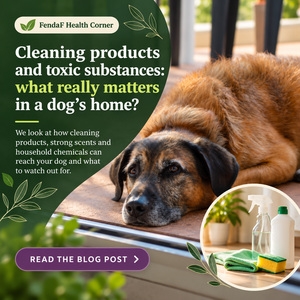
Cleaning products and toxic substances: what matters in a home with dogs?
Reading time: about 7 min
I still remember a comment from a dog owners’ group: “It’s not as though the dog eats the cleaning product.” At first glance, that sounds reasonable. Hopefully dogs are not drinking floor cleaner. But they lie on floors, walk across wet areas and later lick their paws or coats. Sprayed substances and strong fragrances can also reach their airways. Exposure is not limited to a dog opening a bottle and swallowing the contents.
Over the past few years, I have replaced many household detergents and cleaners with gentler, less heavily fragranced alternatives. I have also tried homemade mixtures and stopped using the reed diffusers I once loved. I cannot infer that this caused or prevented any specific disease. But reducing unnecessary exposure seems sensible even though no home is entirely “chemical-free”.
How can cleaning products reach a dog?
The clearest exposure routes are swallowing, contact of wet or concentrated products with skin or eyes, and inhaling aerosols or vapours. Residue on paws mainly reaches the mouth when the dog licks them. Absorption through intact skin depends on the substance, its concentration, the duration and skin condition. We cannot claim every floor-cleaning chemical is absorbed in large amounts through paw pads. But that is no reason to ignore which chemicals we use at home.
We should also be precise with “toxins”. Acute poisoning, irritation of sensitive skin or airways and potential risks of chronic exposure are different situations with different evidence.
Which ingredients and situations deserve particular attention?
Ammonia and strong alkaline cleaners
Concentrated ammonia-based and other highly alkaline cleaners can irritate eyes, skin and airways. The risk depends on the formulation and dilution; not all glass cleaners are alike. Follow the label, avoid spraying at a dog’s face level and let cleaned surfaces dry before allowing the dog back.
Chlorine bleach and disinfectants
Sodium hypochlorite bleach can be a suitable disinfectant when diluted and used as directed. Concentrated product, swallowing it or inhaling fumes can cause serious irritation or injury. Never mix bleach with vinegar, citric acid, ammonia or another cleaning product. Dangerous gases can be released. Keep pets in another room, observe the required contact time and rinse items where directed before letting them dry completely.
Fragrances, phthalates and air fresheners
Some scented products contain phthalates or other fragrance carriers. We cannot label every product listing “perfume” as rich in phthalates or infer a specific health risk just from the presence of an ingredient. Yet a label saying only “perfume” may leave us uncertain about its components. Certain phthalates raise legitimate research questions about hormonal and reproductive effects, but the consequences of a particular dog’s household exposure cannot be read from an ingredient list alone.
There is also a straightforward practical concern: a dog may find a strongly scented room unpleasant even when humans like the smell. Reducing reed diffusers and aerosol fresheners is an easy option.
Essential-oil diffusers do not need to be automatically excluded from homes with dogs. Select an appropriate oil, use only a small amount briefly, ventilate well and allow the dog to leave the scented room. A few drops differ from 30 drops in an enclosed room, although there is no universally established safe drop count. Cats require greater care, especially because droplets from ultrasonic diffusers can settle on fur and then be ingested while grooming. Veterinary toxicologists generally advise against essential-oil diffusers around birds. Animals with respiratory conditions are also at increased risk.
Glycol ethers, formaldehyde and 1,4-dioxane
“Glycol ether” describes a family of substances, not one chemical with one toxicity profile. There are toxicological concerns about some members, while the risks and applications of others differ. Formaldehyde may come from some building materials rather than every soap bottle. 1,4-dioxane can arise as a manufacturing by-product and may not appear on the ingredients list.
It would be wrong to use a formula such as “ingredient name present = dog becomes ill”. A more useful approach is to choose suitable products, prefer less fragrance where needed, ventilate and reduce unnecessary repeated exposure. Persistent coughing, irritated eyes or skin problems warrant investigating several possible causes, not automatically blaming one cleaning product.
Cleaning and disinfecting are not the same
Removing mud and grease from a floor is cleaning. Reducing pathogens to a required level is disinfection. Vinegar may help remove dirt or mineral deposits on some surfaces, but neither vinegar nor lemon juice is a proven universal disinfectant. The CDC recommends soap or an appropriate cleaner for ordinary dirt, and suitable disinfectants used according to label instructions when disinfection is needed.
This distinction matters particularly during infectious disease. In a household dealing with contagious diarrhoea, a floor that smells fresh after vinegar cleaning may still need a disinfectant effective against the particular pathogen, with the correct contact time and prior cleaning.
My homemade cleaning mixtures: what are they suitable for?
1. Vinegar and water for floors
I have used one cup of vinegar per litre of water. It may suit light cleaning on some acid-resistant surfaces, but not automatically varnished wood, natural stone, grout or every floor covering. Acids may damage some finishes. Check the manufacturer’s care instructions, test an inconspicuous area, prevent strong solution contacting paws and rinse when necessary. This is not a disinfecting recipe.
2. Baking soda paste for stubborn stains
An older recipe mixed equal parts baking soda, warm water and salt into a thick paste for scrubbing. Soda and salt can scratch delicate surfaces, and salt may damage some materials. I would use it only on a durable surface whose manufacturer permits abrasive cleaning, then rinse residue thoroughly. Dogs must not lick the paste. Dry baking soda sometimes absorbs moisture or odours, but must also be completely removed before pets regain access.
3. General-purpose vinegar, water and lemon cleaner
My previous recipe combined one part apple cider vinegar with four parts water and a little fresh lemon juice. It may suit certain acid-resistant surfaces, but quantity, material and rinsing matter. Never use it together with bleach or describe it as an all-purpose disinfectant. Rubbing a cutting board with lemon does not ensure pathogens are destroyed.
4. Homemade furniture mixture
Another old recipe contained a quarter cup of olive oil, four tablespoons of apple cider vinegar and two teaspoons of lemon juice. On suitable materials it might function as an oily furniture-care mixture, but the acids and oil may damage finishes, leave sticky residue or encourage licking. I would not use it without checking the furniture manufacturer’s advice and testing a small area. I would not store it for long or allow dogs to lick newly treated furniture. A mild product approved for the surface is often simpler.
What if I simply want my home to smell pleasant?
This was my weakness: those attractive reed diffuser bottles stood in my home for years. Now I often prefer proper ventilation and carefully selected dog-appropriate essential oils in a diffuser. Houseplants are lovely, but they should not be presented as miraculous air-cleaning systems. Examples listed by the ASPCA as nontoxic to dogs and cats include money trees, spider plants, Boston ferns and areca palms. Nontoxic does not mean that eating many leaves cannot upset the stomach. Accurate plant identification matters: sago palm is highly toxic to dogs and must not be confused with areca palm.
What should you do if a dog is exposed to a cleaning product?
If a substance reaches the eyes or skin, follow the label’s first-aid guidance and rinse with plenty of lukewarm water where appropriate. If a dog swallows cleaner, has trouble breathing, drools heavily, vomits repeatedly or shows chemical burns, contact a veterinarian immediately. Provide the exact product name and ingredients. Do not induce vomiting or attempt to “neutralise” one chemical with another.
FendaF’s practical household-chemical checklist
Am I removing dirt or do I actually need disinfection? Choose a product appropriate to that purpose and read the label. Keep pets away during use and let surfaces dry and, where necessary, be rinsed. Never mix cleaners, particularly bleach with acids or ammonia. Consider replacing heavily fragranced products with unscented alternatives. After swallowing a substance or developing acute symptoms, the next step is a veterinarian, not another homemade recipe.
In summary
I do not want to live in a sterile laboratory or turn my home into a crusade against cleaners. Avoiding unnecessary scents, reading labels and using the right product in the right place are enough to make a useful difference. “Natural” does not automatically mean safe, and a properly used commercial cleaner does not automatically poison a dog. Better decisions often begin with more precise questions.
Sources
CDC. About Cleaning and Disinfecting Pet Supplies (2026).
ASPCA Animal Poison Control. Poisonous Household Products.
ASPCA Animal Poison Control. Are Essential Oils Dangerous to Pets?
Pet Poison Helpline. Updates on Essential Oils.
Merck Veterinary Manual. Toxicoses From Essential Oils in Animals.
FendaF. Supporting the liver and kidneys.
🐾 FendaF believes in informed choices
The purpose of the FendaF blog is not to tell you what you must do. Our aim is to share knowledge, introduce different evidence-based and integrative perspectives, and help you make more informed decisions for your pet.
Every animal is unique, and no article can replace a consultation, diagnosis or treatment provided by a veterinarian. If your pet has a health concern or you need individual advice, always contact a veterinarian.








Leave a Reply