


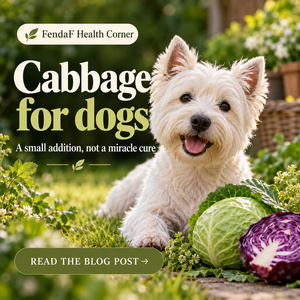
Cabbage for dogs: benefits and precautions
Reading time: about 4 min
Cabbage may not be the first vegetable that comes to mind when choosing a dog treat. Perhaps because nobody wants a dog filling the house with gas! Still, a little cabbage can add variety. There is a big difference between enriching a diet and claiming to treat disease with cabbage.
What does cabbage provide?
Cabbage contains water, fiber, vitamins and plant compounds. Red cabbage contains anthocyanins; brassicas contain glucosinolates and their breakdown products. These substances are scientifically interesting but do not make cabbage a medicine. Levels vary by variety, quantity and preparation.
Quercetin and promising research
Dr Karen Becker highlights quercetin, a flavonoid polyphenol studied for antioxidant, anti-inflammatory and antimicrobial activity in experimental models. The amount in a particular cabbage variety and the quantity a dog actually eats matter. Purified quercetin in a laboratory is not equivalent to a spoonful of cabbage.
Brain health
Zhang and colleagues (2016) studied mice in an amyloid model. Oral quercetin increased brain apolipoprotein E and reduced insoluble amyloid beta. This suggests a possible mechanism, not evidence that eating cabbage prevents canine cognitive dysfunction or treats Alzheimer’s disease in humans.
Skin and inflammation
A randomized double-blind trial involving 40 dogs with atopic dermatitis (2021) examined a diet enriched with polyphenols, antioxidants and omega-3 fatty acids over 60 days. Clinical signs and owner-assessed itching improved. Because the intervention contained several ingredients, the result cannot be attributed to quercetin alone, let alone cabbage.
Quercetin with vitamin C
Choe and Kim (2017) studied quercetin and ascorbic acid in human macrophage cell lines exposed to fructose-induced NLRP3 activation. Inflammatory signaling decreased, but this was a cell experiment, not a feeding trial or treatment study in dogs.
Potential anticancer activity
Hashemzaei and colleagues (2017) examined quercetin in tumor cell lines and mice with tumors. Mice received purified quercetin by intraperitoneal injection at 50, 100 or 200 mg/kg; tumor volume decreased under experimental conditions. Dogs were not fed cabbage. This cannot justify claiming that cabbage shrinks tumors or replaces cancer treatment.
Other antioxidants
Cabbage also provides vitamin C, carotenoids, anthocyanins, lutein and zeaxanthin. Healthy dogs synthesize their own vitamin C. Beta-carotene and other compounds have been studied for immune and antioxidant effects, but results from other species do not automatically apply to dogs. Research on lutein and zeaxanthin in eye health does not prove cabbage prevents cataracts. Anthocyanin studies largely use experimental models rather than clinical feeding trials.
Fiber: more than gas
Becker estimates roughly 0.10 g fiber per tablespoon, but actual amounts depend on variety and portion size. Fiber may influence stool consistency, intestinal microbes, fermentation and satiety. Different fibers act differently. A canine and feline gastrointestinal review (Moreno et al., 2022) discusses these mechanisms, but it is not a clinical trial of cabbage. Too much cabbage may cause gas, bloating or stool changes. A little plain steamed cabbage may suit dogs that do not tolerate raw cabbage.
What do the studies actually prove?
Cell and animal experiments reveal possible biological mechanisms. They do not establish that an ordinary cabbage portion treats dementia, atopic dermatitis or tumors in dogs. Equally, promising research questions need not be erased. The right approach is to retain them with clear limitations.
Raw or steamed?
Dogs may eat small amounts of finely chopped cabbage, but raw cabbage fiber can cause gas. Light steaming makes it easier for some dogs to tolerate. Do not add onion, salty seasoning mixes or rich sauces. Large, hard pieces are not a good idea for dogs that gulp their food.
What about the thyroid?
Brassicas contain compounds that may affect how the thyroid uses iodine under certain conditions. This does not mean a normal small serving of cabbage causes thyroid disease in a healthy dog. Long-term consumption of very large amounts of raw cabbage, or a special diet for a dog with thyroid problems, is a different question and needs individual nutritional assessment.
How much?
As noted in the original article, treats and dietary extras should generally provide less than 10% of daily calories so that balanced complete food remains the foundation. This is a general guideline, not a required serving of cabbage. Cabbage has a low energy density, and too much may upset the gut well before the calorie limit is reached. Start with a few small, soft pieces, watch tolerance and do not increase the amount quickly.
FendaF’s cabbage rule
Offer a small amount of finely chopped or lightly steamed unseasoned cabbage. Watch for gas, vomiting or changes in stool over the following day. If it repeatedly causes discomfort, there is no reason to persist. Cabbage does not replace complete food or medical treatment.
Sources
- PetMD: Can Dogs Eat Cabbage?
- American Kennel Club: Can Dogs Eat Cabbage?
- Karen Becker: Cabbage
- Zhang et al. (2016): Quercetin and amyloid
- Canine atopic dermatitis dietary study (2021)
- Choe and Kim (2017): Quercetin and vitamin C
- Hashemzaei et al. (2017): Experimental anticancer effects
- Moreno et al. (2022): Dietary fiber and canine/feline GI disease
- Abd El-Wahab et al. (2023): Fiber sources in dog diets
🐾 FendaF believes in informed choices
The purpose of the FendaF blog is not to tell you what you must do. Our aim is to share knowledge, introduce different evidence-based and integrative perspectives, and help you make more informed decisions for your pet.
Every animal is unique, and no article can replace a consultation, diagnosis or treatment provided by a veterinarian. If your pet has a health concern or you need individual advice, always contact a veterinarian.





Leave a Reply